
The useful part, up front
- Rent increase rules are set mostly by states and cities. Some places cap the percentage, some only require written notice, and some do both, so start with your own state and city rules.
- Check four things before you reply: the type of tenancy you have, the notice period and how it was delivered, the effective date, and whether a cap applies to your building.
- In California, Washington, and Oregon, official pages describe caps in the 8 to 10 percent range for many rentals in the current period. On a $1,500 rent, 10 percent is $150 a month, or $1,800 a year.
The letter is real. Is it valid?
Picture the scene. You come home, and taped to the door, or sitting in your email, is a notice saying the rent is going up next month. The number is bigger than you expected, the language sounds final, and the landlord has given you a short deadline to “accept.”
Take a breath before you accept, argue, or start apartment hunting. A rent increase is a legal act with rules attached, and those rules usually cover how much notice you get, how the notice is delivered, how often rent can rise, and in some places how large the increase can be. A notice that misses the rules may be defective, and a defective notice does not always mean you owe the new amount on the date it names.
That does not mean every increase is illegal. Many are perfectly lawful, and rents do rise. The goal of this guide is simple: figure out which rules apply to you, test the notice against them, and then make a calm decision about whether to pay, negotiate, or move. Nothing here is legal advice for your exact situation. It is a way to ask better questions of the official sources for your state.
There is no single national rulebook
Landlord-tenant law in the United States is mostly state law, and cities and counties can add their own rules on top. A tip that is true in Seattle may be wrong in Houston. A cap that exists in Portland may not exist anywhere in the state next door. So any article that gives one nationwide number for “how much a landlord can raise rent” should make you suspicious. Treat this one the same way.
To show how much the rules can differ, here are three states whose official pages I read for this guide. The figures describe the rules for the current period and can change, so confirm them on the linked pages before you rely on them.
| State | Notice before an increase | Cap on the size of the increase |
|---|---|---|
| California | Written notice, 30 days for increases of 10 percent or less, 90 days for larger ones, per the Attorney General’s tenant page | Statewide limit of 5 percent plus a cost-of-living change, never more than 10 percent, for covered housing; stricter local caps may apply |
| Washington | At least 90 days in writing, per the Attorney General | The lesser of 10 percent or 7 percent plus inflation; the stated maximum for 2026 is 9.683 percent |
| Oregon | At least 90 days in writing after the first year, per the state statute | The lesser of 10 percent or 7 percent plus inflation, for many tenancies; the state published 9.5 percent for 2026 and 10 percent for 2027 |
Other states may have no statewide cap at all and only require a short written notice, or leave the notice period to your lease. If your state is not on this list, look for your state attorney general’s tenant page, your state courts’ self-help center, or a legal aid site, and search it for “rent increase.” Check your city and county too, because local rent rules can be stricter than the state’s.
Step one: identify what kind of tenancy you have
Before you read the notice, find your lease. The first question is whether you are in a fixed-term lease, such as twelve months ending on a set date, or on a month-to-month arrangement.
- Fixed-term lease: The rent stated in the lease is generally the rent for the whole term unless the lease itself says it can change. A landlord who tries to raise rent in the middle of a term should be able to point to a clause that allows it. Many landlords simply wait for the end of the term and propose new rent in the renewal.
- Month-to-month: This is where mid-year increases are most common, because there is no end date to wait for. The notice rules are the ones doing the heavy lifting here.
- Subsidized or regulated housing: If you have a housing voucher, live in income-restricted housing, or rent a regulated unit, different procedures and different amounts may apply. Your housing agency or program rules usually come first. The Oregon statute I read, for example, carves out separate treatment for certain government-regulated affordable units.
If you are coming up on the end of a fixed-term lease, our lease renewal checklist covers what to read in the renewal paperwork, and it pairs well with the checks below.
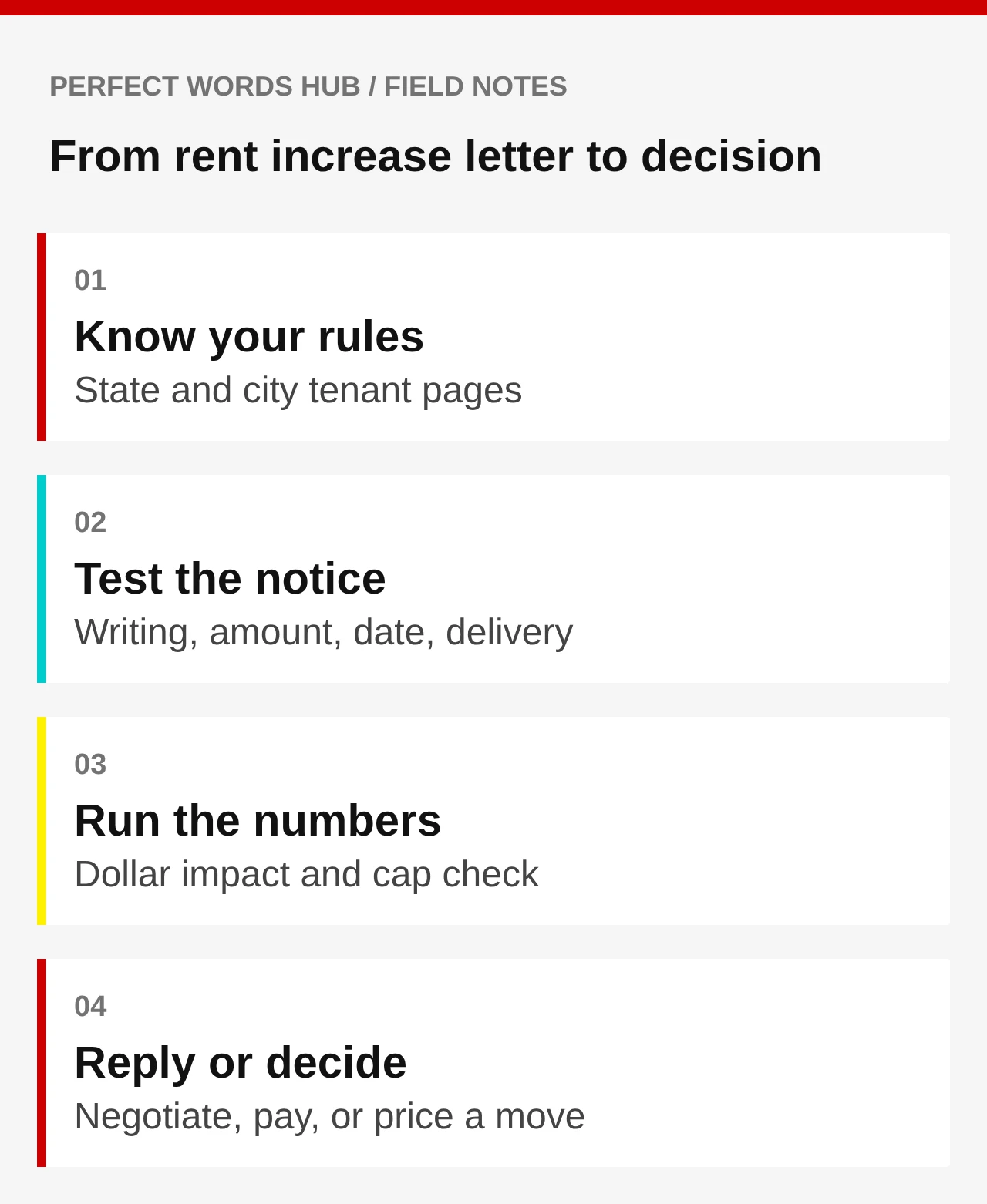
Step two: test the notice itself
Lay the notice next to the calendar and ask these questions in order.
- Is it in writing? Official pages for California, Washington, and Oregon all describe written notices. A verbal “rent is going up” from the property manager is a heads-up, not a notice.
- Does it say the amount? Oregon’s statute, for example, requires the notice to state the amount of the increase, the new rent, and the date it takes effect. Even where a state is less specific, a vague notice (“rent will be adjusted”) is a reason to ask for the exact figures in writing.
- Is the notice period long enough? Count from the date the notice was properly delivered, not from the date printed on the letter. If it was mailed, taped to the door, or emailed, ask whether your state or your lease treats delivery methods differently. Some places add days for mailing and some restrict electronic delivery unless the lease allows it.
- Is the effective date after your lease term, if you have a fixed term? A date in the middle of a fixed term needs a reason in the lease.
- Is it the first year? Washington’s official page says landlords cannot raise rent during the first 12 months of a tenancy, and Oregon’s statute says the same for most tenancies. Not every state has such a rule.
- Has rent already gone up in the last twelve months? Oregon’s statute bars more than one increase in a 12-month period. Again, other states may not have an equivalent limit.
Write down each answer and keep a photo or copy of the notice, the envelope if there is one, and the date you received it. That is the same habit we recommend in our guide to the rental repair paper trail: dates and copies settle arguments later.
Step three: do the date math
Notice periods are where an otherwise reasonable letter often goes wrong, so do the arithmetic yourself rather than trusting the date on the page.
Say you received a notice on Tuesday, October 20, 2026, and you live in a state that requires 90 days. Counting 90 days forward lands on Monday, January 18, 2027. A notice that tries to take effect on December 1 gave you about six weeks, not 90 days. In a 90-day state, that notice is a candidate for being defective, and you should ask the landlord for a corrected one. If your state requires only 30 days, the same notice would reach November 19, 2026.
Two cautions. First, some states count days differently, for instance by excluding weekends or adding days when a notice is mailed. Second, a defective notice generally does not erase a landlord’s ability to raise rent. It more often means the landlord has to start over with a proper notice, which delays the increase. Whether you can withhold the increase, and for how long, depends on your state, so read the official page or ask a legal aid office before you rely on a technicality.
Also check what happens if you do nothing. In some states a month-to-month tenant who keeps paying after the effective date is treated as having accepted the new rent. In others, a defective notice means the old rent remains the legal rent. This is exactly the kind of detail to confirm with a local source.
Step four: put the cap math on one page
Where a cap exists, the cap is usually a formula built from a fixed percentage and an inflation measure, with an upper limit. California’s Attorney General describes the statewide limit as 5 percent plus the local cost-of-living change, up to 10 percent. Washington and Oregon use a similar shape with 7 percent plus inflation and a 10 percent ceiling.
The simplest way to test a notice is to convert the percentage into dollars. Here is a worked example using a hypothetical $1,500 monthly rent.
| Scenario | New rent | Extra per month | Extra per year |
|---|---|---|---|
| 10 percent increase | $1,650.00 | $150.00 | $1,800 |
| 9.683 percent (Washington’s stated 2026 maximum) | about $1,645.25 | about $145.25 | about $1,743 |
| 9.5 percent (Oregon’s published 2026 figure) | $1,642.50 | $142.50 | $1,710 |
| 8.6 percent (California’s listed figure for most counties, 8/1/26 to 7/31/27) | $1,629.00 | $129.00 | $1,548 |
The calculation is new rent minus current rent, divided by current rent. If your rent is $1,500 and the notice says $1,700, that is $200 of increase, which is 13.3 percent. Whether that is lawful depends on whether a cap applies to your unit and what the cap is. In a place with a 10 percent ceiling and no exemption, 13.3 percent would be a problem. In a place with no cap, it may be legal but still worth negotiating.
Be careful with the cap number itself. The figures in the table were the ones published on official pages when I read them, and several are tied to specific date ranges. Oregon’s agencies calculate a new percentage each year, and which year’s number applies depends on when the increase takes effect, so look up the date on your notice. California lists different numbers by county and separate local caps for cities such as Los Angeles, Oakland, and San Francisco.
When the cap does not apply
A cap is not a universal shield. Most capped systems carve out exceptions, and landlords sometimes assume an exception applies when it does not.
- Newer buildings. Oregon’s statute exempts units whose first certificate of occupancy was issued less than 15 years before the notice. California’s statewide limit covers rental housing more than 15 years old and has a separate set of exclusions, and its local caps generally do not apply to buildings with a certificate of occupancy issued after February 1, 1995.
- Certain kinds of housing. California’s page notes that single-family homes and condos owned by individuals are often outside local caps, and the statewide cap treats corporate owners differently. Details matter, so ask the landlord which exemption they are relying on and read the official page.
- Regulated or subsidized units. Government-regulated affordable housing often follows program rules instead of the general cap. Oregon’s statute, for example, allows changes required by program eligibility or by a change in the tenant’s income.
- New tenants. California’s Attorney General notes that when a tenant moves out and a new one moves in, the landlord may set the starting rent. That is why asking rents can jump between tenants.
In Oregon, a landlord who raises rent above the permitted amount can be liable to the tenant for three months of rent plus actual damages. In Washington, the Attorney General’s office offers a response form tenants can use for an increase above the cap, and a complaint process. These are examples; remedies vary widely, and some states leave enforcement to private lawsuits.
Increases that do not look like increases
Not every price hike arrives as a letter titled “rent increase.” A new monthly package fee, a mandatory pest or trash charge, a parking fee that used to be free, or a utility billing change can raise what you pay without touching the number labeled rent. Whether those add-ons fall under a state’s cap or are treated as fees under separate rules depends on the state. Washington’s Attorney General, for instance, published a response form that covers both rent and fee increase notices.
Add everything up. If the lease is silent on a new charge, ask in writing which clause allows it. Our guide to total monthly rental cost and junk fees walks through how to compare the full monthly figure rather than the headline rent.
The reverse also happens. A landlord may offer a smaller increase in exchange for a longer lease, free parking, a waived fee, or a one-time repair. Those trade-offs can be worth taking, but only after you compare them with the dollar impact of the increase.

Increases that arrive right after you complained
Timing can matter. Many states have anti-retaliation rules that restrict a landlord from raising rent, cutting services, or ending a tenancy because a tenant made a good-faith complaint or exercised a legal right. Oregon’s statute lists, among protected acts, complaining to a government agency about a housing-code violation, making a good-faith complaint to the landlord about the tenancy, and joining a tenants’ organization. It specifically names increasing rent as prohibited retaliation.
If your increase landed soon after you reported a repair, asked for the heat to be fixed, or contacted a code inspector, note the sequence of dates. Keep your original request, any replies, and any inspection report. Retaliation rules vary, and in many places they come with exceptions, so this is a case where a short call to legal aid is worth the time. Our guide on the repair paper trail explains how to build that record without turning it into a fight.
Do not stop paying rent while you sort this out. Withholding rent can trigger the eviction process in many places, whatever the underlying merits. If you believe the increase is unlawful, a common approach is to continue paying the existing lawful amount, or the full amount under protest, only after confirming with a local source which option protects you. If you do receive a pay-or-quit or similar notice, read what to do first with an eviction notice right away, because deadlines in those notices can be short.
Reply, negotiate, or move: a practical checklist
Once you know the notice is valid, or that it is not, you have three realistic options. Work through them with numbers.
- Send a short written reply. Stay factual. Acknowledge receipt, state the date you received it, and ask the landlord to confirm the amount, effective date, and the legal basis for any exemption from a cap. If the notice looks short or incomplete, ask for a corrected one. Keep a copy.
- Negotiate. Landlords weigh the cost of turnover, which includes vacancy, cleaning, repairs, and advertising. A reasonable request, such as a smaller increase, a phase-in over several months, or a longer lease at a fixed rate, is sometimes accepted. Present your history as a reliable tenant without making threats.
- Price the move. Compare the annual cost of staying with the full cost of leaving. As a hypothetical example, suppose the increase is $150 a month, or $1,800 a year. A comparable unit at $1,550 would save $100 a month, or $1,200 a year, against your new rent of $1,650. If moving would cost you $1,400 for a truck, deposit, application fees, and an overlapping week of rent, the savings take a bit over a year to cover it. Your own numbers will differ, so list the real ones.
Then fit the new rent into your budget. If the increase will squeeze you, the method in money after the bills shows how to see what is left after fixed costs, so you can decide between staying, negotiating, and moving based on a real figure.
One more note: if you decide to leave, check your lease and state rules on how much notice you must give to end a month-to-month tenancy, and give it in writing so the dates are clear.
Where to get state-specific help
Start with official and nonprofit sources, not forums or listing sites. Your state attorney general’s consumer or tenant page, your state courts’ self-help site, and your city or county housing department are the best first stops. California’s Attorney General publishes a rent-cap chart with local caps, Washington’s Attorney General explains the state’s limits and complaint options, and Oregon posts both the statute and the yearly maximum percentage.
For personal advice, civil legal aid organizations help eligible people with housing problems, often for free. The Legal Services Corporation, a federally funded nonprofit, has a locator for the legal aid organization that serves your address, and its page also points to LawHelp.org for plain-language information and forms. Many bar associations run lawyer-referral services as well, and tenant unions and housing counseling agencies can explain local practices.
Bring the right paperwork to any call: your lease, the rent increase notice, proof of the date and method of delivery, your last few rent receipts or bank records showing what you have paid, and any messages with the landlord. With those in hand, a short call can usually tell you whether the notice follows local rules and what your realistic options are.
Sources & further reading
- California Attorney General: Landlord-Tenant Issues
- California Attorney General: Limits on Rent Increases
- Washington Attorney General: Tenant Rights
- Oregon Revised Statutes, Chapter 90 (Residential Landlord and Tenant)
- Oregon Department of Administrative Services: 2027 maximum rent increase
- Legal Services Corporation: Get Legal Help
Source links checked October 17, 2026. Rules, rates and product terms can change.
General education about tenant rights, not legal advice. Rules differ by state and city; check local law or ask a legal aid office.