The useful part, up front
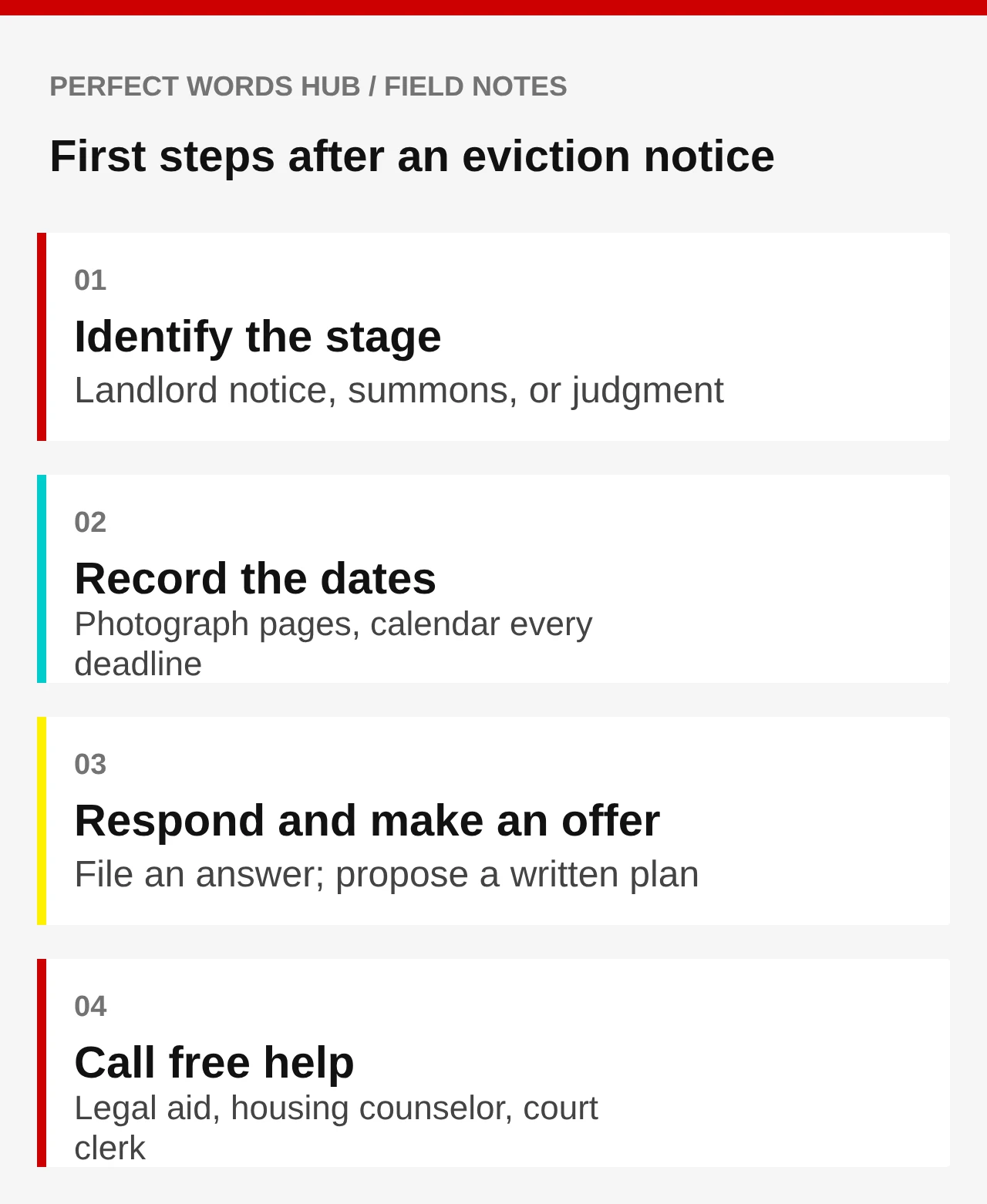
- A notice from a landlord, a court summons and a court judgment are three different stages. Work out which one you are holding before you decide what to do.
- If a lawsuit has been filed, answering by the deadline on the summons is one of the most important steps, and you can often file an answer without a lawyer. Ask the court clerk how long you have.
- Notice periods, court procedures and protections vary by state and sometimes city. Free legal aid, housing counselors and court self-help centers can tell you the rules where you live.
The paper in your hand
It is on the door, or in the mail, or handed to you by someone from the property office. It might say "notice to pay or quit," or "notice of termination," or "notice to cure." It might be a court document with a case number. Your stomach drops, and the temptation is to either panic or put it in a drawer.
Do neither. The first useful thing you can do takes no money and about ten minutes: read it slowly, find the date on it, and work out what kind of document it is. A notice from your landlord and a summons from a court are not the same thing, and the deadlines attached to them are different.
Eviction cases are common enough that you are not alone in this. The Eviction Lab reported that landlords filed about 1.23 million eviction cases across the 48 places it tracked in 2025, down slightly from about 1.25 million in 2024. It put the average filing rate at 7.9% of renter households, roughly one case for every 13. Some places went the other way: Travis County, Texas, which includes Austin, was about 30% above its baseline. Those numbers come from preliminary data in a limited set of cities and states, so they show scale and variation, not a national count.
Three stages that look alike but are not
Sorting out where you are is the single most useful thing to do first, because the right next step depends on it.
- A landlord's notice. This is usually a written demand to pay what is owed, fix a lease violation, or leave by a stated date. It is not a court order. In most places a landlord has to give a notice before filing a case, and the required wording, length and delivery method are set by state law. The names differ everywhere, so do not rely on a label.
- A court summons and complaint. If you do not leave or fix the problem, the landlord may file a case. You are then served with court papers, which name a court, a case number, and a deadline to respond. This is the stage where a written response matters most.
- A judgment or order. After a hearing, or after a tenant fails to respond, a court may rule for the landlord. The ruling can lead to an order that lets law enforcement carry out the removal. Even at this stage there can be options, such as asking about a delay.
If the paper has a court's name, a case number, or the words "summons" or "complaint," treat it as urgent. If it is only from the landlord, you usually have more room, though not necessarily much.
One related point: in most states, ending a tenancy against a tenant's will requires going through a court. Changing the locks, removing belongings or shutting off utilities to push someone out is generally treated as unlawful self-help, though the details and penalties vary by state. If that is happening, contact a legal aid office or local housing agency the same day.
The first hour: read it, date it, photograph it
Before you call anyone, do the simple things that protect you.
- Note how and when you got it. Write the date, the time, and how it arrived: posted, mailed, or handed over. Keep the envelope if there is one. Delivery method can matter later.
- Photograph every page, front and back, and keep the original somewhere safe.
- Find the key dates. Look for a date to pay, a date to move out, a date to appear in court, and a date by which you must respond. Write each one on a calendar and set a reminder a few days earlier.
- Read what the landlord says you owe. Compare the amount to your own records. Mistakes happen: late fees added, a payment missed, a different month listed.
- Gather the lease and your payment proof. Bank records, money order receipts, and any texts or emails with the landlord are worth printing or saving as screenshots.
If your own records are thin, start now. Our guide to a repair paper trail explains the same habit for maintenance problems: dated, written, and saved in one place.
If you owe rent, move quickly on three fronts
The Consumer Financial Protection Bureau's guidance for renters behind on rent starts with a plain message: if you want to stay, make a plan to catch up. The agency describes three parts to that plan.
First, look for money. State and local organizations distribute federal funds for rent, utilities and other housing costs. The CFPB notes that many pandemic-era federal programs have closed, though some funds may remain, so availability depends on where you live. Housing counselors and legal aid offices usually know what is open.
Second, talk to your landlord. The CFPB says it is very rare for a landlord to prefer an eviction over receiving rent, and that starting the conversation is often the hardest part. Propose something specific: a payment today, a date for the balance, and what you are doing to cover it. Ask for the agreement in writing, and keep a copy. A verbal promise is difficult to prove.
Third, check for local protections. Some areas have rules that can delay an eviction while you seek help. A housing counselor, legal aid office or social services group can tell you whether yours does.
A short example of why the order matters. Say you owe two months at $1,200, or $2,400. You can pay $600 today. A written offer of $600 now and $900 on each of the next two paydays comes to $600 + $900 + $900 = $2,400. A landlord can evaluate that. "I will catch up soon" gives them nothing to say yes to. That is a made-up illustration of the method, not a prediction of what any landlord will accept.
If the problem is not rent
Not every notice is about money. Some say you broke a lease term, such as an unauthorized occupant, a pet, noise, or damage. Others end a month-to-month tenancy or decline to renew, sometimes without giving a reason.
For a lease violation, find the exact clause the notice cites and compare it to the lease. Is the claim accurate? Is there a way to fix it, and does the notice give you time to do so? Some notices allow you to cure the problem and stay. If you can cure it, do it and record that you did, with dates and photos.
For a notice ending a tenancy without a stated cause, the rules vary a great deal. Some states and cities require a reason, or give longer notice for longer tenancies, and others do not. Ask a local legal aid office or tenant organization how your state treats it.
If you believe the notice is a response to something you did, such as asking for repairs or complaining to a housing inspector, tell a legal aid office. Some places restrict that kind of response. The details and what you would need to show differ by state, so do not assume you have or lack this protection.
If a lawsuit has been filed, the deadline is the deadline
The CFPB's message to renters sued for eviction is direct: do not give up before court. Respond to the lawsuit. A response lets you share information that could help you avoid eviction and dispute statements that are untrue. Talk to a lawyer without delay.
Courts set their own timelines, and they differ. The summons should state how long you have, but if it is unclear, call the court clerk. The CFPB suggests asking:
- How long do I have to file a written answer after being served?
- Has a court date been set?
- Does the court offer mediation, or referrals to housing counselors?
- Do I have a right to a lawyer, and where can I find one if I cannot afford one?
You may be able to file an answer yourself. The CFPB says you can, and suggests including your situation and the steps you are taking to find help, what the landlord has or has not done about rental assistance, and any pending applications for rent or utility help. It adds that a judge may delay or dismiss an eviction if you are actively seeking help, which is a possibility rather than a promise.
Many courts have self-help centers or forms for tenants. Ask the clerk whether yours does. Missing the deadline can mean losing by default, which is why this part should not wait.
Where free help actually comes from
Three kinds of help are worth contacting, and they overlap.
Legal aid. Free civil legal help may be available depending on income and the issue. USAGov recommends talking to a lawyer if your landlord threatens eviction. The Legal Services Corporation, which funds legal aid programs, lets you enter an address to find an LSC-funded organization near you. The CFPB also points tenants to LawHelp.org for free legal help and for guidance on filing an answer in their state. Your local bar association may also run a referral service.
Housing counseling. HUD-approved housing counseling agencies can advise on renting, defaults and related issues, often at little or no cost, according to the CFPB's search tool, where you can enter your ZIP code. The CFPB gives 800-569-4287 as the number for HUD-approved counseling. Not every agency offers every service, so ask what they do before you book.
Special situations. If you are in the military, a base Legal Assistance Office can explain the Servicemembers Civil Relief Act. The CFPB notes that for rent below a threshold set by law and adjusted over time, servicemembers and dependents generally cannot be evicted during service without a court order, and a court can pause an eviction for up to 90 days. If you have a disability, USAGov points to your state's National Disability Rights Network agency.
When you call, have the notice, the lease, and your payment records in front of you. The first conversation goes faster when you can read out the dates.
If the court rules against you
A ruling for the landlord is not always the end of the options, though it narrows them. The CFPB's guidance for that stage has three suggestions.
- Ask whether rental assistance can cover more than back rent. Some local programs also cover moving costs, security deposits and application fees for a new home.
- Ask the judge or court clerk whether the eviction order can be put on hold while an assistance application is processed.
- Ask a housing counselor, legal aid office or social services group about state or local rules that might delay the removal.
Also think about the paperwork that follows. A court record can show up in tenant screening, so ask a legal aid office or the court about any options in your state to contest, seal or limit it. Those options exist in some places and not others.
If you must move, start the next search early, and ask the new landlord for the total monthly cost in writing. On day one, make a move-in record of the unit with dated photos.
A one-page plan to print
Write this on a sheet of paper and tape it where you will see it.
- What stage am I at: landlord notice, court summons, or judgment? (Circle one.)
- Key dates: pay by ____, move out by ____, answer due ____, court date ____.
- Amount claimed: $____. Amount I believe is correct: $____.
- Who I called today: legal aid ____, housing counselor ____, court clerk ____, landlord ____.
- Documents saved: notice, lease, payment proof, messages, photos.
- Money I can offer and when: $____ on ____.
The point is not to have every answer. It is to turn a frightening piece of paper into a short list you can work through one item at a time.
This article is general education, not legal advice. Eviction rules differ by state and city, and your facts matter. A local legal aid office, a tenant organization or a lawyer can tell you what applies in your case.
Sources & further reading
- CFPB: What to do if you are facing eviction
- USAGov: Avoid eviction
- USAGov: Tenant rights
- CFPB: Find a housing counselor
- Legal Services Corporation: Get legal help
- Eviction Lab: 2025 Eviction Tracking System report
Source links checked October 17, 2026. Rules, rates and product terms can change.
General education about tenant rights, not legal advice. Rules differ by state and city; check local law or ask a legal aid office.