
The useful part, up front
- Start with the amount still needed and the time left.
- Keep planned expenses distinct from an emergency reserve.
- Revisit the estimate when prices or payment dates change.
Look backward before planning forward
An annual subscription, vehicle registration, or seasonal expense can disappear from view between payments. Review your own statements and calendar for costs that repeat less often than monthly. Record what each payment was for, when it last occurred, and whether you expect it again. Do not assume last year’s amount is this year’s price.
Split the list into confirmed bills and rough possibilities. That distinction helps you decide which numbers need checking. An upcoming renewal notice is stronger evidence than a vague memory of what you paid several years ago.
Divide the remaining gap, not the whole bill
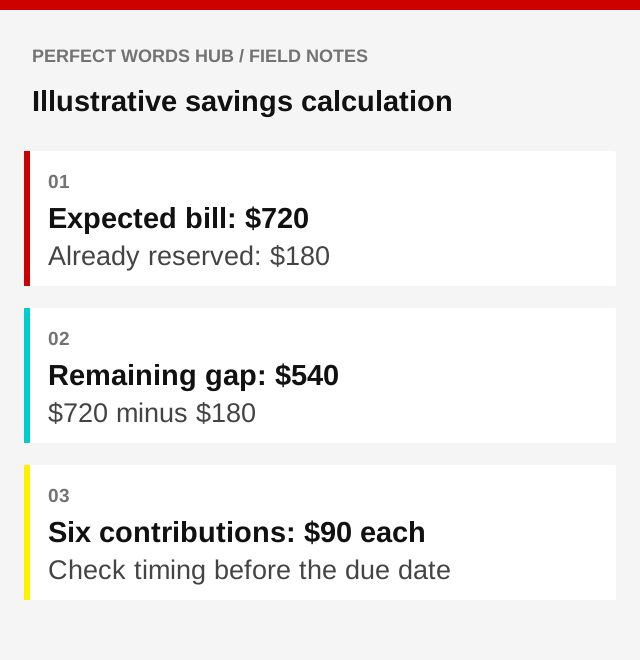
Suppose an illustrative annual bill is expected to be $720 in six months and you already have $180 set aside. The gap is $540. Dividing that gap across six monthly contributions gives $90 per month. This is a planning calculation, not a recommended savings amount.
If the payment is due before your sixth transfer, the schedule needs changing. Count actual opportunities to contribute before the due date. A calendar makes that easier than assuming every month contains a convenient payday.
Give each reserve a clear job
You can track reserved money in a notebook, spreadsheet, or account feature. The important part is knowing which dollars are assigned to which expense. Separate account labels do not create additional money; the total of your labels should reconcile with the money actually held.
Avoid treating a known annual payment as an emergency simply because it is inconvenient. A planned-expense reserve and an emergency reserve answer different questions. Your own income, obligations, and access to cash determine what is workable.
Check the plan against everyday cash flow
A mathematically correct contribution can still be unaffordable this payday. Put it alongside housing, food, transport, and other commitments in your cash-flow plan. If the numbers do not fit, revisit the timing, the expense, or the contribution. Do not silently count uncertain income as available money.
For optional renewals, a reminder before the cancellation deadline can be more useful than automatically saving for another year. Check the actual agreement before changing payment arrangements; a smaller installment is not necessarily a lower total cost.
Reset the reserve after the payment
When the bill arrives, record the actual cost and compare it with the estimate. If it was higher, identify whether the change is likely to repeat. If money remains, assign it deliberately instead of forgetting it inside the account.
Then begin the next cycle using the new expected date. A brief recurring review keeps the plan grounded in current facts. The aim is fewer avoidable surprises, not a forecast that never changes.
Questions worth checking
What if the bill is due sooner than expected?
Recalculate using the contributions that can actually arrive before payment is due. In the example above, a $540 gap spread across three contributions becomes $180 each. If that does not fit the budget, investigate the expense or available payment arrangements instead of assuming the old monthly amount will be enough.
Does the reserve need a separate account?
Not necessarily. A clear ledger can distinguish assigned money inside one account. If using another account, check access, fees, and transfer timing. Whichever method you use, the assigned totals should never exceed the money actually available.
Sources & further reading
- CFPB: Budgeting and cash-flow tools (opens in a new tab)
- CFPB: Using a bill calendar (opens in a new tab)
Source links checked September 30, 2026. Requirements and guidance may change.
For general education in a U.S. context. This is not financial, insurance, legal, tax, or medical advice. Examples are illustrative. Check current rules and relevant policy documents, and seek qualified help for your circumstances.
How well do you read your money?
Put the ideas into practice with 10 questions and explanations.
Take the quiz