The useful part, up front
- Put paydays and bills on the same timeline.
- Reserve money for expenses that have not left your account yet.
- Treat a forecast as a working estimate, then update it with real transactions.
A balance is a snapshot
Imagine opening your banking app on a Friday and seeing $1,480. It feels like room to breathe. But rent is about to leave, a utility payment is scheduled, and groceries still need buying before the next payday. The number is accurate; the story you attach to it may be incomplete.
A cash-flow plan gives that money a timeline. Instead of asking only whether income exceeds spending over a month, it asks whether the money arrives before each bill needs paying. A month can balance on paper and still contain a difficult Tuesday.
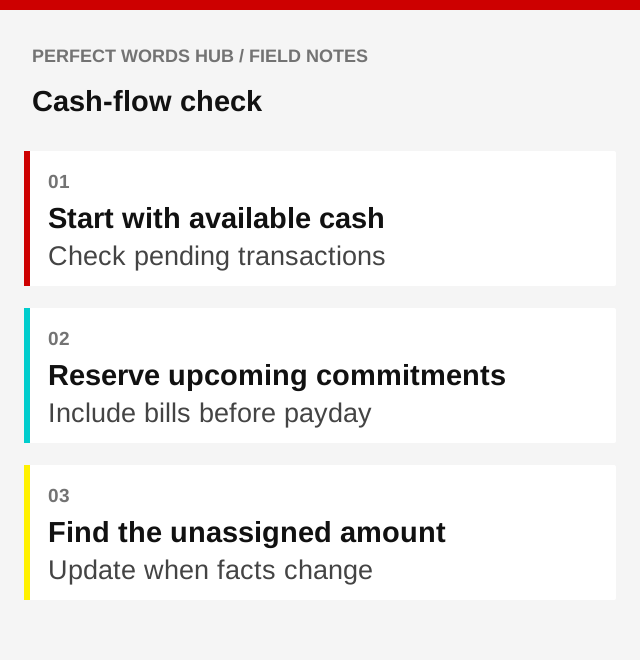
Give the next payday a starting line
Choose a short period you can actually picture, such as today through your next reliable payday. Write down cleared cash, expected income, and payments due during that window. Keep uncertain income separate. A promised freelance payment and a deposited paycheck are different kinds of information.
Check how your bank handles pending transactions. If a card purchase has already reduced the available balance, subtracting it again would count it twice. Transfers between your own accounts are also not new income. These small bookkeeping distinctions matter more than a beautifully colored spreadsheet.
Follow one small example
Suppose the $1,480 balance has not yet been reduced by any of these upcoming items. All figures below are invented to explain the method, not spending targets.
| What the money needs to do | Amount |
|---|---|
| Starting available cash | $1,480 |
| Rent due before payday | −$900 |
| Utilities and transport | −$190 |
| Planned groceries | −$160 |
| Chosen cushion for uncertainty | −$100 |
| Unassigned remainder | $130 |
The useful number for a new optional purchase is closer to $130 than $1,480. It is still an estimate: a forgotten bill changes it. The $100 cushion is simply this example’s choice, not a recommended amount for every household.
Make irregular bills visible
Some expenses arrive slowly and then all at once. A yearly membership, seasonal utility spike, or vehicle renewal can disappear inside a monthly average. Add its actual due date to the calendar. If you decide to set money aside along the way, label the reserve so you do not accidentally spend it twice.
When a projected balance goes below zero, the calendar has found a timing problem. List which payments are essential, confirm incoming dates, and ask a biller whether another due date is available. A date change is not guaranteed, and borrowing can introduce costs that the first forecast did not contain.
Keep the check-in small
At each payday, compare the plan with what really happened. Replace estimates, add new obligations, and look ahead again. Ten accurate entries are more useful than fifty abandoned categories.
The goal is not to assign a moral label to every purchase. It is to make commitments visible before a new purchase competes with them. Start with one pay cycle and let the routine earn its place.
Sources & further reading
- CFPB: Your Money, Your Goals toolkit (opens in a new tab)
- CFPB: Using a bill calendar (opens in a new tab)
Source links checked September 30, 2026. Requirements and guidance may change.
For general education in a U.S. context. This is not financial, insurance, legal, tax, or medical advice. Examples are illustrative. Check current rules and relevant policy documents, and seek qualified help for your circumstances.
How well do you read your money?
Put the ideas into practice with 10 questions and explanations.
Take the quiz