
The useful part, up front
- The rent in an ad and the amount you pay each month can differ by the sum of mandatory fees. The FTC has opened a rulemaking on this gap, but no federal rental-fee rule exists yet, so your protection depends largely on state and local law.
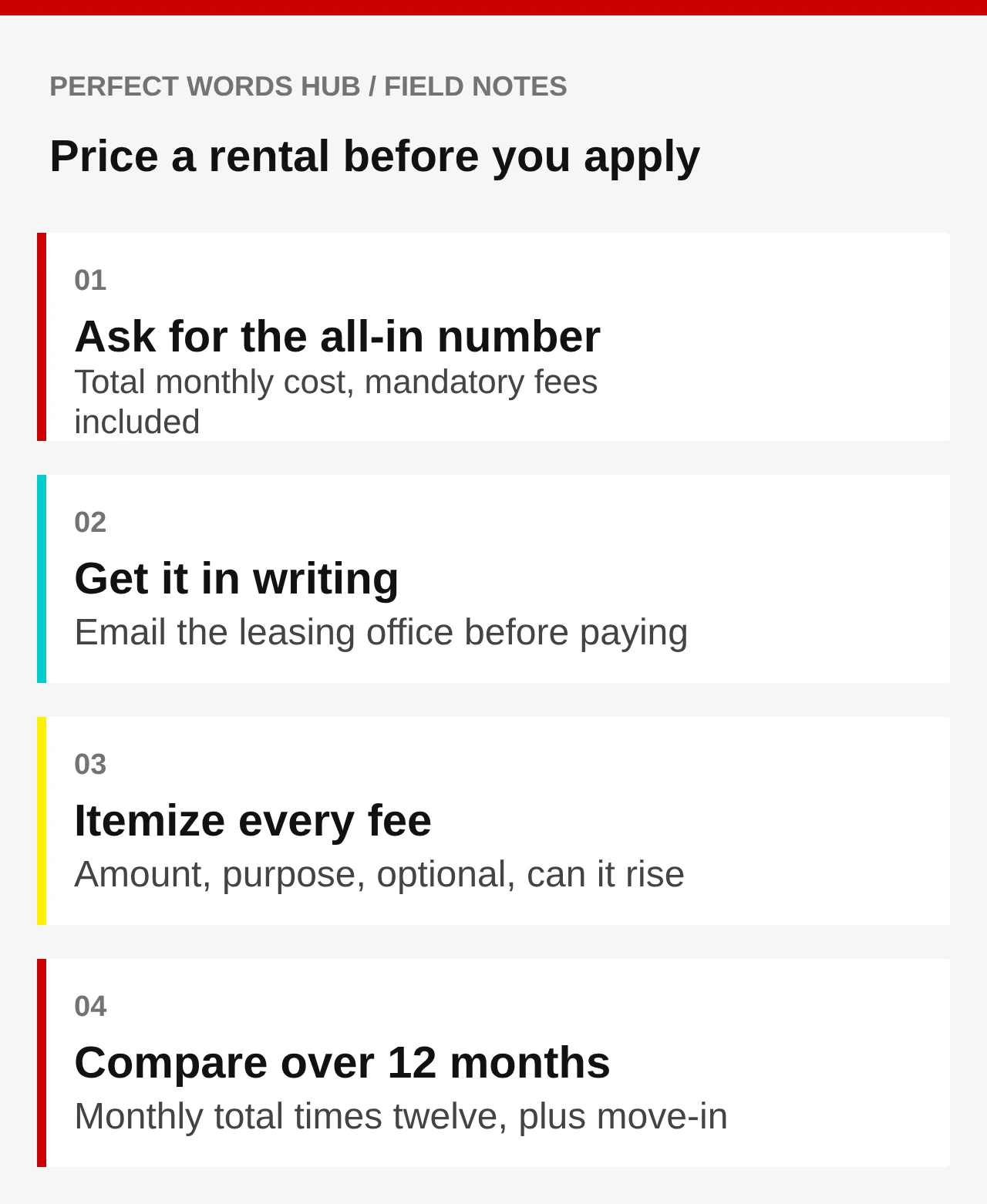
- Ask for the total monthly cost, in writing, before you pay an application fee. Then check every fee for its amount, its purpose, whether it is optional, and whether it can rise.
- Add the fees up over twelve months and compare apartments on that number, not on the headline rent. If you have already been charged something unclear, ask for an itemized explanation and contact your state attorney general.
Start with the number you will actually pay
You find a one-bedroom listed at $1,500. The photos are good, the commute works, and the application fee is $50 per adult. You and your partner apply. A week later the lease arrives, and the monthly figure is not $1,500. There is a pest control charge, a trash charge, a package service charge, and an administrative charge on top of utilities. Each one looks small. Together they are a different apartment.
This is the situation regulators are describing when they talk about "junk fees" in housing. The label is informal, and a fee that sounds trivial may be perfectly lawful where you live. The useful question is narrower: what is the total I must pay every month, what does each piece cover, and did anyone tell me before I paid to apply?
Housing law is mostly state and local. What a landlord may charge, how fees must be disclosed, and what you can do about a bad one all depend on where the rental is. This article explains what has changed at the federal level, uses Colorado as one concrete state example, and then gives you a method that works anywhere.
Why the ad price and the real price drift apart
In March 2026 the Federal Trade Commission published a notice about rental housing fees in the Federal Register. It describes a market in which advertised rents often leave out mandatory charges, and it lists the many names those charges travel under: amenity fees, common area maintenance fees, pest control fees, parking fees, technology and smart-home fees, trash collection fees, administrative fees, utility-related fees, move-in fees, community fees, payment processing and convenience fees, and more. The notice treats the list as examples, not a complete set.
The concern the agency raises is timing as much as size. A renter who has already paid application and screening fees, spent weekends touring, and perhaps started thinking about ending a current lease has strong reasons to go ahead when the extra charges finally appear. The FTC notice says the problem is that these fees obscure the total rent, which makes comparison shopping harder.
The same document gives a sense of what applying alone can cost. It cites survey data indicating that the average renter submits two applications and that the median application fee is $50 per application. It also notes that each adult applicant is typically charged separately. If two adults each pay the median fee on two applications, that is four fees, or $200, before a lease exists. Those figures come from the surveys the agency cited, so your market may be higher or lower.
One more figure from the same notice is worth knowing. A survey it cites found that 83% of renters pay a security deposit and that the median deposit reached $795 in 2025. A deposit is not a fee in the usual sense, since it is meant to be returned, but the notice points out that many renters do not know in advance when it can be kept. If that is a concern for you, our guide to a move-out record that is easy to compare covers the other end of the lease.
What the FTC has done, and what it has not
Two things are true at the same time. The FTC has taken enforcement action against large landlords, and it has started the process of writing a rule. Neither is the same as a rule being in force.
On enforcement: the agency announced a settlement in December 2025 with Greystar, which it describes as the largest manager of multifamily rental properties in the country. Greystar agreed to pay $24 million in total, with $23 million going to the FTC and $1 million to Colorado, and to change how it discloses pricing. The Colorado Attorney General's office, which joined the case, listed the fees at issue as pest control, valet trash, package concierge, utility administration and certain amenity charges, and said that tenants often could not see the full cost until after they had paid a non-refundable application fee. Under the proposed order, Greystar must disclose the total monthly price when it advertises base rent and must disclose each fee's amount, purpose and whether it is mandatory before it takes any payment. The order was filed in federal court and takes effect once a judge approves it. As the FTC's March release notes, it also reached a $48 million agreement with Invitation Homes, which rents single-family homes.
On rulemaking: on March 12, 2026 the FTC asked for public comment on an advance notice of proposed rulemaking covering fees from application to move-out. That is the earliest stage, a request for information on whether a rule is needed and what it should cover. The comment period closed April 13, 2026. In the sources reviewed for this article, which run through the agency's comment page, no final rule had been published. A later rule, if issued, could change the picture, so check the FTC's website for the current status before relying on this article.
The practical meaning: enforcement actions are aimed at specific companies, and a rulemaking is a possibility. For most renters shopping this month, the protection that matters is whatever your state and city already require, plus your own habit of asking.
One state's answer: Colorado
Colorado shows what a state-level rule can look like. A law known as HB25-1090 took effect on January 1, 2026. According to the Colorado General Assembly's summary, it requires sellers who advertise a price to clearly disclose the maximum total amount a buyer may have to pay, and it addresses landlords directly: a landlord may not require a tenant to pay a prohibited fee or put one in a lease. The Colorado Division of Real Estate's summary adds that the "total price" includes amounts that must be paid and cannot reasonably be avoided, and that required disclosures must be clear and conspicuous.
The law also repeats a limit on markups. Where a landlord passes along a bill from a third party, such as a utility, the lease may include either a markup of up to 2% of the amount billed or a flat fee of up to $10 per month, but not both. On a $120 utility bill, for example, the 2% option is $2.40, while the flat option could be as much as $10. Whichever the landlord chooses, the total extra charge on that bill is capped.
On remedies, the legislature's summary says violations are deceptive trade practices under the state consumer protection act. A tenant may send a written demand for reimbursement or a written notice of refusal to pay, and if the violator does not comply within 14 days, it may owe actual damages plus 18% annual compounded interest. That is a summary of a bill, not advice about your lease. If you rent in Colorado, read the Attorney General's guidance and talk to a legal aid office before you withhold anything.
Colorado is one example. Other states and some cities have their own rules on application fees, deposits, late fees or fee disclosure, and many have none. Do not assume that a protection in one place exists in another.
Ask these questions before you pay to apply
The best time to learn the total cost is before the application fee leaves your account. Many leasing offices will answer if you ask directly and ask for the answer in writing. Use an email so there is a record.
- What is the total monthly amount a tenant must pay for this unit, including every mandatory fee, but not including utilities billed by the provider?
- Which of those charges are mandatory, and which are optional? What happens if I decline an optional one?
- Is the application fee per adult? Is it refundable if the unit is rented to someone else, or if I am denied?
- Is a holding or reservation deposit applied toward rent or the security deposit, and under what circumstances do I lose it?
- How are utilities billed? Are they metered to my unit, or split among residents by a formula? Is there an administrative fee on top?
- Are there one-time charges at move-in, such as an administrative or community fee, in addition to the deposit?
- Can any of these fees rise during the lease term? By how much, and with what notice?
If the answers are vague, treat that as information. A landlord who cannot or will not state the total in writing has told you something about the next twelve months.
Read the lease like a price list
Once you receive a lease, do not stop at the first page. Look for the fee schedule, which is often an addendum, and go through it with a highlighter.
For each charge, write down four things: the amount, how often it recurs, what it is said to cover, and whether the lease calls it mandatory. Then flag three types.
- Charges for something the landlord must provide anyway. Basic maintenance and repairs are usually part of the landlord's duty in most places. A mandatory fee labeled "maintenance" or "pest control" deserves a second look at your state's rules, because some states restrict shifting those costs to tenants.
- Charges with no service you can see. A "technology" or "amenity" fee is easier to defend when the amenity exists, works, and is open. If the pool is closed all summer or the app does not do anything, note it with dates.
- Charges tied to how you pay. Some leases add a fee for paying rent online or by card. Check whether a free way to pay exists and whether the lease says so.
Also look at late fees, returned-payment fees, and the rules for rent increases. Our lease renewal checklist walks through the same fee schedule from the other side, when a landlord offers you a new term.
If something is unclear, ask the landlord to explain it in writing before you sign. A signed lease is harder to change than an unsigned one.
A worked comparison of two apartments
Here is the arithmetic, with made-up numbers chosen only to show the method. Apartment A is advertised at $1,500. Its lease adds a $15 pest charge, a $25 trash charge, a $10 package charge and an $8 administrative charge on utilities. Apartment B is advertised at $1,540 with no mandatory monthly fees.
Apartment A: $15 + $25 + $10 + $8 = $58 in monthly extras. Total per month: $1,500 + $58 = $1,558. Over twelve months: $1,558 × 12 = $18,696.
Apartment B: $1,540 per month × 12 = $18,480.
On the headline numbers, A looks $40 cheaper each month. Over a year, B is cheaper by $18,696 − $18,480 = $216. If A also charges a $150 one-time move-in fee, the gap grows to $366 in the first year. None of that proves B is the better home, since location, condition and the landlord matter. It does show why the headline number is the wrong thing to compare.
Do the same with any recurring fee that can rise. A flat $58 is not the same as $58 that goes up on renewal. Ask what the increase limit is, then check whether your state or city restricts it.
What to do if you were already charged
If you have signed a lease and now suspect that a charge was not disclosed or does not belong, take the steps in this order.
- Collect the paperwork. Pull together the listing or screenshot if you have one, any emails with the leasing office, the lease, the fee addendum, and your payment history.
- Ask for an itemized explanation in writing. Keep the tone factual: name the charge, the date, the amount, and ask what it covers and where the lease authorizes it.
- Keep paying what you clearly owe. Do not stop paying rent because of a dispute over one fee unless a lawyer or legal aid office advises it for your state. Nonpayment can lead to an eviction case.
- Check your state's rules. Start with your state attorney general's consumer protection or housing pages, or the state tenant rights resources linked from USAGov's tenant rights page.
- File a complaint if the answer does not hold up. State attorneys general generally accept consumer complaints about deceptive practices. Local housing departments may also take them.
- Consider free legal help. Legal aid offices can sometimes advise on lease disputes, depending on income and the issue. The Legal Services Corporation maintains a search tool for LSC-funded programs.
Keep copies of everything. If a fee was refunded, note the date. If you are in a state with a specific repayment process, such as a written demand with a deadline, the dates matter.
What this article cannot tell you
This is general education, not legal advice. It cannot tell you whether a specific fee is allowed where you live, because that varies by state and sometimes by city. Federal action on rental fees is still developing, and the status of the FTC's rulemaking may have changed since this was written.
What does hold up everywhere is the method. Ask for the all-in monthly number early. Get the fee schedule in writing. Add it up over twelve months. Compare on that number. Keep a folder of the listing, the emails and the lease, and save a few photos of the unit on move-in day using something like a move-in record, so the later disputes are about documents rather than memory.
If a fee looks wrong, a calm written question is usually the first step, and it costs you nothing.
Sources & further reading
- FTC: Rule on Unfair or Deceptive Rental Housing Fee Practices (Federal Register, March 13, 2026)
- FTC: Press release seeking comment on rental housing fee rulemaking (March 2026)
- FTC: Greystar agrees to pay $24 million (December 2025)
- Colorado Attorney General: FTC and Colorado announce Greystar settlement
- Colorado Division of Real Estate: HB25-1090 summary
- USAGov: Tenant rights and where to find state help
Source links checked October 17, 2026. Rules, rates and product terms can change.
General education about tenant rights, not legal advice. Rules differ by state and city; check local law or ask a legal aid office.