
The useful part, up front
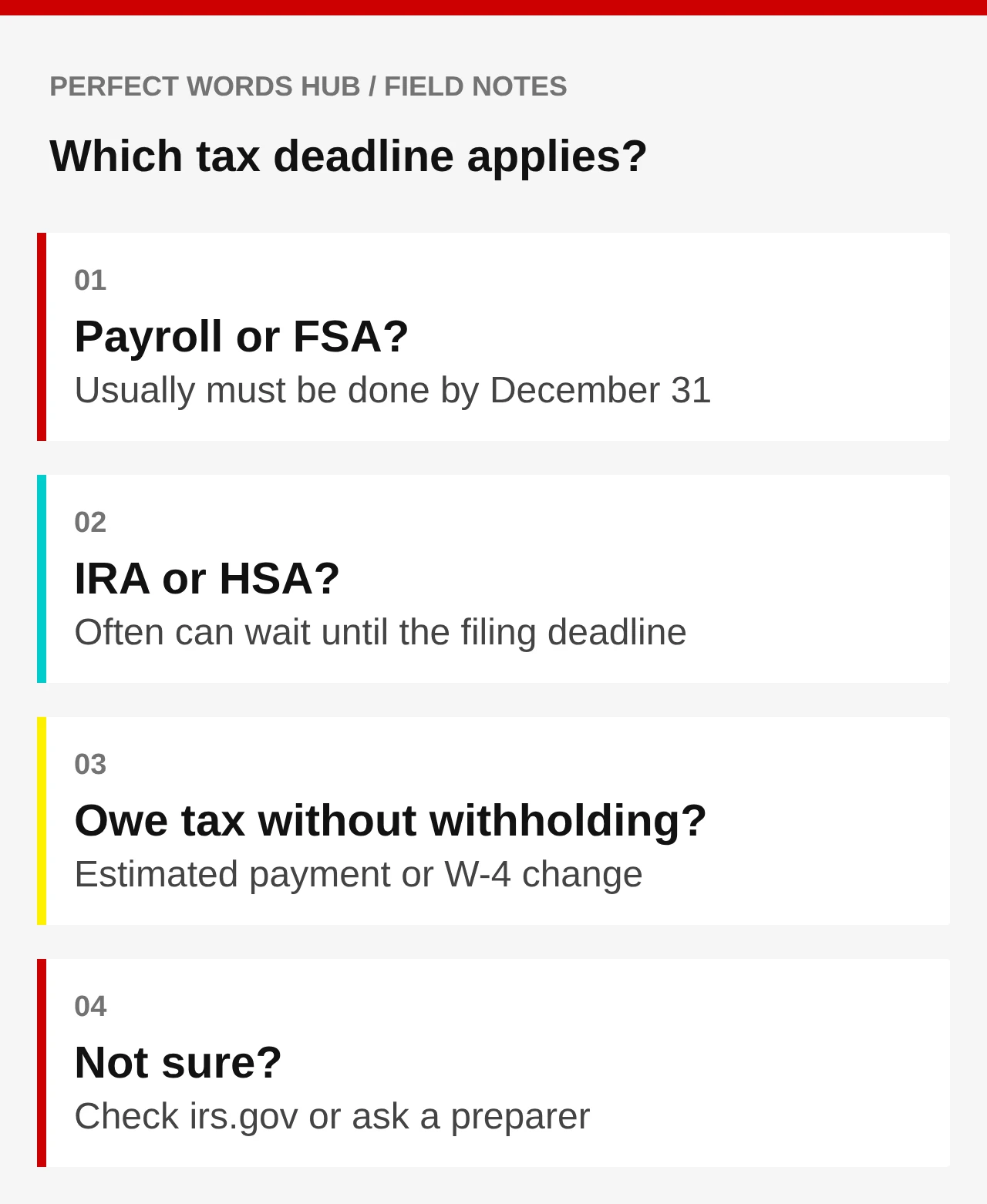
- Many tax moves must be completed by December 31 to count for the year. Others, such as IRA and HSA contributions, can be made after the year ends, up to the filing deadline.
- Withholding and estimated tax have their own timing rules, and underpayment penalties depend on how much you paid and when.
- The IRS publishes new limits each year. Look up the current figures instead of relying on last year’s numbers.
Why two deadlines cause trouble
Most people think of tax time as April. But the tax year for individuals is the calendar year, and a number of decisions are locked in when the year ends. Others stay open for months afterwards. The problem is that the rules look similar. Two contributions to two different accounts can have different deadlines, and the same account can have different deadlines for different types of contributions.
This guide sorts common moves into three groups: things that must happen by December 31, things that can wait until the filing deadline, and things that depend on your situation. It does not tell you what you should do, because that depends on your income, filing status, and goals. It is meant to help you find what to ask a tax professional or look up on irs.gov.
Nothing here is a recommendation to make any particular contribution. A tax benefit is only one part of the picture, and a sensible decision also considers cash flow, emergency savings, and what the money is for. The sections below are meant to make the calendar clear, so your choices are made on purpose rather than by default.
If you want a refresher on how withholding and estimated payments differ, see our guide on two routes for paying tax before the return is filed.
Group one: moves that generally need to happen by December 31
These actions typically count for the tax year only if they are completed within that calendar year.
Workplace retirement contributions. Contributions to a 401(k), 403(b), or similar plan are usually taken from paychecks. To change how much goes in for this year, your election needs to take effect on a payroll date before the year ends. Check your plan’s rules on how fast changes apply, since payroll cutoffs can come earlier than you expect. The IRS publishes annual limits for employee contributions and catch-up contributions for people 50 and older.
Health FSA spending. Many flexible spending accounts are use-it-or-lose-it. Employers may offer a carryover of a limited amount or a short grace period, but they are not required to, so read your plan documents. Eligible expenses generally need to be incurred by the plan’s deadline.
Charitable donations. To deduct a gift in a given year, it generally needs to be made by December 31. A check mailed by that date is usually considered given on the date of mailing, and credit card gifts count when charged. Deductions are available only if you itemize rather than take the standard deduction, and substantiation rules apply for larger gifts.
Required minimum distributions (RMDs). If you are old enough that the rules apply to you, the withdrawal for the year generally needs to be made by December 31, with a special rule for the first year. Missing an RMD can lead to a penalty, which is why many people set an automatic withdrawal. The IRS website explains the starting age and the calculation tables.
Expenses and income timing. Business owners and self-employed people may have flexibility about when income is received and expenses are paid. Whether that helps depends on your accounting method and goals, so ask a professional before changing anything.
Group two: moves that can wait until the filing deadline
Some contributions can be made after the year ends and still apply to the earlier year.
Traditional and Roth IRA contributions. You can generally contribute for a given year up to the original filing deadline for that year’s return, usually in mid-April of the following year. When you make the contribution, tell the financial institution which year it is for. Many people forget and end up with a contribution counted for the wrong year. Whether a contribution is deductible depends on your income, your filing status, and whether you or your spouse are covered by a workplace retirement plan.
Health savings account (HSA) contributions. If you are eligible, you can often contribute for a given year until the filing deadline of the following year. Your eligibility depends on being covered by a qualifying high-deductible health plan, and the amount is limited by the IRS, with different limits for self-only and family coverage and an extra amount for people 55 and older. Again, make sure the contribution is designated for the right year.
Self-employed retirement plans. Some plans for self-employed people, such as SEP IRAs, can be funded up to the filing deadline, including extensions, but a plan such as a solo 401(k) may need to be established by December 31 for certain types of contributions. The details differ by plan, so check the rules before assuming.
Be careful with one detail: a contribution made in the first months of the next year is easy to misfile. Write the intended tax year in the memo line of a check, or choose the year in the online form, and keep the confirmation. If a financial institution automatically labels a contribution for the wrong year, ask them to correct it before you file, since fixing it afterwards can be slow.
The key idea: a later deadline gives you time to make the decision with better information, such as your final income. It does not mean you can forget about it.
Group three: payments to the IRS and their timing
Taxes are supposed to be paid as income is earned, through withholding or estimated payments. Paying too little during the year can lead to an underpayment penalty even if you pay in full by April.
Withholding. Withholding from wages is treated as paid evenly through the year, no matter when it was actually taken out. This makes a late-year withholding increase useful for people who realize they are behind, because extra withholding can reduce or eliminate penalties. If you are close to the end of the year, a Form W-4 change to your final paychecks is something to ask about. The IRS provides a Tax Withholding Estimator that helps you decide.
Estimated payments. If you have income without withholding, such as freelance or investment income, you may need to make quarterly estimated payments. The final installment for the calendar year is usually due in mid-January of the next year. Paying it on time, or the equivalent withholding adjustment, helps avoid penalties.
Safe harbor. The IRS provides a safe harbor rule: you generally avoid an underpayment penalty if you pay at least 90 percent of the current year’s tax, or 100 percent of last year’s tax. For higher-income taxpayers, the prior-year figure is 110 percent. The details depend on your situation and the IRS publishes the exact conditions.
If you work for yourself and want a plan, our guide on side-income recordkeeping shows what to track so these payments are based on real numbers.

A quick checklist you can run in thirty minutes
Use this as a starting list. Skip anything that does not apply to you.
- Pull your latest pay stub. Check year-to-date withholding and compare it with last year’s total tax.
- Run the IRS Tax Withholding Estimator. It can show whether you are on track, and what to change on a W-4.
- Check your workplace retirement contributions. Look at the year-to-date amount and your plan’s remaining pay dates.
- Check your FSA balance. Look up your plan’s deadline and what counts as an eligible expense.
- List planned donations. Confirm receipts for anything over the documentation threshold.
- Note IRA and HSA room. Decide whether you will contribute before or after year end, and write down the tax year for each.
- Set a reminder for the January estimated payment if you have untaxed income.
- Gather records. Open a folder for this year’s tax documents. Our guide on a simple tax record system keeps it painless.
Common mistakes worth avoiding
Assuming every contribution has the April deadline. Only specific accounts allow it. A payroll election for a 401(k) cannot be made after the paychecks are gone.
Forgetting to label the tax year. If you make an IRA or HSA contribution in the first months of the year, specify whether it applies to the prior year or the current year.
Treating a deduction and a credit as the same thing. They work differently. A deduction reduces taxable income, while a credit reduces tax directly. Our guide on the difference between a deduction and a credit explains how to compare them.
Chasing a tax break at the expense of cash flow. Money contributed to a retirement account is not available for emergencies without penalties in many cases. Do not push your emergency savings too low in the name of a deduction.
Relying on last year’s limits. The IRS adjusts contribution limits, brackets, and the standard deduction most years. Check the current numbers.
When to get help
Consider a qualified tax professional if you had a large change in income, sold a business or property, started self-employment, received a large bonus or stock compensation, moved states, or have multiple sources of income. The cost of advice is often small compared with the cost of a penalty. IRS Free File, Volunteer Income Tax Assistance (VITA), and Tax Counseling for the Elderly (TCE) programs offer free help for people who qualify.
Before you act on any specific number from the internet, including this article, check the figures on irs.gov for the right year and your filing status. The rules are published in plain language, and the limits are updated regularly.
Sources & further reading
- IRS: Tax Withholding Estimator
- IRS: Estimated taxes
- IRS: Retirement topics, contribution limits
- IRS: Individual retirement arrangements (IRAs)
- IRS: Free tax help (VITA and TCE)
Source links checked October 17, 2026. Rules, rates and product terms can change.
General US tax education, not individual tax advice. Check irs.gov for current figures or ask a qualified tax professional.