
The useful part, up front
- A deduction generally reduces income used to calculate tax.
- A credit generally reduces the calculated tax itself.
- Refundability, eligibility, limits, and the tax year all matter.
Picture the calculation in stages
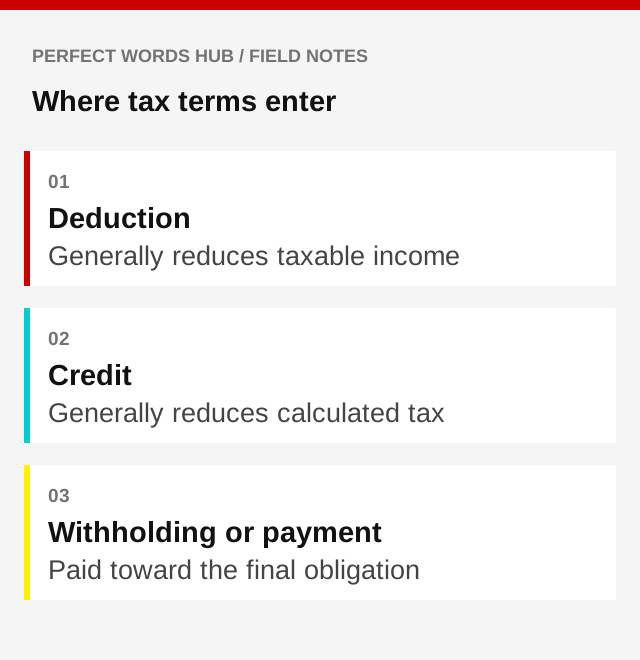
Tax vocabulary becomes easier when you attach each word to a step. First, income and applicable adjustments lead toward taxable income. The relevant rules calculate tax on that income. Eligible credits then affect the tax, while withholding and other payments help determine what remains to pay or refund.
This is a learning model, not a complete tax return. Actual returns include interactions, phaseouts, additional taxes, and other rules. Its purpose is to explain why two equally sized tax benefits may not produce equal savings.
Work through a deliberately simple example
Imagine that a hypothetical $1,000 deduction removes income that would otherwise all be taxed at an assumed marginal rate of 20%. In that simplified situation, the tax reduction is $200. The assumed rate is only for arithmetic; it is not a statement of a current U.S. tax bracket.
A usable $1,000 credit instead subtracts $1,000 from the tax, subject to its rules. The equal face values therefore enter different parts of the calculation.
| Illustrative benefit | Effect in this example |
|---|---|
| $1,000 deduction at an assumed 20% marginal rate | $200 less tax |
| $1,000 fully usable credit | $1,000 less tax |
A deduction’s actual effect can change when income crosses a bracket boundary or interacts with another provision. Do not use this shortcut to prepare a real return.
Ask whether the credit is refundable
A nonrefundable credit generally reduces applicable tax no lower than zero. A refundable credit can, under its rules, produce a refund beyond the tax otherwise owed. Some credits have both refundable and nonrefundable components or other restrictions.
“Refundable” does not mean everyone qualifies, and “nonrefundable” does not mean it has no value. Read the eligibility and calculation instructions for the specific credit and year. Carryover rules, where available, are also specific to the provision.
Separate a tax benefit from a payment
Withholding is money paid toward tax during the year. It is not itself a deduction or credit that makes the underlying tax disappear. A refund can reflect payments exceeding the final liability, refundable credits, or a combination.
That is why a large refund alone cannot tell you whether someone paid less tax than another person. You need the full calculation, not just the final amount returned.
Check the year before checking the box
Before claiming a benefit, confirm its availability for the tax year, who qualifies, what records are needed, and how it interacts with other choices. Federal and state rules may differ. A social post using last year’s numbers is not a substitute for current instructions.
Use IRS resources or a qualified tax professional for your own circumstances. Understanding where a benefit enters the calculation is a good first question, not a determination that you are entitled to claim it.
Sources & further reading
- IRS: Credits and deductions for individuals (opens in a new tab)
- IRS: Tax withholding (opens in a new tab)
Source links checked September 30, 2026. Requirements and guidance may change.
For general education in a U.S. context. This is not financial, insurance, legal, tax, or medical advice. Examples are illustrative. Check current rules and relevant policy documents, and seek qualified help for your circumstances.
Do these tax terms add up?
Put the ideas into practice with 15 questions and explanations.
Take the quiz