
The useful part, up front
- Reconcile receipts, platform adjustments, and bank deposits.
- Keep business-purpose evidence with potential expenses.
- A missing tax form does not make earned income disappear.
Follow a transaction from customer to bank
A platform payout may combine several sales or jobs and subtract fees or refunds before the money reaches you. Keep the transaction report as well as the bank entry. Otherwise, the deposit alone may hide how the amount was produced.
Create columns for date, transaction reference, gross amount, adjustments, and payout. This is an organizational example, not a universal tax ledger. The records needed depend on your activity and accounting method. Ask a preparer which details your situation requires.
Use a small reconciliation example
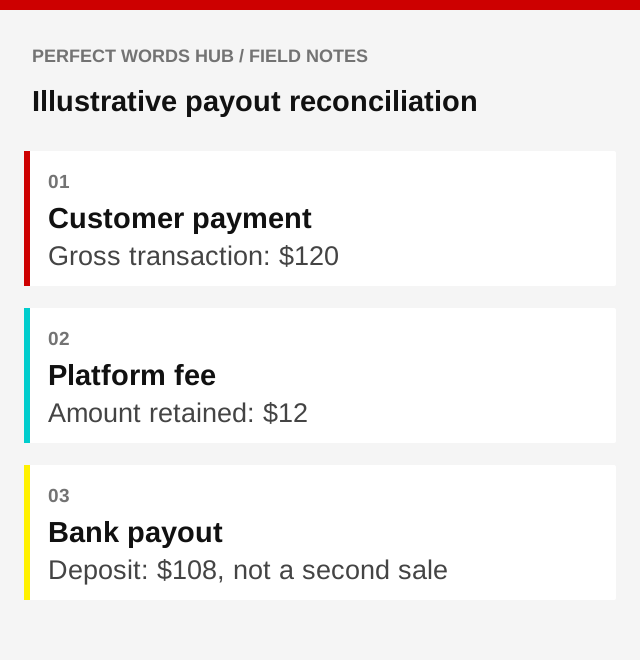
Imagine a hypothetical service payment of $120, a $12 platform fee, and a $108 deposit. Recording only the deposit loses the relationship between the customer payment and the fee. Recording both $120 and $108 as separate revenue would count the same transaction twice.
The example explains reconciliation rather than deciding how a particular fee is reported or deducted. Keep the original report and label the connection. If a refund occurs later, retain that record too instead of overwriting the original transaction.
Document expenses before judging eligibility
For a potential business expense, save the receipt, date, payment evidence, and a factual note explaining its purpose. Mixed personal and business use can raise additional allocation and substantiation questions. Paying with a particular card does not automatically make an expense deductible.
Use a separate list for uncertain items. A question such as whether equipment must be treated as an asset deserves a current rule check, not a guessed category. The IRS recordkeeping resources describe the role of supporting documents.
Reconcile forms with your own records
The IRS states that gig-work income can be reportable even when no information return arrives. A form is one piece of evidence, not the only record of your activity. Conversely, a form and a payout report may describe overlapping transactions, so adding every total can duplicate amounts.
If a form appears wrong, investigate through the issuer’s official process and retain the correspondence. Reporting thresholds and requirements can change; use instructions for the actual tax year. This article intentionally does not supply a threshold to reuse indefinitely.
Finish each month with fewer open questions
Set aside a short review to match transactions to deposits, attach missing receipts, and list unresolved items. Keep copies protected and backed up. Do not share documents containing tax identifiers through an unexpected message or public link.
Payment obligations can arise before annual filing, so pair the record system with the withholding and estimated-payment overview. A reliable record makes professional help more productive; it does not decide worker classification, business status, or the tax due.
Questions worth checking
Should refunds erase the original entry?
Keep enough history to explain the original payment and subsequent refund. A linked adjustment preserves the transaction trail. The correct tax reporting depends on the situation, but overwriting the only evidence makes reconciliation and professional review harder.
Does a separate account prove an expense is deductible?
No. Separating activity may make records easier to follow, but the transaction’s purpose and applicable tax rules still matter. A personal purchase does not become a business deduction simply because it was paid from an account used for side work.
Sources & further reading
- IRS: Gig economy tax center (opens in a new tab)
- IRS: Business recordkeeping (opens in a new tab)
- IRS: Starting a business and keeping records (opens in a new tab)
Source links checked September 30, 2026. Requirements and guidance may change.
For general education in a U.S. context. This is not financial, insurance, legal, tax, or medical advice. Examples are illustrative. Check current rules and relevant policy documents, and seek qualified help for your circumstances.
Do these tax terms add up?
Put the ideas into practice with 15 questions and explanations.
Take the quiz