
The useful part, up front
- Freddie Mac's weekly survey put the average 30-year fixed rate at 7.40% on October 15, 2026, up from 6.27% a year earlier. A refinance only helps if your new rate and costs beat what you have now by enough, and for long enough.
- The break-even month is your total refinance costs divided by your real monthly savings. If you may move, sell, or refinance again before that month arrives, the deal loses money even with a lower rate.
- Compare the new loan against the remaining term of your current one, not just against today's payment. Restarting a 30-year clock can shrink the payment and still raise what you pay over time.
The letter in the mailbox says you could save
It arrives as a postcard, an email, or a call from a number you do not know: "Lower your payment today." Maybe your own loan was signed when rates were higher, or you have an adjustable rate that is about to reset, or you simply saw a headline and wondered if you are missing out.
The headline number this week is not small. Freddie Mac's Primary Mortgage Market Survey reported an average 30-year fixed rate of 7.40% for the week ending October 15, 2026. That was unchanged from the week before and well above the 6.27% recorded a year earlier. The 15-year fixed average was 6.71%, compared with 5.52% a year ago.
So the honest first question is not "how low can I go?" It is "is there any version of a refinance that beats my current loan once I pay for it?" For many people who bought or refinanced during the past year, the answer is no. For some who took a loan at a higher rate, or who carry mortgage insurance they could remove, the answer may be yes. Break-even math sorts you into one group or the other in about ten minutes.
What a refinance actually is
A refinance replaces your current mortgage with a new one. The new loan pays off the old loan, and from then on you owe the new lender under new terms. The Consumer Financial Protection Bureau notes that it usually involves many of the same steps and fees as getting your original mortgage: an application, underwriting, and a closing, and lenders often require an appraisal.
People refinance for different reasons, and the reason decides which numbers matter. Some want a lower rate and payment. Some want to shorten the loan and pay less interest overall. Some want to swap an adjustable rate for a fixed one so the payment stops moving. Others want to cash out some equity, or drop private mortgage insurance. A refinance can do one of these well and another badly, so write down your main goal before you collect any quotes.
One more point before the math: the Freddie Mac rate is a benchmark, not an offer. Its survey is built from purchase loan applications for borrowers with good or excellent credit and 20% down on conforming loans, and it does not publish points or fees. Your quote can sit above or below it depending on your credit, your equity, the property, and the points you choose to pay.
The break-even formula, step by step
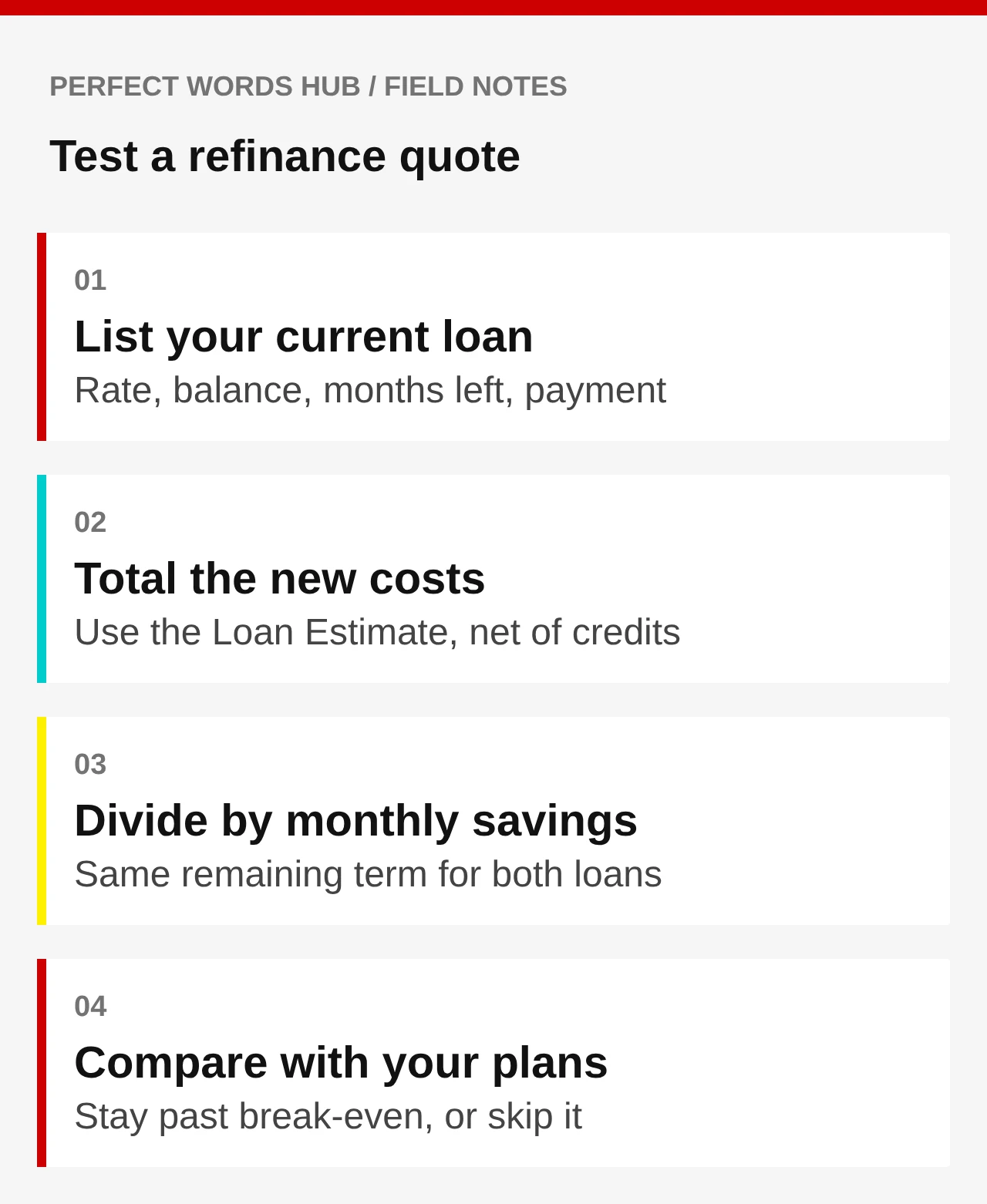
The break-even month answers one question: how long until the money you save each month adds up to the money you paid to get the new loan?
- Add up every cost of the new loan: lender fees, appraisal, title and settlement charges, recording fees, and any discount points. The Loan Estimate the lender must give you after you apply lists these, and the total sits on its closing-cost pages.
- Subtract any lender credit you will actually receive, and note that a credit usually comes with a higher rate.
- Work out your monthly savings. Compare the new principal-and-interest payment with the payment you make now. Use the same stretch of time for both loans (more on that in the next section).
- Divide total costs by monthly savings. The answer is the number of months you must keep the new loan before you come out ahead.
- Compare that number with how long you honestly expect to stay. Be conservative. Jobs change, families grow, and a plan to stay forever is not the same as a plan you have signed.
The CFPB's guidance puts the same idea as a question: will you stay in the home long enough to recover the cost of refinancing? The formula just turns that question into a date you can check against your plans.
Worked example: a big rate drop that still takes nearly three years
Say you borrowed $400,000 on a 30-year fixed loan at 8.25% two years ago. Your principal-and-interest payment is about $3,005, and your balance has fallen to roughly $393,000 with 28 years (336 months) left. This is a hypothetical loan, but the arithmetic is standard.
You are quoted 7.40% on a new 30-year loan with $8,000 in total costs. That is a 0.85-point drop, bigger than many refinance pitches. Here is what it does under two ways of measuring it.
| New loan | Monthly P&I | Monthly savings | Break-even on $8,000 |
|---|---|---|---|
| New 30-year term (clock restarts) | about $2,724 | about $281 | about 28 months |
| Same 28 years left (336 months) | about $2,778 | about $227 | about 35 months |
Which number is the honest one? The second is closer to apples-to-apples, because it keeps the same payoff date. The first looks better partly because stretching the debt back to 30 years lowers the payment by itself. If you take the longer loan, you can still pay it down faster by sending extra principal each month, but nothing forces you to.
At the 35-month break-even, staying 36 months puts you only about $180 ahead. Staying five years puts you ahead by roughly $5,600. Selling after two years leaves you about $2,500 behind. The same loan is a good deal for one household and a bad one for another, and the only difference is how long they stay.
Over the full life, the same-term refinance also cuts the interest you would still owe: about $540,000 on the new loan versus roughly $616,000 left on the old one. That is a long-run figure, and it only becomes real if you keep the loan to the end.
Worked example: a small drop that may never be worth it
Now try a quieter scenario. Your balance is $380,000, with 29 years (348 months) remaining, at 7.90%. A lender offers 7.40% and estimates $7,000 in costs.
Your payment falls from about $2,786 to about $2,656, a saving of about $130 a month. Dividing $7,000 by $130 gives roughly 54 months, or four and a half years. If you expect to sell, move, or refinance again within that window, you are paying $7,000 to save less than $7,000.
There is also a second hidden cost: a refinance now means you cannot refinance later at a lower rate without paying closing costs again. If rates fall next year, you will want the option to use it. That option has value, and a break-even calculation that ignores it is a little too friendly to the refinance.
A common rule of thumb says a drop of at least a point makes refinancing worthwhile, but the example above shows why rules of thumb fail. A 0.85-point drop looked good at $8,000 in costs and mediocre at higher costs or a shorter stay. Run your own numbers instead. Our walkthrough of what a 7.4% rate does to a monthly payment shows how to build the payment side of the calculation.
Costs people forget to put in the formula
The list on your Loan Estimate is where to start, but a few items are easy to miss when you do break-even in your head.
- Prepayment penalty on the current loan. Some loans charge a fee for paying them off early. The CFPB suggests checking your loan documents before you refinance, and the Loan Estimate for the new loan also shows whether the new one carries a penalty.
- Rolled-in costs. Many lenders let you add closing costs to the loan balance so you pay nothing upfront. That is convenient, but you pay interest on those costs for decades. In the first example, rolling in $8,000 raises the new payment on the 336-month loan from about $2,778 to about $2,834, cutting the monthly saving from about $227 to roughly $171.
- Escrow reshuffling. Closing often involves setting up a new escrow account and paying some taxes and insurance in advance. Your old servicer should return the balance of your old escrow account after payoff, but timing varies, so the cash you need at closing may exceed the fees alone. Our closing cash checklist lists the usual items.
- Lost progress. A new 30-year loan starts you at the beginning of the amortization schedule, where most of each payment is interest. If you were already well into the loan, you reset that progress.
- A higher fee for a lower rate. Discount points trade cash now for a lower rate. The CFPB describes one point as 1% of the loan amount and says points make most sense if you plan to keep the loan a long time.
Do the same math for discount points
Points are a refinance inside a refinance, and they deserve their own break-even. Suppose you have a $350,000 balance and two quotes: 7.40% with no points, or 7.15% with one point. The one point costs $3,500. The monthly payment drops from about $2,423 to about $2,364, a difference of about $59.
Divide $3,500 by $59 and you get roughly 59 months, nearly five years. Anyone who keeps the loan longer than that comes out ahead; anyone who moves earlier loses. The 7.15% rate here is hypothetical, because points buy different amounts from different lenders on different days. Ask each lender for the quote with and without points, and compare them on identical Loan Estimates.
If you are collecting offers, comparing Loan Estimates line by line keeps the numbers honest. Pay attention to the origination charges, the services you cannot shop for, the services you can, and the APR and total interest percentage in the comparison section.

Cases where the reason is not the rate
Break-even is a savings test, so it fits best when your goal is a lower payment. Other goals follow different logic.
Removing mortgage insurance. If you put less than 20% down on a conventional loan, you probably pay private mortgage insurance. Under the federal rules the CFPB summarizes, you can ask your servicer in writing to cancel it when your balance is scheduled to reach 80% of the home's original value, and the servicer generally must end it automatically at 78%. You must be current on your payments, and you may need to show the home has not lost value. If your home has gained value, a refinance based on a new appraisal can reset the starting point for those calculations. Before refinancing for this reason, ask your servicer what it needs to remove PMI on your existing loan. A phone call costs nothing, while a refinance costs thousands. FHA and VA loans follow different rules.
Switching out of an adjustable rate. If your payment is about to reset, the comparison is not your current payment against the new one. It is the new payment against what the reset could cost. Ask your servicer for the maximum rate and payment, and compare the fixed rate with that figure, not the low teaser rate.
Shortening the term. Going to a 15-year loan at 6.71% on the $393,000 balance in the first example would make the payment about $3,472, roughly $470 higher than the $3,005 you pay now, though the interest over the life of the loan would be about $232,000 instead of more than $600,000. The numbers look wonderful and the monthly strain is real. This is a budgeting decision, not just a rate decision.
Cash-out. Pulling equity out turns part of your home into new debt at today's rate, and it can raise the rate on your entire mortgage balance. If your current rate is low, compare it with a home equity loan or line that leaves the first mortgage alone, and consider carefully what the cash is for. Our guide to what the monthly payment leaves out is a useful reality check before you add debt.
Taxes, cancellation rights, and the paperwork trail
Tax effects are modest but worth knowing, especially if you itemize. IRS Publication 936 explains that points paid on a refinance are generally spread over the life of the new loan instead of deducted all at once, with an exception when part of the money goes toward improving your main home. If you pay off a loan on which you were still spreading points, the leftover amount can generally be deducted in the year the loan ends, but not when you refinance with the same lender, where it carries into the new loan. Tax rules change, so confirm the current year's rules or ask a tax professional.
Federal rules also give you a short cooling-off period on many refinances. The CFPB says that for most non-purchase mortgages such as refinances, you generally have three business days after closing to cancel, for any reason. Saturdays count and Sundays and legal holidays do not. You must cancel in writing, not by phone, and keep a copy. If you cancel, you remain responsible for the original loan. Read the disclosure you are given at closing for the exact deadline and delivery method.
Keep the paper trail. Save the Loan Estimate, the closing documents, the payoff statement from the old loan, and your first statement from the new one. Check that the old loan shows a zero balance and that the old servicer sent you any escrow refund.
A ten-minute decision checklist
Before you accept any offer or sign any form, run through these steps in order.
- Write down your current rate, balance, remaining months, and principal-and-interest payment from your latest statement.
- Check for a prepayment penalty in your loan documents, and ask your servicer for the payoff figure.
- Pick your goal: lower payment, shorter term, stability, PMI removal, or cash.
- Ask at least three lenders for Loan Estimates on the same loan type, on the same day, and ask for quotes with and without points.
- Calculate break-even using the same remaining term, not the restarted 30-year term, to see the savings fairly.
- Add rolled-in costs, escrow cash, and any prepayment penalty, then subtract any credit you really receive.
- Compare the break-even month with your honest timeline. If you may move or refinance again before then, the answer is usually no.
- If you cannot tell whether the deal is good, talk to a HUD-approved housing counselor or a licensed professional you trust, and never sign anything you have not had time to read.
Rates are published every Thursday in the Freddie Mac survey, so the benchmark will move before you decide. If your numbers fail today, they may not fail next month. Rerun the formula when rates, your balance, or your plans change, and keep the answer in a note beside your mortgage statements.
Sources & further reading
- Freddie Mac: Primary Mortgage Market Survey (weekly mortgage rates and methodology)
- CFPB: Should I refinance? handout
- CFPB: What are discount points and lender credits?
- CFPB: When can I remove private mortgage insurance (PMI)?
- CFPB: The right of rescission on a refinance
- IRS: Publication 936, Home Mortgage Interest Deduction
Source links checked October 17, 2026. Rules, rates and product terms can change.
General real estate and mortgage education, not financial or legal advice. Rates change often; confirm current terms with licensed lenders.