
The useful part, up front
- Distinguish down payment, closing costs, and cash to close.
- Reconcile deposits and credits against the final calculation.
- Independently verify payment instructions before moving money.
Start with the final document’s labels
A down payment is the portion of the purchase price paid apart from the mortgage financing. Closing costs include transaction expenses. Cash to close is the amount the closing calculation says must be provided, after relevant deposits, credits, and adjustments.
The exact components depend on the transaction. Keep your Loan Estimate, Closing Disclosure, deposit receipts, and purchase agreement available so you can trace the figures. Do not use a generic online percentage as a substitute for the actual documents.
Use a simple example to spot double-counting
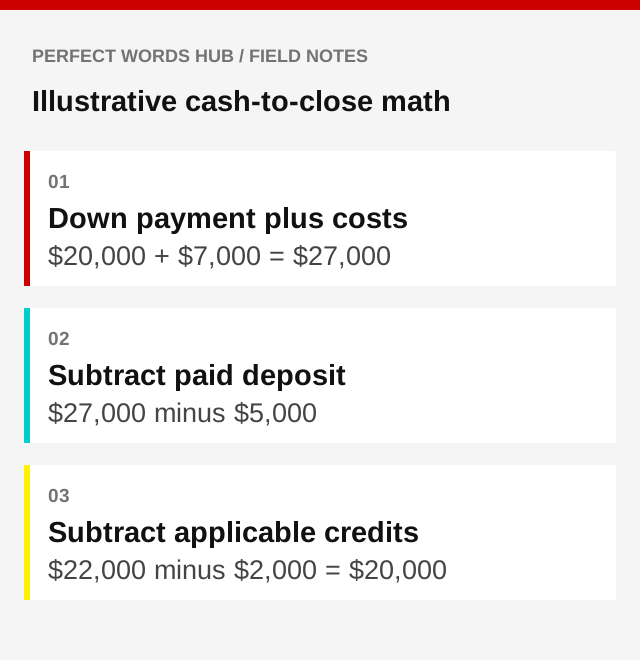
Suppose an illustrative transaction has a $20,000 down payment and $7,000 in closing costs. A $5,000 deposit already paid and $2,000 of applicable credits would leave $20,000 in this deliberately simplified cash-to-close calculation. Real transactions may include further adjustments.
If you add the full deposit again as a new payment, you count money twice. If you assume an expected credit is already approved without checking, you may underestimate the cash needed. Follow each amount back to its supporting document.
Ask about changes before the appointment
Compare the Closing Disclosure with the relevant Loan Estimate and ask the lender or closing professional to explain changed amounts. Check names, property details, loan terms, and payment components as well as the total. A familiar-looking document can still contain a detail that needs correction.
Write questions down and save the response. If a revision arrives, keep version dates clear. Do not assume every change is an error, but do not sign solely because someone says the total is close enough.
Verify the route for sending money
A convincing email can imitate a participant in a home purchase and supply fraudulent payment instructions. Use a previously verified phone number or another independently trusted channel to confirm the recipient and instructions. Do not rely on contact details supplied only in the unexpected message.
Treat a last-minute change as a reason to verify carefully. If you suspect money went to a scammer, contact the payment institution immediately through its official channel and consult the FTC’s response guidance. Recovery is not guaranteed.
Keep post-closing needs in the picture
Cash required to complete the transaction is different from money needed afterward for moving, utilities, repairs, and other obligations. Review those needs in your broader budget without describing them as charges due to the closing agent.
After closing, retain the signed documents and payment confirmations securely. The mortgage-offer comparison guide helps with the earlier stage. This checklist is educational and does not approve a purchase, payment instruction, or transaction.
Questions worth checking
Do moving costs belong in cash to close?
Your personal moving budget is generally separate from the transaction’s cash-to-close calculation. It still affects how much money remains available afterward. Keep the two lists distinct so you neither omit an important expense nor mistake it for an amount payable to the closing agent.
What if a payment instruction looks genuine?
Appearance alone does not authenticate it. Verify the recipient and details using an independently trusted channel established before the unexpected instruction. Even a familiar-looking thread can be compromised; urgency is a reason to slow down and check.
Sources & further reading
- CFPB: Understanding the Closing Disclosure (opens in a new tab)
- CFPB: Understanding the Loan Estimate (opens in a new tab)
- FTC: Recognizing phishing (opens in a new tab)
- FTC: Steps after a scam (opens in a new tab)
Source links checked September 30, 2026. Requirements and guidance may change.
For general education in a U.S. context. This is not financial, insurance, legal, tax, or medical advice. Examples are illustrative. Check current rules and relevant policy documents, and seek qualified help for your circumstances.
Are you seeing the whole homebuying picture?
Put the ideas into practice with 14 questions and explanations.
Take the quiz