The useful part, up front
- Freddie Mac’s survey for October 15, 2026 put the average 30-year fixed rate at 7.40 percent, compared with 6.27 percent a year earlier.
- On a $300,000 loan, that gap is roughly $226 a month in principal and interest, or about $2,700 a year, before taxes and insurance.
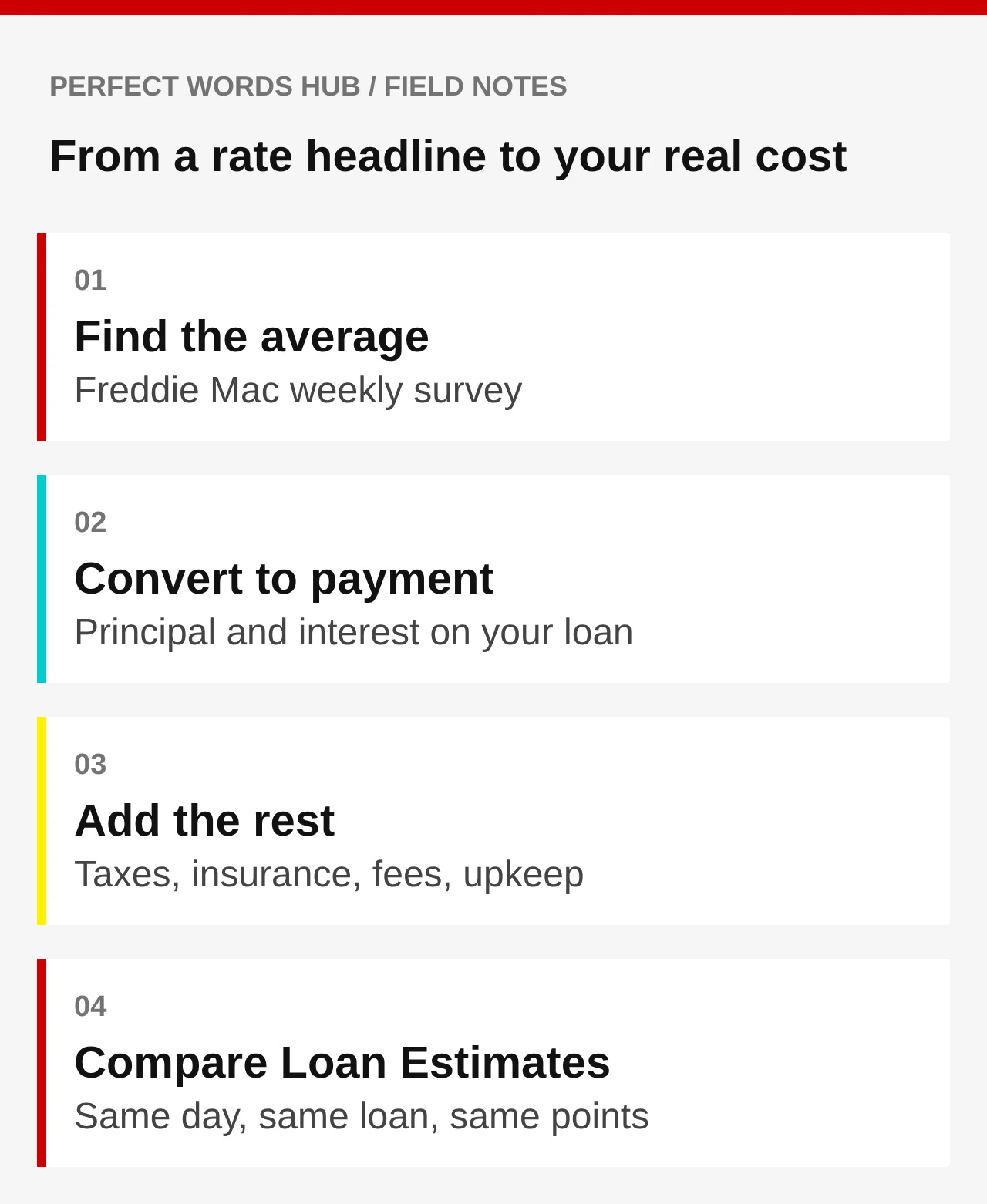
- Compare real offers on the same day, with the same loan amount and points, using the Loan Estimate form. Rates in the news are averages, not your rate.
The headline number and where it comes from
Freddie Mac publishes the Primary Mortgage Market Survey each week. In its October 15, 2026 release, the average rate on a 30-year fixed-rate mortgage was 7.40 percent, unchanged from the week before. The 15-year fixed average was 6.71 percent. A year earlier, the averages were 6.27 percent and 5.52 percent. These are national averages for borrowers with strong credit and a sizable down payment, and the figures change weekly, so check the latest release on Freddie Mac’s website before you rely on them.
An average rate is a reference point, not an offer. Your actual rate depends on your credit score, down payment, loan type, the property, the loan amount, points, and the day you lock. Two borrowers can be quoted rates that differ by a full percentage point on the same day.
Still, the average tells you something real: borrowing is more expensive than a year ago. The next sections translate that into payments.
The monthly payment gap, on a $300,000 loan
Principal and interest on a 30-year fixed loan can be calculated with a standard formula. Here is what the loan payment looks like at two rates, ignoring taxes, insurance, and any mortgage insurance.
| Loan amount | Rate | Monthly principal and interest |
|---|---|---|
| $300,000 | 6.27% | about $1,851 |
| $300,000 | 7.40% | about $2,077 |
| Difference | about $226 a month |
Over a year, that is about $2,700. Over the full thirty years, total interest at 7.40 percent on $300,000 is roughly $448,000, compared with about $366,000 at 6.27 percent, if you keep the loan to term and never refinance or pay it down. These are illustrative calculations, not predictions, and your numbers will differ.
Different loan sizes move proportionally. On $250,000, the gap is roughly $188 a month. On $400,000, it is roughly $301 a month. If you are comparing a house to another, those differences can change which one fits a budget.
Remember what the figure leaves out. Property taxes, homeowners insurance, mortgage insurance for a smaller down payment, homeowners association fees, and maintenance can add substantially to the monthly cost. Our guide on what the monthly mortgage number leaves out shows how to build the full picture.
How much house does the payment buy?
Lenders look at your debt-to-income ratio, which compares monthly debts with gross monthly income. Rules vary by loan type and lender, but a common rule of thumb is that housing costs should not take too large a share of income. If your target payment is fixed, a higher rate lowers the loan you can afford.
For example, if you want a principal and interest payment around $2,000 a month, a 30-year loan at 6.27 percent supports a loan of roughly $324,000, while at 7.40 percent it supports roughly $289,000. That is a difference of about $35,000 in purchasing power, from the rate alone. Those are rough figures and ignore taxes and insurance.
The takeaway is not to panic. It is to run the numbers for your own budget with realistic rates, and to leave room in the monthly plan for the other housing costs.
Points and buydowns: what they can and cannot do
A discount point is a fee paid at closing to lower the interest rate. Typically one point costs one percent of the loan amount, and the rate reduction it buys depends on the lender and the market. A buydown can also be funded by a seller or builder.
Imagine, purely as an example, that paying one point on a $300,000 loan, which costs $3,000, lowered the rate from 7.40 percent to 7.15 percent. That would cut the payment by about $51 a month, and it would take about 59 months, close to five years, to earn back the cost. If you expect to move or refinance in two or three years, you may lose money on the points. If you expect to keep the loan a long time, the same trade can pay off.
Temporary buydowns, such as a 2-1 buydown, lower the rate for the first one or two years and then rise to the full rate. They can make early payments easier, but the full payment still arrives, so make sure you can afford it afterwards. Do not count on refinancing, since future rates are not guaranteed.
Other ways to compare, and their trade-offs
- Shorter terms. A 15-year loan has a lower rate and a higher monthly payment. On $300,000, the monthly principal and interest at the October 15 average of 6.71 percent would be roughly $2,648, compared with about $2,077 for the 30-year at 7.40 percent, but you build equity much faster and pay far less interest overall.
- Adjustable-rate mortgages (ARMs). An ARM usually starts with a lower fixed rate for an initial period, then adjusts. The risk is a higher payment later. Read the caps, how often it adjusts, and the index it follows.
- A larger down payment. It reduces the loan, may remove mortgage insurance, and can lead to a better rate. It also reduces the cash you keep for emergencies, so be careful. Our guide on closing cash explains why the down payment is only one part of what you need on closing day.
- Different loan programs. FHA, VA, USDA, and conventional loans have different rates, fees, and insurance rules. A lender can show side-by-side numbers for programs you qualify for.
- Improving your credit profile. A higher score often reduces the rate you are offered. Reviewing your reports for errors costs nothing. See our guide on a credit report review routine.

Comparing offers the right way
Interest rate alone does not tell you the cost of a loan. When you apply, the lender must give you a Loan Estimate within three business days. It is a standard three-page form designed so you can compare loans. Use it, and request Loan Estimates from at least three lenders on the same day, for the same loan amount, loan type, and points.
Look at the rate, the annual percentage rate (APR), the monthly payment, the cash needed to close, and the lender fees in section A. Compare the APR as a guide to the cost including fees, with the caveat that APR assumes you keep the loan to term. Our guide on putting mortgage offers on the same measuring line walks through the form line by line.
Shopping among lenders for the same mortgage within a short period is generally treated as a single inquiry by credit scoring models, so it does not multiply the effect on your score. The length of that window depends on the scoring model, often between 14 and 45 days, so try to complete your shopping in a couple of weeks.
Ask each lender about the lock. A rate lock holds your rate for a set period, such as 30, 45, or 60 days. Longer locks may cost more. Ask what happens if closing is delayed, and whether a float-down option exists.
A practical plan for buyers right now
- Set a payment ceiling, not a price ceiling. Decide the total monthly housing cost you can carry, including taxes, insurance, and maintenance.
- Run three scenarios. Use the current rate, a rate one percentage point higher, and one lower, to see how sensitive your budget is.
- Get pre-approved with more than one lender. A pre-approval letter lets you know your range, and shopping for it gives you actual rate quotes.
- Keep a cash reserve. Do not drain emergency savings for the down payment. Our guide on where emergency savings should sit can help.
- Negotiate what you can. Sellers sometimes agree to concessions toward closing costs or a rate buydown, particularly when homes sit on the market.
- Do not assume you will refinance. Refinancing costs money and depends on future rates, your credit, and your home’s value. Treat it as a possible bonus, not the plan.
What this does not tell you
Rates also move for reasons outside any buyer’s control, including inflation data, decisions by the Federal Reserve, and demand for mortgage-backed securities. Anyone who tells you exactly where rates are headed is guessing. A better use of your time is to build a plan that works at today’s rate, and to treat any future drop as a possible improvement rather than a requirement.
If you are early in the process, a useful habit is to keep a simple one-page note with the rate you were quoted, the date, the points, and the lock period for each lender. Comparing from memory is how people end up choosing an offer that only looked better because the terms were different.
The numbers in this article are examples, built from a single week’s national average, and they assume a standard fixed-rate loan with no mortgage insurance. They are not a quote. Rates change daily, and your offer may be higher or lower. Confirm current rates with lenders, and read your Loan Estimate and closing documents carefully. For a general explanation of the process, the Consumer Financial Protection Bureau’s Owning a Home site is a trustworthy place to start.
Sources & further reading
- Freddie Mac: Primary Mortgage Market Survey
- CFPB: Owning a Home
- CFPB: Loan Estimate explainer
- CFPB: What is a discount point and a lender credit?
- HUD: Buying a home
Source links checked October 17, 2026. Rules, rates and product terms can change.
General real estate and mortgage education, not financial or legal advice. Rates change often; confirm current terms with licensed lenders.