The useful part, up front
- Deposit insurance protects money in an insured bank or credit union if that institution fails. It does not protect against fraud, scams, or poor investments.
- The standard limit is $250,000 per depositor, per insured bank, per ownership category, so how an account is titled changes the answer.
- A savings app is not automatically a bank. Check who actually holds the money before you rely on a headline about insurance.
Start with the job the money has to do
Emergency savings has a narrow job: it should be there, in full, when something goes wrong. A car repair, a medical bill, a gap between paychecks. The CFPB describes an emergency fund as money set aside for unexpected expenses, and many consumer educators suggest building toward several months of essential costs. How much is right depends on your income stability, household size, and obligations, so treat any single number as a starting point rather than a rule.
That narrow job explains why the place you keep the money matters more than the last fraction of a percent of interest. Emergency money should be easy to reach, should not swing in value, and should be protected if the institution holding it runs into trouble. A higher rate that comes with a delay, a penalty, or a risk of loss is solving a different problem.
If you are still building the cushion, our guide on saving for bills that do not arrive every month shows how to separate predictable lumpy expenses from true emergencies, so one does not quietly drain the other.
What deposit insurance actually is
In the United States, two federal systems stand behind most everyday savings. The Federal Deposit Insurance Corporation (FDIC) insures deposits at member banks. The National Credit Union Administration (NCUA) insures member accounts at federally insured credit unions through its share insurance fund. Both are backed by the federal government, and both use the same standard maximum: $250,000.
Deposit insurance covers the money you have placed in deposit products: checking accounts, savings accounts, money market deposit accounts, and certificates of deposit. If an insured institution fails, the insurer pays depositors up to the limit, and historically this has happened quickly, often within a few business days.
It does not cover everything that sits near a bank. Stocks, bonds, mutual funds, annuities, cryptocurrency, and life insurance policies are not deposits, even when you buy them through a bank branch or a banking app. It also does not reimburse you if a scammer talks you into sending money, or if someone takes over your account. Those are fraud issues, handled by different rules and by your institution’s fraud process.
The limit is per bank, per category, and that changes the math
The $250,000 figure is not a flat cap on everything you own. It applies per depositor, per insured institution, and per ownership category. That sentence hides a lot of detail.
- Single accounts are owned by one person. All of your single accounts at the same bank are added together and insured up to $250,000.
- Joint accounts are insured per co-owner. A joint account with two owners can be insured up to $500,000 in total at that bank, if each owner’s share is within the limit.
- Certain retirement accounts, such as IRAs held as deposits, are a separate category from your regular savings.
- Trust accounts have their own rules that depend on the beneficiaries named.
This is why two people with the same balance can have different protection. A couple who keeps $400,000 in a single-owner account at one bank has $150,000 above the limit. The same couple with a properly titled joint account may be fully covered. A one-person household may prefer to split larger balances across two institutions instead.
Do not rely on mental math for anything near the limit. The FDIC provides a free tool, the Electronic Deposit Insurance Estimator (EDIE), that lets you enter your accounts and ownership types and see what is covered. The NCUA offers a similar calculator for credit unions.
Check that the institution is insured at all
Insurance belongs to the institution, not to the brand on the app. Before you move emergency money, confirm three things.
- The institution appears in the FDIC’s BankFind tool, or in the NCUA’s credit union lookup.
- The specific account type you are opening is a deposit product, not an investment account with a similar name.
- The name on the legal paperwork matches the name you were told. A savings product might be offered by a company that is not a bank, with a partner bank somewhere behind it.
That last point deserves attention. Many savings and spending apps are financial technology companies that partner with insured banks rather than being banks themselves. Under the right arrangement, your money is held at the partner bank and the insurance can pass through to you, but only if the records are accurate and the bank can identify who owns what. The FDIC has warned consumers that insurance does not protect you if the technology company, rather than the bank, fails, and several high-profile failures of such middlemen in recent years left customers waiting for access to their funds. Read the fine print about which bank holds your money, and keep the name of that bank somewhere you can find it.
If an app advertises insurance, look for a plain statement of which bank holds the deposits and whether you are covered if the company itself stops operating. If you cannot find that statement in a few minutes, that is useful information.
Other places people keep cash, and how they differ
Not every safe-sounding place is insured the same way. Here is a quick comparison of what you may encounter.
Brokerage cash or sweep accounts. Cash inside a brokerage account may be swept into one or more partner banks, in which case deposit insurance may apply, or it may stay as a credit balance at the broker, in which case it is not FDIC-insured. SIPC protection, where it applies, covers missing assets if a brokerage fails. It does not protect against falling market values.
Money market funds. These are investment products, not bank deposits. They aim to keep a stable value but they are not insured.
U.S. Treasury bills and savings bonds. These are not covered by deposit insurance, but they are obligations of the U.S. government. Some people use them for a portion of their reserves, understanding the timing and access rules.
Cash at home. A small amount can be useful in a power outage, but it can be lost, stolen, or destroyed, and no insurer guarantees it.
The practical pattern for many households is simple: keep the core emergency fund in an insured savings account, and treat any other product as something you chose for a different reason.
Brokered certificates of deposit and other fine print
Certificates of deposit bought through a brokerage can be insured, but the insurance follows the issuing bank, not the broker. Buying many CDs through one platform can accidentally pile more than $250,000 into one bank. Keep a list of the issuing bank for each CD, and add them up per bank.
Interest counts too. Accrued interest is part of your balance when the insurer calculates coverage, so a balance sitting right at the limit can drift over it.
Mergers can also change the picture. When two banks merge, deposits at both may be combined for insurance purposes after a grace period. If you hold large balances at banks that merge, recheck.
A simple placement check you can do in one sitting
Use this order. It takes about thirty minutes and does not require moving money unless you find a gap.
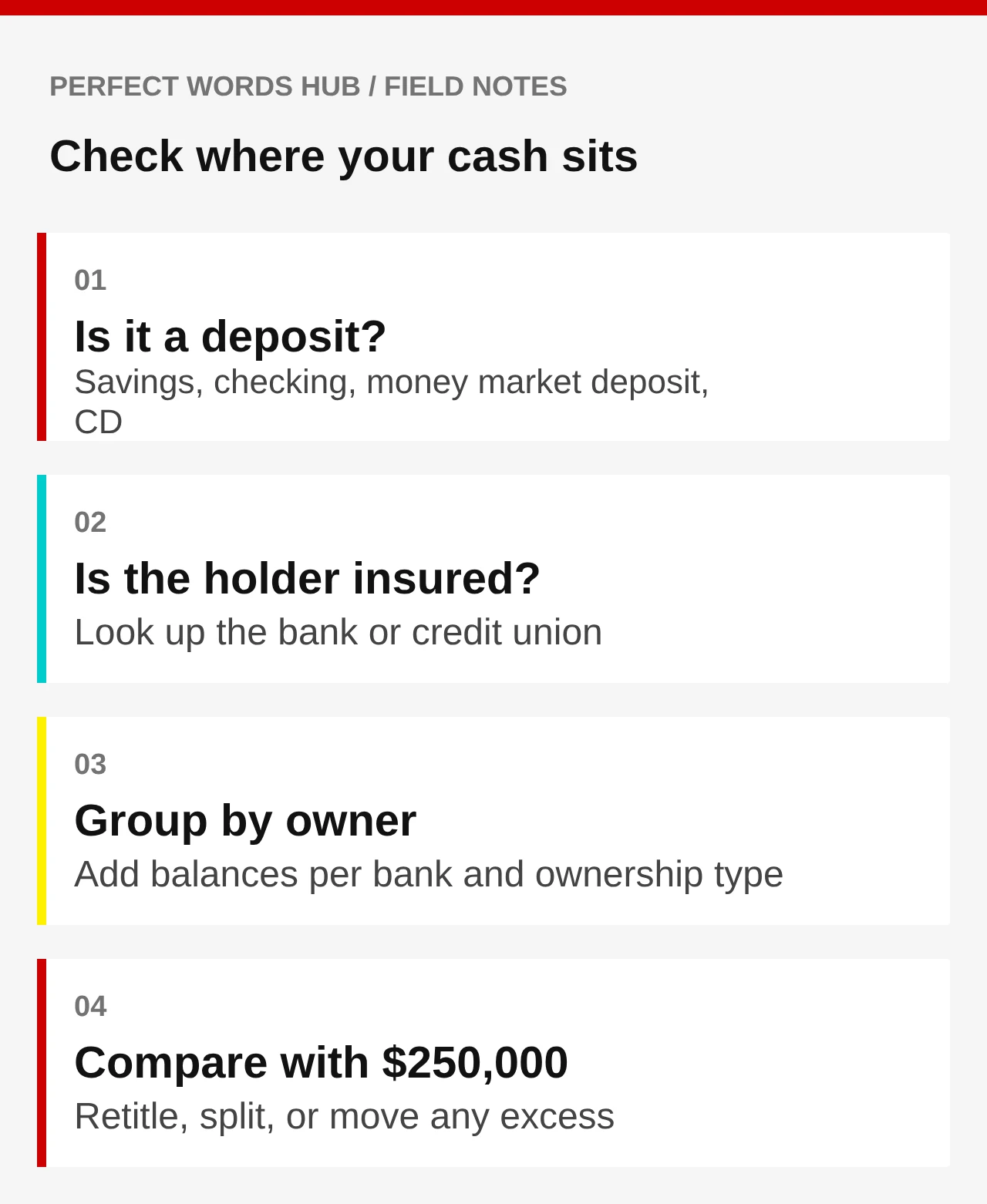
- List every account that holds cash: checking, savings, CDs, brokerage cash, and any app balances.
- For each, write down the institution name, the ownership type (single, joint, retirement, trust), and the balance, including interest.
- Group them by institution and ownership category. Add each group.
- Compare each group with $250,000 per owner. For gaps, decide whether to retitle, split across institutions, or move some money into Treasury securities.
- Save the list with your other financial records. If a bank ever fails, you will want account numbers and statements in one place.
Doing this once a year, or after a large deposit such as a home sale or inheritance, is enough for most people.
What to do if a bank does fail
Bank failures are rare, but the process is worth knowing. The FDIC typically either arranges for another bank to assume the deposits or pays depositors directly. In many cases customers see their accounts open as usual at the new institution on the next business day.
Keep paying bills from an account you can still reach, and do not rush to withdraw funds. Official communication will come from the FDIC and the failed bank’s successor, usually by mail and on the FDIC website. Be suspicious of unsolicited calls or messages that claim to help you recover money. Fraudsters often target the confusion after a bank failure.
A realistic way to think about it
People often ask whether it is worth the effort to spread money across several banks. For most households with balances well under the limit, the answer is no. One insured account with a clear title is simpler and safer than a web of small accounts you forget about. Spread money only when a balance genuinely exceeds the limit, or when you want a second, separate place to reach cash if one app or bank has an outage.
Deposit insurance is a safety net, not a plan. The real protection comes from small habits: keeping the core emergency fund in an insured account you can reach quickly, knowing the exact institution that holds it, and checking totals when balances grow.
If you take one action after reading this, make it the list in the previous section. The first time you write it down, you may find that nothing needs to change. That is a good outcome, and it takes less time than worrying about it.
Sources & further reading
- FDIC: Deposit insurance
- FDIC: Electronic Deposit Insurance Estimator (EDIE)
- FDIC: BankFind Suite
- NCUA: Share insurance coverage
- CFPB: An essential guide to building an emergency fund
Source links checked October 17, 2026. Rules, rates and product terms can change.
General personal finance education, not individual financial advice. Confirm details with your institution or a qualified professional.