
The useful part, up front
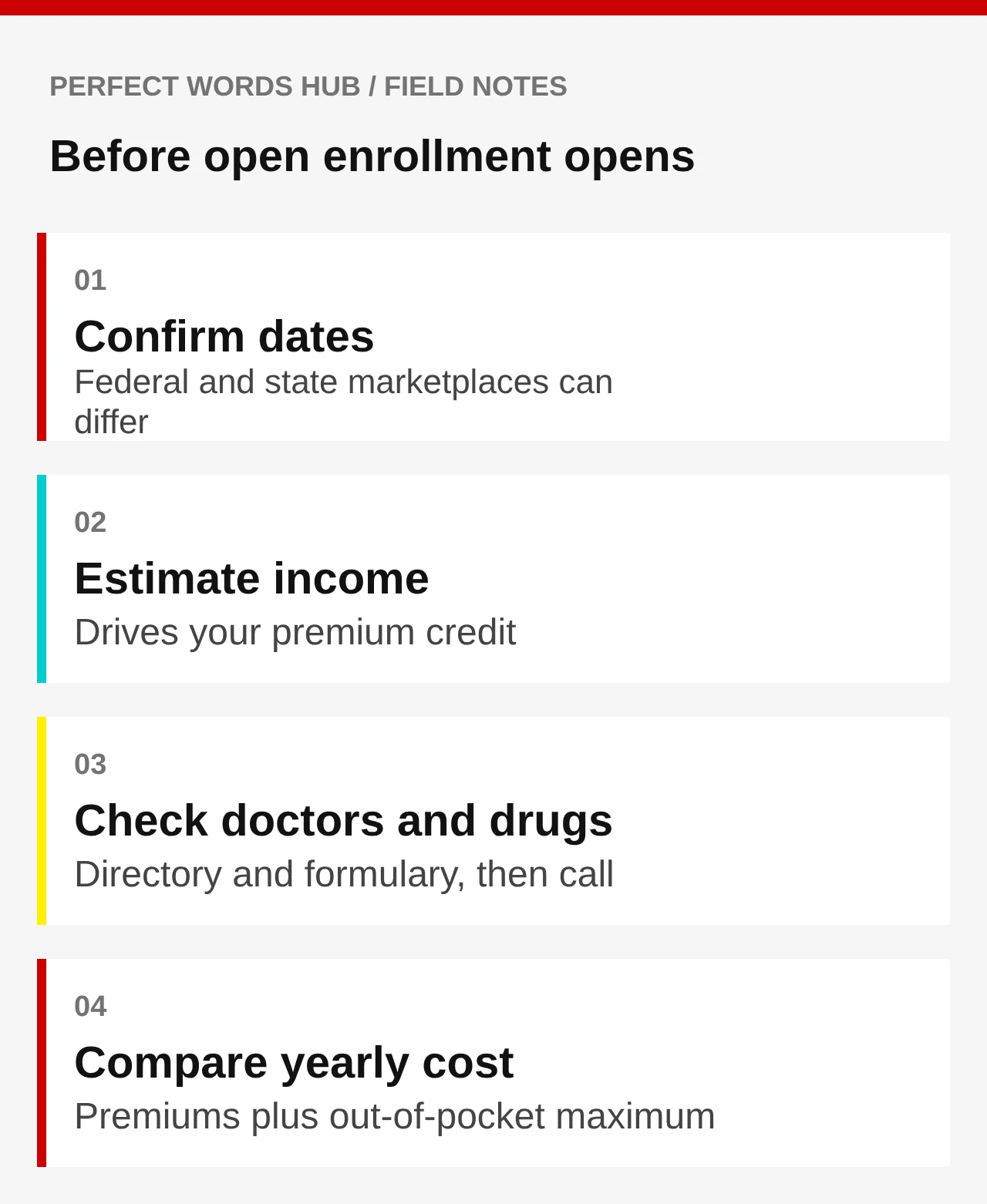
- HealthCare.gov lists November 1 as the start of open enrollment for 2027 coverage, December 15 as the deadline for coverage that starts January 1, and January 15 as the last day to sign up. State-run marketplaces can have different dates.
- Your income estimate for the year drives how much help you may get with premiums. Update it honestly, because a gap shows up when you file your tax return.
- The cheapest premium is not the cheapest plan. Compare the deductible, out-of-pocket maximum, doctors, and drugs together.
Start with the dates, and confirm them for your state
According to HealthCare.gov, you can apply for 2027 coverage or update your application starting November 1. The site lists December 15 as the final day to sign up or switch plans for coverage starting January 1, and January 15 as the last day of open enrollment. People who enroll between December 16 and January 15 and pay their first premium get coverage starting February 1.
Those dates apply to the federal HealthCare.gov marketplace. If your state runs its own marketplace, the schedule can be different, and some states extend the window. Rules about enrollment periods have also changed in recent years, so check the dates on your state’s marketplace website or on HealthCare.gov itself rather than relying on a screenshot or an older article, including this one.
Outside open enrollment you generally need a qualifying life event to enroll, such as losing other coverage, moving, getting married, or having a baby. You can apply for Medicaid or the Children’s Health Insurance Program at any time of year. If you are not sure whether you qualify for a special enrollment period, the marketplace has a screening tool.
If you already have a marketplace plan, do not assume it will carry over unchanged. Insurers update prices, benefits, and networks each year. Your plan may be renewed automatically at a different cost, or it may be discontinued.
Check 1: Estimate your income for the whole year
Premium tax credits are based on your expected household income for the coverage year, not last year’s tax return. When you apply, the marketplace asks for your best estimate. Include wages, self-employment income, unemployment benefits, and other taxable income. Make a conservative but honest estimate and be ready to update it if it changes during the year.
If your income is higher than you estimated, you may have to repay some of the credit when you file taxes. If it is lower, you may receive more at tax time. This reconciliation happens on IRS Form 8962. Many people get a surprise bill because they forgot a raise or a side job. Our guide on side income recordkeeping can help if your income varies.
Also list everyone in your tax household. That includes anyone you will claim as a dependent. The rules about who counts can be different from who lives with you.
Check 2: Know what help is available now
Help paying for coverage comes in two main forms. Premium tax credits lower the monthly premium for marketplace plans. Cost-sharing reductions lower deductibles and copayments, but only for certain income levels and only if you choose a Silver plan. Medicaid and CHIP may be available depending on your income and state.
The rules for premium tax credits have changed over time. Analysts at KFF have described the expiration of the enhanced premium tax credits that were in place in recent years and the effect that has on what people pay. Whatever the current law is when you enroll, the practical step is the same: use the marketplace’s window-shopping tool or a plan comparison tool, enter your household details, and see your actual estimated premium after any credit. Do not rely on last year’s net premium.
If the numbers are higher than you expect, check whether you qualify for a different program, look at other metal tiers, and ask a navigator. Free, trained help is available at no cost through marketplace navigators and certified assisters, and you can find them through HealthCare.gov.
Check 3: Learn the four plan tiers
Marketplace plans are grouped into Bronze, Silver, Gold, and Platinum. These are not quality ratings. They describe how costs are shared between you and the insurer on average for a typical group of people.
- Bronze plans usually have the lowest premiums and highest costs when you use care. On average, the plan pays about 60 percent of covered costs.
- Silver plans pay about 70 percent on average. They are the only tier that can come with cost-sharing reductions if you qualify.
- Gold plans pay about 80 percent on average, with higher premiums and lower deductibles.
- Platinum plans pay about 90 percent on average and are not available everywhere.
A Bronze plan can make sense if you rarely use care and want to protect yourself from a major event. A Silver plan with cost-sharing reductions can be a better deal than a Gold plan for some lower-income households. Look at the deductible and the out-of-pocket maximum, not only the monthly premium. Our guide on the monthly price being only the first line walks through adding up the real yearly cost.
Check 4: Put your doctors and drugs through the plan
A plan is only as useful as the care it lets you use. Before you pick, check:
- Your doctors and hospitals. Use the insurer’s provider directory, then confirm by phone with the doctor’s office that they accept that specific plan, not only the insurer’s name. Directories can be out of date.
- Your prescriptions. Look up each drug in the plan’s formulary and note its tier, whether prior authorization is needed, and any quantity limits. The same drug can cost very different amounts on different plans.
- Your pharmacy. Check whether your pharmacy is in the plan’s network and whether a preferred pharmacy has a lower price.
- Specialists and procedures you expect. If you plan surgery, therapy, or ongoing treatment, ask how the plan handles referrals and prior authorization.
Our guide on a health plan network checklist goes deeper on how to ask these questions. Keep notes of who you spoke to and when, because an answer on the phone is not always the final word.
Check 5: Do the yearly cost math for two or three plans
Pick two or three finalists and estimate your total cost for the year under a light-use scenario and a heavy-use scenario.
Light-use scenario: add the twelve monthly premiums plus a few routine visits and prescriptions. Heavy-use scenario: add the premiums plus the plan’s out-of-pocket maximum, since that is the most you would pay for covered, in-network care in a year. The difference between the two scenarios shows how much risk each plan leaves with you.
Then ask: could I pay the out-of-pocket maximum if I had to? If not, a plan with a lower maximum may protect you better, even at a higher monthly premium. If a Health Savings Account is available with your plan, check the rules, because only certain high-deductible plans qualify and the account has its own tax features.
Do not forget other costs: separate dental or vision coverage, if wanted, and whether your plan covers care when you travel. If you have to see an out-of-network provider in an emergency, federal rules generally protect you from some surprise bills, but you should still understand your plan’s emergency and out-of-area rules.
Check 6: Gather your paperwork before the window opens
Applications go faster when documents are ready. Have these on hand:
- Social Security numbers or document numbers for everyone applying, if available.
- Employer and income information for everyone in your household, such as pay stubs or recent tax return.
- Policy numbers for any other health coverage you or family members currently have, and whether any workplace coverage is offered to you.
- Your current plan’s name and policy number if you are renewing.
- Immigration documents, if applicable.
Create or confirm your HealthCare.gov or state marketplace account before November 1 so you do not run into password problems when the site is busy. Write down your username, and store your password in a password manager. Do not share login details by text or email. Our guide on an account recovery plan explains how to set up a recovery route.
Watch for these common mistakes
Letting the plan auto-renew without checking. Prices, networks, and drug coverage can change. A renewal that was a good deal last year may not be this year.
Choosing a plan only by monthly premium. Low premium plans often have high deductibles. Use the six checks.
Forgetting to update income during the year. If you get a job, lose one, or marry, update the marketplace so your credit matches your situation.
Skipping the payment. Coverage typically starts only after the first premium is paid. If you enroll but do not pay, you may not have coverage on January 1.
Trusting an unofficial website. Only enroll through HealthCare.gov or your state’s official marketplace. Imitation sites and aggressive ads can collect personal information. Check the web address carefully.
If you miss the window or lose coverage mid-year
If you miss open enrollment, you may still have options. A special enrollment period is available after certain life events. Medicaid and CHIP enrollment is open all year. Some employers offer coverage at specific times, and a short-term plan or other product may be offered, but those often do not meet the same consumer protection rules as marketplace plans, so read them carefully before buying.
Do not wait if you have a major event. For example, if you lose employer coverage, you usually have a limited number of days to apply for a special enrollment period. Check the deadline on HealthCare.gov and apply quickly.
Sources & further reading
- HealthCare.gov: Dates and deadlines
- HealthCare.gov: Health plan categories (Bronze, Silver, Gold, Platinum)
- HealthCare.gov: Find local help
- IRS: About Form 8962, Premium Tax Credit
- KFF: Affordable Care Act resources
Source links checked October 17, 2026. Rules, rates and product terms can change.
General health insurance education, not medical, legal or individual insurance advice. Your plan documents and applicable law control coverage; confirm details with your insurer.