
The useful part, up front
- FHA allows as little as 3.5% down and some conventional loans allow 3%, but both usually add mortgage insurance. Compare the full monthly payment, not the down payment alone.
- FHA charges an upfront premium (which can be rolled into the loan) plus a monthly premium that, with a small down payment, can last for the whole loan. Private mortgage insurance on a conventional loan can be removed once you build enough equity.
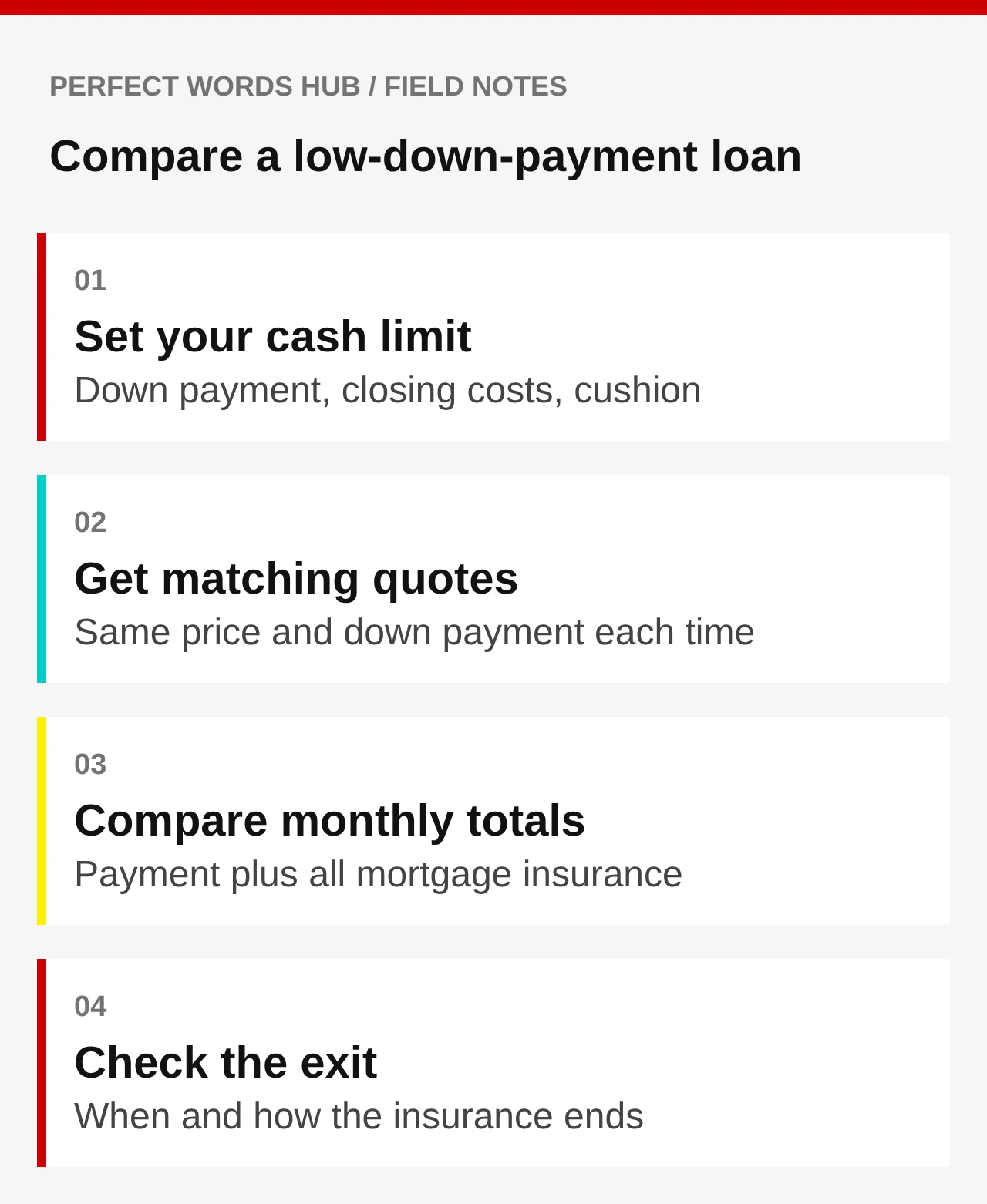
- Ask each lender for the same house price, the same down payment, and the insurance numbers in writing. Then decide how long you realistically expect to keep the loan.
You have the savings for a small down payment. Now what?
Say you have found a house at $300,000 and you have a little over $15,000 set aside. That is 5%, nowhere near the 20% people mention at family dinners. The question is no longer whether you can buy. It is which kind of loan turns that smaller down payment into the lower total cost.
Two loan families dominate the answer. An FHA loan is insured by the Federal Housing Administration, which is part of HUD. A conventional loan is not government-insured, and when the down payment is small it is usually paired with private mortgage insurance, or PMI, bought through the lender. The CFPB explains that mortgage insurance of any kind protects the lender, not you. If you fall behind, you can still lose the home.
So the real comparison is not “3.5% versus 5%.” It is what each path charges you for that insurance, what it does to your payment, and how and when it ends. This article walks through those pieces with arithmetic you can repeat on your own numbers.
Where mortgage rates sit right now
Freddie Mac’s Primary Mortgage Market Survey, released Thursday, October 15, 2026, put the average 30-year fixed-rate mortgage at 7.40%, unchanged from the week before. The 15-year fixed averaged 6.71%. A year earlier the 30-year average was 6.27%. Freddie Mac notes that the survey reflects rates offered over the prior Thursday-through-Wednesday window, so your own quote can land higher or lower depending on your credit, your down payment, the points you pay, and the lender.
That survey is a benchmark for conventional loans, not a quote for an FHA loan, and rates change every week. In the worked examples below I use 7.40% for every loan on purpose, so that the only things that differ are the down payment and the insurance. Swap in the rate from your own Loan Estimate. If you want to see what a rate like this does to a payment on its own, our walkthrough on what a 7.4% mortgage rate does to the monthly payment covers it.
What “low down payment” actually means
On its homeownership page, HUD says an FHA down payment can be as low as 3.5% of the purchase price. The CFPB’s planning guide for buyers adds that conventional loans backed by Fannie Mae or Freddie Mac can require as little as 3% down. Veterans, rural buyers, and some first-time buyers have other programs, including options with no down payment.
Notice what the minimum is a minimum of. It is the smallest check a program will accept, not the amount that makes the loan cheap. A smaller down payment means a bigger loan balance, more interest, and mortgage insurance. The CFPB says plainly that low-down-payment options can mean higher costs over the life of the loan, and suggests asking lenders to show you several choices side by side.
There is a second cash number buyers forget. The CFPB says closing costs typically run 2% to 5% of the purchase price, separate from the down payment. On a $300,000 house that is roughly $6,000 to $15,000. It also advises setting aside a cushion, often described as three to six months of expenses, before deciding how much cash can go into the house. Our closing cash checklist lists every item to expect.
Two kinds of mortgage insurance, two sets of rules
With a conventional loan, private mortgage insurance rates vary by down payment and credit score. The CFPB says PMI is generally cheaper than FHA for borrowers with good credit, and that most PMI is paid monthly with little or nothing due at closing. Borrowers with weaker credit can see much higher quotes, because the price follows the lender’s risk.
FHA works differently. Its mortgage insurance is required on every FHA loan, goes to the FHA, and, according to the CFPB, costs the same regardless of your credit score, with only a slight bump for down payments under 5%. That flat pricing is why FHA often looks better to buyers with lower scores and worse to buyers with strong ones.
FHA insurance has two parts. The first is an upfront premium paid at closing. If you do not have the cash, you can roll it into the loan, which raises the balance and the lifetime cost. The second is an annual premium, billed monthly with your payment. Conventional PMI has no standard upfront part, though it can be offered that way, and a lender-paid version exists. The CFPB cautions that “lender-paid” or “no PMI” offers are not free; they usually come with a higher interest rate.
The FHA price list, from HUD’s own letter
HUD set the current structure in Mortgagee Letter 2023-05, effective for FHA case numbers on or after March 20, 2023. It keeps the upfront premium at 1.75% of the base loan amount. It also lowered the annual premium. For a 30-year loan at or under the letter’s base-loan threshold of $726,200, the annual rate is:
| Down payment (loan-to-value) | Annual premium | How long it lasts |
|---|---|---|
| 10% or more (LTV 90% or less) | 0.50% | 11 years |
| 5% to under 10% (LTV above 90% up to 95%) | 0.50% | Life of the loan |
| Under 5% (LTV above 95%) | 0.55% | Life of the loan |
Read the last column twice. A buyer who puts down 10% or more gets an FHA premium that ends after 11 years. A buyer who puts down 3.5% to 9.99% pays for the whole mortgage term, unless the loan ends sooner through a sale or payoff. Because HUD can change these numbers, treat the table as a snapshot of that letter and confirm current rates with your lender before relying on them.
One more detail, from HUD’s model comparison form: the monthly premium is calculated on the average principal balance each year, so it shrinks slowly as you pay the loan down.
A $300,000 house, three ways, at 7.40%
Here is the arithmetic for a 30-year loan at 7.40% on a $300,000 purchase. These are principal, interest, and mortgage insurance only. Taxes, homeowners insurance, and any HOA dues come on top, which is why we separately cover what the monthly mortgage number leaves out.
| FHA, 3.5% down | Conventional, 5% down | Conventional, 20% down | |
|---|---|---|---|
| Cash for down payment | $10,500 | $15,000 | $60,000 |
| Starting loan | $294,566 (includes $5,066 upfront premium) | $285,000 | $240,000 |
| Principal and interest | about $2,040 | about $1,973 | about $1,662 |
| Monthly mortgage insurance | about $133 (0.55% a year on $289,500) | about $143 if PMI is quoted at 0.6% a year (an assumption) | none |
| Approximate monthly total | about $2,172 | about $2,116 | about $1,662 |
The PMI line is an assumption, not a published price. Real PMI quotes move with credit score and down payment, and they can be lower or much higher than 0.6%. The point of the table is the shape. The FHA buyer needs about $4,500 less cash than the 5%-down conventional buyer and pays roughly $56 more a month in this example. The 20%-down buyer needs far more cash and pays roughly $450 to $510 less each month.
Run the same numbers with a higher credit score and a quote of 0.3% a year, and PMI drops to about $71 a month; the conventional path then looks clearly cheaper than FHA. Run them with a weaker score and a PMI quote of 1% a year, about $238 a month, and FHA wins. This is why a single article cannot tell you which loan is cheaper. Your quotes can.
How the insurance ends, and why that matters
For conventional loans, federal rules give you a clear way out. The CFPB explains that you can ask your servicer in writing to cancel PMI once your balance is scheduled to reach 80% of the home’s original value, provided you are current, have no second mortgage on the home, and can show the property has not lost value. The servicer must end PMI automatically when the balance is scheduled to reach 78% of the original value, as long as you are current. There is also a backstop at the midpoint of the loan term. These rules cover single-family primary residences with mortgages that closed on or after July 29, 1999, and the CFPB notes that FHA and VA loans follow different requirements.
Apply that to the 5%-down example. With a $285,000 loan at 7.40%, the scheduled balance reaches $240,000 (80% of $300,000) in about 11 years and 3 months, and $234,000 (78%) in about 12 years and 3 months. Extra principal payments can bring that date forward. The CFPB’s toolkit points out that prepaying may let you cancel mortgage insurance early, though you should first check whether your loan has a prepayment penalty.
On FHA, the end date is fixed by the table above. With under 10% down, the premium runs for the loan’s full term. In practice, ending it means selling, paying off, or refinancing the loan, and your servicer can tell you what applies to yours. For the 3.5%-down example, a rough calculation puts premiums over the first 11 years at about $16,600, and the premium keeps going after that. If you expect to stay put for 20 years, that tail is part of the price.
Down payment help, and the paperwork it can bring
HUD notes that state and local governments run programs that can help with a down payment, and it points buyers to a state-by-state directory. The CFPB’s planning guide also says a program through your state, local government, or a nonprofit may be available, and suggests contacting a local housing counselor. You can find HUD-approved counselors through the CFPB’s directory at consumerfinance.gov/find-a-housing-counselor or by phone at (800) 569-4287.
Programs differ widely in what they give and what they ask for in return. Some come as grants, others as loans with their own terms and conditions. Ask whether the assistance must be repaid, whether it is recorded as a second loan on the property, whether it has income limits or a required class, and what happens if you sell or refinance. A CFPB page on the “total of payments” figure adds one practical wrinkle: a subordinate loan through certain homebuyer assistance programs may come with Truth in Lending disclosures rather than a standard Loan Estimate, so check the paperwork carefully.
Also tell your lender early. Assistance often has to line up with the loan type, and it can change what the lender needs to document. Do not assume that a program available at one lender is accepted by another.
Five questions to ask before you pick
Bring this list to every lender and write the answers down. Use the same house price and down payment so you can line the offers up the way our guide to comparing Loan Estimates suggests.
- What are the interest rate, the monthly mortgage insurance, and any upfront mortgage insurance, as separate lines on the Loan Estimate?
- If I roll the upfront premium into the loan, what is my starting balance and how much does that add to my payment?
- On this loan, when does mortgage insurance end, and what do I have to do to make that happen?
- If I improve my credit score before closing, does the price change, and by how much? (Under the CFPB’s description, this matters for PMI and not for FHA premiums.)
- How much cash will I have left after the down payment and closing costs, and does it leave a cushion?
If both FHA and conventional financing are available to you, ask for the lender’s written comparison. HUD’s model Informed Consumer Choice Disclosure, tied to Section 203(f) of the National Housing Act, exists to help borrowers compare the costs of an FHA-insured mortgage against similar conventional mortgages. HUD notes that lenders are not required to use its sample form, and its sample numbers are illustrative only. The sample’s monthly premium line works out to a higher rate than the 0.55% in the 2023 letter, so rely on the figures your own lender gives you.
Keep the decision honest
No loan is the “best” in the abstract. FHA tends to help buyers whose credit scores would make private insurance expensive, and buyers who need the smallest possible down payment. Conventional loans tend to reward buyers with stronger credit and a bit more cash, and they offer an exit from insurance once equity builds. A bigger down payment improves almost everything, but not at the cost of emptying the account that has to cover a broken furnace in month two.
Two final habits help. First, compare totals over a time horizon that matches your life: five years, ten years, and the full term. Second, treat any figure in an article, including this one, as a reference point. Rates, premiums, and program rules change, and your own quote is the number that counts. Talking with a HUD-approved housing counselor before you apply can help you catch a mismatch early.
Sources & further reading
- Freddie Mac: Primary Mortgage Market Survey (released October 15, 2026)
- HUD: Mortgagee Letter 2023-05, FHA annual mortgage insurance premium
- HUD: Model Informed Consumer Choice Disclosure Notice
- CFPB: What is mortgage insurance and how does it work?
- CFPB: When can I remove private mortgage insurance from my loan?
- CFPB: Figure out how much you want to spend (down payment planning)
Source links checked October 17, 2026. Rules, rates and product terms can change.
General real estate and mortgage education, not financial or legal advice. Rates change often; confirm current terms with licensed lenders.