
The useful part, up front
- COBRA lets you keep the exact plan you had, but you generally pay the full premium plus up to 2 percent. You get at least 60 days to elect it and at least 45 days after electing to make the first payment.
- A Marketplace plan is a separate option with its own 60-day window after you lose job-based coverage. Your savings depend on your expected income for the coverage year, not on whether you have a job.
- Dropping COBRA on your own, or simply stopping payment, generally does not open a new Marketplace window. Decide with the dates in front of you before you pay anything or cancel anything.
The letter arrives after the news, and the clock is already running
You are told your last day is the end of the month. Somewhere in the same stack of paperwork is a line about health coverage, usually vague, usually promising a notice later. Your head is on severance, on the résumé, on how to tell your family. Health insurance feels like a problem for next week.
It is a problem for this week, mostly because of how many separate deadlines hang off one event. The federal Department of Labor describes COBRA continuation coverage as a right to keep your job-based group health coverage for a limited time, usually at your own expense. HealthCare.gov describes a separate right to enroll in a Marketplace plan when you lose job-based coverage. The two are not sequential steps. They overlap, and each one has its own deadline.
The goal of this guide is simple: lay the deadlines on one calendar, show how the costs are built so you can compare them fairly, and flag the choices that cannot be reversed. It is general education, not advice for your situation. Your plan documents and the official pages in the source list are what govern.
What COBRA is, and who gets it
COBRA stands for the Consolidated Omnibus Budget Reconciliation Act. In practice it means that when certain events end your group coverage, the plan must offer you the chance to continue it. Qualifying events for an employee include losing the job for any reason other than gross misconduct, and a cut in hours that causes you to lose coverage. Spouses and dependent children can also qualify, and they can elect COBRA even if the employee does not.
The law generally applies to group health plans at private employers that had at least 20 employees on more than half of their typical business days in the previous year, and to most state and local government plans. Part-time workers count as fractions toward that 20. It does not apply to federal government plans or to churches and some church-related organizations. If you worked for a smaller employer, many states have similar rules, often called mini-COBRA. The Labor Department points people to their state insurance commissioner to find out what exists locally.
What you get is the same plan. Continuation coverage must match what similarly situated active employees have, so your doctors, copays, deductibles, claims process, and appeal rights stay as they were. If the employer changes the plan for current staff, the change applies to you too. For anyone mid-treatment, that continuity is the main attraction.
Some plans start COBRA from the date you elect it. Others make it retroactive to the day coverage ended. The plan rules decide, so read the election notice rather than assuming.
What COBRA really costs, with the arithmetic
Here is where people get surprised. While you were employed, your paycheck showed only your share of the premium. Your employer paid the rest, and you never saw that number. Under COBRA, you may be charged the whole thing, plus a small administrative margin. The Department of Labor says the premium cannot exceed 102 percent of the plan’s total cost of coverage, which means your old share, the employer’s old share, and 2 percent on top.
Take a hypothetical household with family coverage. Payroll deductions were $400 a month and the employer paid $1,350. The total cost is $1,750. At the 102 percent ceiling, COBRA would be $1,750 × 1.02 = $1,785 a month. That is $21,420 over twelve months, compared with $4,800 you were paying through payroll. The numbers are invented, but the shape is real: the same plan can feel like it quadrupled in price when it did not change at all.
There are two ways this can come out better. Some employers agree to pay part or all of COBRA as part of a severance package. That is not required, but it is worth asking about, and the Labor Department notes that if you get such an arrangement you should tell the plan administrator how it affects payment. And a third party is allowed to pay on your behalf. Check the election notice for the actual monthly figure, because it is the number you will compare everything else against.
One more cost rule: premiums can rise during COBRA if the plan’s cost rises, or if you change coverage options or add a dependent. Ask how and when the plan reprices.
The three COBRA clocks: 60, 45, and 30
COBRA has three time limits that people routinely blur together. Separating them prevents the most common mistake.
- Election: at least 60 days. After the plan receives notice of your qualifying event, it must send an election notice within 14 days. Your 60-day window to choose runs from the later of the date that notice is provided or the date you would otherwise lose coverage.
- First payment: at least 45 days after you elect. You do not pay at the moment you elect. The plan must give you at least 45 days to make the first payment, and if you miss it, the plan can end COBRA. Coverage may not be active until that first premium is in.
- Each later payment: a 30-day grace period. Plans must give you a 30-day grace period each month. The plan does not have to send a bill, so you owe the payment on schedule even if no statement arrives. Falling short of the full amount by the end of the grace period can end coverage.
If you waive COBRA during the election period, you can change your mind by revoking the waiver, as long as it is still inside the 60 days. That matters if you decline in a rush and then a doctor’s appointment turns up.
To see how the dates stack, take a worker whose coverage ends October 31 and whose election notice is dated November 10:
| Step | Date in this example | How it is counted |
|---|---|---|
| Coverage ends | October 31 | Last day of job-based coverage |
| Election notice provided | November 10 | Plan has 14 days after being told of the event |
| COBRA election deadline | January 9 | 60 days from the later date (the notice), not from October 31 |
| Marketplace deadline for the loss-of-coverage window | December 30 | 60 days from the day coverage was lost |
Look at the gap between those last two rows. The COBRA deadline falls after the Marketplace one. Waiting to decide on COBRA does not extend your Marketplace window.
The Marketplace route: separate application, separate 60 days
HealthCare.gov says you can enroll in a Marketplace plan if you lost qualifying job-based coverage within the past 60 days, or if you expect to lose it within the next 60 days. Having an offer of COBRA does not stop you from applying. The Department of Labor says the same: you can apply for Marketplace coverage even if you are eligible for COBRA, and you must select a plan within 60 days of losing your job-based coverage.
Because the window opens up to 60 days before the coverage ends, someone with a known last day can start comparing early. You may be asked to send documents confirming the loss of coverage, and HealthCare.gov warns that without acceptable documents you will not qualify for the Special Enrollment Period. A termination letter from the employer or an insurer’s end-of-coverage notice is the usual kind of proof. Keep copies.
There is also a calendar wrinkle this fall. Marketplace open enrollment for 2027 coverage runs November 1 through January 15. Someone who loses coverage in late October or November is therefore in both worlds at once: the loss-of-coverage window and the regular enrollment period. Our open enrollment checklist for 2027 walks through the plan-comparison steps, and they apply the same way here. The thing to check is the coverage start date of whatever you pick, so there is no uninsured stretch between the old plan ending and the new one beginning.
If you are eligible for Medicaid or CHIP, HealthCare.gov says you can enroll any time and coverage can start immediately. It also advises waiting for a final eligibility decision before ending COBRA, which is sensible: do not cancel one thing until the other is confirmed in writing.
How Marketplace savings are figured when your income is in flux
HealthCare.gov states that savings and eligibility are based on your household size and your estimated income for the year you need coverage, not on your employment status. That is useful and slightly counterintuitive. Being unemployed does not by itself qualify you for anything, and having had a high salary earlier in the year does not disqualify you.
The calendar year is what counts. If you are enrolling for coverage that starts in 2026, your estimate covers all of 2026, including the paychecks you already received. Suppose you earned $5,000 a month for ten months, which is $50,000, got $10,000 in severance, and expect $450 a week in unemployment benefits for 16 weeks, which is $7,200. Using the categories HealthCare.gov lists as counted income, such as taxable wages and unemployment compensation, a rough estimate for 2026 would be $50,000 + $10,000 + $7,200 = $67,200. That is the figure to work from for 2026, not $0 and not your current weekly benefit multiplied out.
For coverage starting in 2027, you estimate your 2027 income instead, and that depends on your job search. HealthCare.gov notes that if you are unsure about affording coverage, you should apply first to find out whether you qualify for a Marketplace plan with savings, Medicaid, or CHIP. It also says to make the best estimate you can, because a poor one can leave you owing money when you file your federal tax return. You can update the application when your income changes, for example when you start a new job.
HealthCare.gov also publishes a note that 2027 income levels and savings amounts arrive on November 1, and suggests using 2026 amounts for a rough idea before then. Treat any early number as a placeholder.
Side by side: the questions that decide it
Neither option is better in the abstract. They trade continuity for price flexibility. Put the specific numbers for your household in a table like this and answer each row honestly.
| Question | COBRA | Marketplace plan |
|---|---|---|
| Plan and network | Same plan you had | New plan, new network and drug list |
| Monthly price | Up to 102% of the plan’s full cost | Varies by plan, income and household |
| Help with cost | Only if a former employer or another party pays | Possible premium savings based on estimated income |
| How long | Usually up to 18 months, longer in some cases | Ongoing, with yearly re-enrollment |
| Enrollment window | At least 60 days to elect | 60 days from losing coverage, or open enrollment |
Two practical checks decide a lot of cases. First, if you are in the middle of care, such as a pregnancy, a course of treatment, or a surgery you have scheduled, compare the specific providers and drugs against any new plan before giving up the old one. Our network checklist covers how to confirm that a doctor, a drug and a facility are in a plan. Second, ask what the total yearly picture looks like, not only the monthly premium. Our guide on total health plan cost shows how deductibles and out-of-pocket maximums change the answer.
Deductibles deserve a note. Because COBRA is the same plan, the dollars you have already spent this year toward the deductible are generally part of the same plan year, but confirm with the administrator. A new Marketplace plan is a new plan with its own deductible, so a switch in the last months of the year can mean starting over just before the calendar resets anyway.

Other doors that may be cheaper than either
The Labor Department lists alternatives to take seriously before you elect anything. Losing job-based or COBRA coverage can open a special enrollment period for another employer group plan, such as a spouse’s plan, a parent’s plan if you are under 26, or an employer plan of your own. The catch is the clock. The Labor Department says you usually have only 30 days from the day you lose coverage to request this special enrollment, and coverage generally starts the first day of the month after your request. A 30-day window is shorter than either of the others, so ask a spouse or parent’s benefits office right away.
Medicaid and CHIP can be options if household income is low enough, and the Marketplace application screens for them. Medicare may apply if you are 65 or older. There is a trap here that catches people close to retirement. Medicare says COBRA is not considered group health plan coverage for the purpose of its Special Enrollment Period, and getting COBRA does not change when that period ends. For Part B, the window after employer coverage or employment ends is generally eight months. Someone planning to ride out COBRA before enrolling in Medicare can face late-enrollment problems. If you are close to Medicare age, read Medicare’s sign-up rules for your situation, and see our Medicare open enrollment guide for how the plan choices work once you are enrolled.
HealthCare.gov adds that people who do not qualify for savings based on household income may be able to get a catastrophic plan and pair it with a health savings account. Eligibility rules apply, so check the details on the site.
Mistakes that cannot be undone
A few errors are costly mainly because the fix is not available.
- Ending COBRA early to switch. HealthCare.gov says that if you choose to end COBRA before it runs out, you generally have to wait until the next open enrollment to get Marketplace coverage, unless another qualifying life event happens. Dropping voluntarily, or just stopping the premium payments, does not count as losing coverage for this purpose.
- Treating an unpaid first premium as a pause. The 45-day first-payment window is real, but if it passes without payment the plan can end COBRA. You then have neither option, because the election period alone does not keep the coverage alive.
- Confusing the clocks. People often assume one 60-day period covers everything. The COBRA election deadline, the Marketplace deadline, and a spouse’s plan deadline each start from different events and end on different dates.
- Underestimating income on the Marketplace application. A low estimate can raise your savings now and cost you at tax time. Make the best honest estimate and revisit it.
- Skipping the paper trail. Save the termination notice, the COBRA election notice with its mailing date, proof of payment, and your Marketplace confirmation.
A one-week plan
If you are in the first days after the news, this order keeps the important dates visible.
- Write down your last day of coverage, not your last day of work. They are not always the same.
- Ask the benefits contact for the COBRA election notice and the exact monthly cost for each family member. Ask whether the severance includes any payment toward premiums.
- Check the spouse or parent plan route and the 30-day request window first, since it expires soonest.
- Estimate your household income for the year you need coverage, then run a Marketplace application to see whether you qualify for savings, Medicaid, or CHIP.
- Compare the actual doctors, drugs and likely yearly costs, not just the premiums.
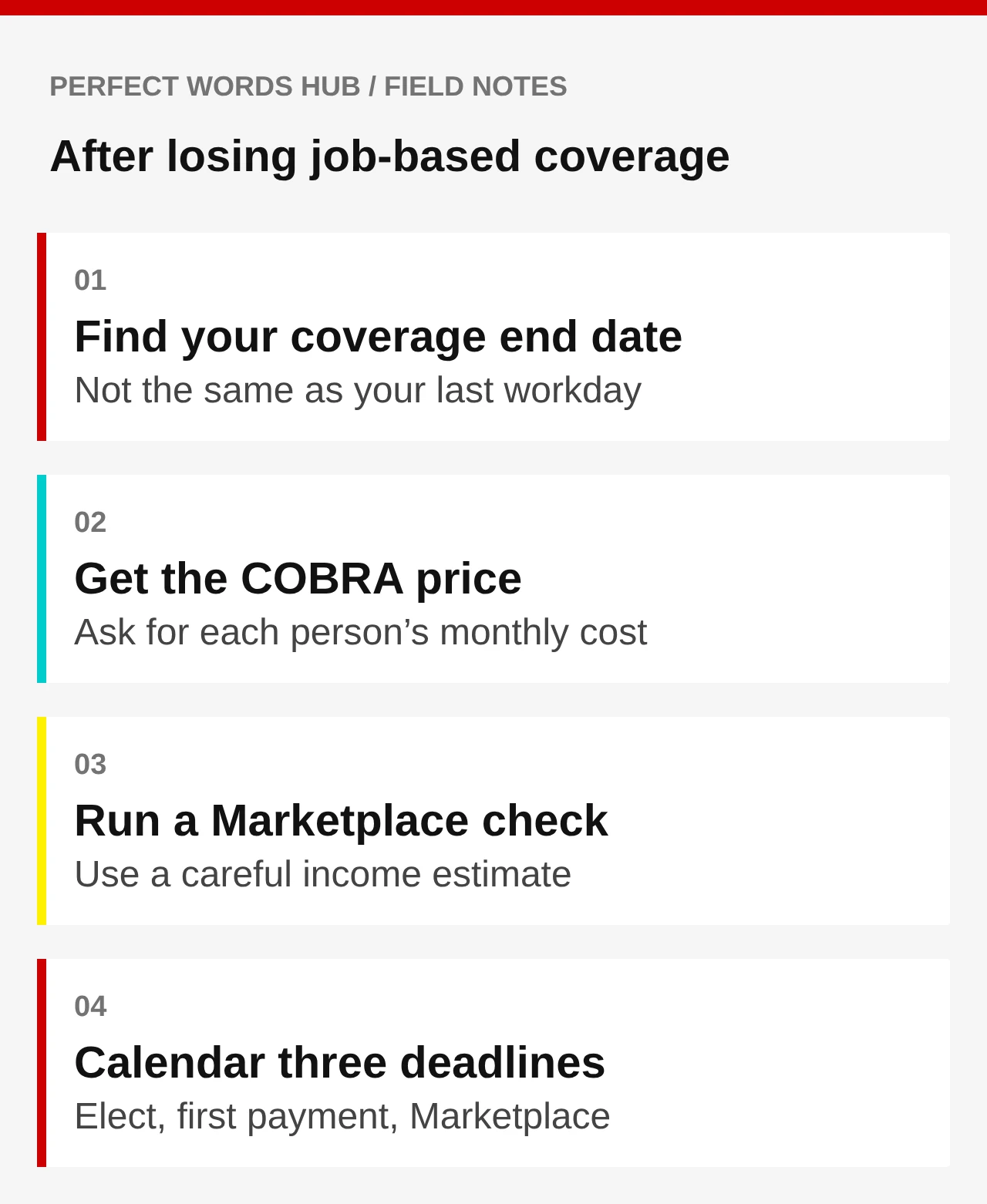
- Put three dates on a calendar: the COBRA election deadline, the first-payment deadline if you elect, and the Marketplace deadline.
- Do not cancel the old coverage until the new coverage is confirmed with a start date.
If an employer or plan administrator does not send a notice, or you think you were wrongly denied COBRA, the Labor Department’s Employee Benefits Security Administration offers help at 866-444-3272. If a Special Enrollment Period is denied and you believe you qualify, HealthCare.gov says you can appeal.
A layoff takes enough from you already. This is one of the few parts of it where a calm calendar and a few phone calls protect real money.
Sources & further reading
- U.S. Department of Labor: A Worker’s Guide to Health Benefits Under COBRA
- U.S. Department of Labor: COBRA Continuation Coverage
- HealthCare.gov: COBRA coverage when you’re unemployed
- HealthCare.gov: Health coverage options if you’re unemployed
- HealthCare.gov: Special Enrollment Periods
- HealthCare.gov: How to estimate your expected income
Source links checked October 17, 2026. Rules, rates and product terms can change.
General health insurance education, not medical, legal or individual insurance advice. Your plan documents and applicable law control coverage; confirm details with your insurer.