
The useful part, up front
- Medicare open enrollment runs October 15 through December 7, 2026. Changes you make take effect January 1, 2027, and the plan must receive your request by the deadline.
- Plans change every year. Your premium may hold steady while your drug list, pharmacy network, or doctors’ participation changes, so the comparison is about your own medications and providers, not national averages.
- Official help is free: Medicare.gov, 1-800-MEDICARE, and your State Health Insurance Assistance Program. Medicare will never call you to sell you something.
You probably already have the paperwork
Sometime in September, a thick envelope from your Medicare plan likely arrived. It is called the Annual Notice of Change, and it explains what will be different about your plan in January: costs, coverage, and other details. Medicare says plans send it each fall, and the booklet on Medicare Advantage plans describes it as usually mailed by September 30, followed by a longer document called the Evidence of Coverage by October 15. If nothing showed up, call your plan and ask for it.
Many people toss that mailing because the plan “looked fine” last year. That is the trap. A plan can keep the same name and the same monthly premium while it drops a medication from its list, moves a drug to a more expensive tier, or loses a hospital or specialist group from its network. The notice is the plan’s own admission of what is changing, so it is the best first read you will get.
CMS, the agency that runs Medicare, says that if you are happy with your current coverage you generally do not need to re-enroll. That is true, and staying put is a legitimate choice. The point of open enrollment is that it should be a choice, not a default you slid into.
What you can and cannot do between October 15 and December 7
Open enrollment is the one stretch of the year when the widest set of changes is allowed. Medicare.gov lists what it covers: you can join, drop, or switch a Medicare Advantage Plan, with or without drug coverage; you can move from Original Medicare to Medicare Advantage or back; and if you have Original Medicare you can join, drop, or switch a stand-alone Part D drug plan.
The deadline matters in a specific way. The plan has to receive your request by December 7, so a paper form that is mailed on December 6 may not count. Whatever you choose during this window starts January 1 of the following year.
| Window | Dates | Who it is for |
|---|---|---|
| Open Enrollment | October 15 to December 7 | Most people with Medicare; broad switching allowed |
| Medicare Advantage Open Enrollment | January 1 to March 31 | Only people already in a Medicare Advantage plan |
| Special Enrollment Period | Varies | Life events such as moving, losing coverage, or gaining Medicaid or Extra Help |
Read the January window carefully. If you are in a Medicare Advantage plan and discover in February that you made a poor choice, you can switch to another Medicare Advantage plan or go back to Original Medicare, and add a drug plan if you do. If you have Original Medicare with a stand-alone drug plan, that January window does not apply to you. For you, the fall is the main opportunity.
What CMS says is changing for 2027
On September 28, 2026, CMS published its 2027 outlook for Medicare Advantage and Part D, and it describes things as stable. The headline figures are averages, which is exactly why they should be read as a backdrop and not as a prediction for your plan.
- The average monthly premium for Medicare Advantage plans, weighted across all plans, is projected to drop from $14.37 in 2026 to $12.00 in 2027.
- The average monthly premium for stand-alone Part D plans is projected to rise from $35.09 to $36.
- For Medicare Advantage plans that include drug coverage, the average Part D portion of the premium is projected to fall from $11.32 to $7.
- CMS expects roughly 5,532 Medicare Advantage plans nationally, compared with 5,553 this year, and says about eight in ten Medicare Advantage members can stay in their current plan with the same or a lower premium.
CMS also notes that a Part D premium stabilization demonstration, narrowed for 2026, is planned to end in 2027. You do not need to understand the mechanics. What matters is that the people who run the program say some prices may move, and that stand-alone drug plan premiums are heading modestly upward on average.
An average is a poor guide to your situation. If you take one brand-name medication, a plan with a low premium and a high price for that drug can cost more over twelve months than a plan with a higher premium and a lower drug price. Which brings us to the math.
The Part D numbers worth knowing
Medicare.gov lists the 2027 Part D rules this way. No drug plan may have a deductible above $700 in 2027, up from a $615 maximum in 2026, and some plans have no deductible at all. After you meet the deductible, you generally pay 25 percent of the cost of covered drugs until your out-of-pocket spending reaches $2,400 in 2027, up from $2,100 in 2026. After that, you pay nothing for covered Part D drugs for the rest of the calendar year. Payments made on your behalf, such as through Extra Help, count toward that limit.
Here is what that looks like using the standard design and a plan with the maximum deductible. Your plan may set its own copayments, so treat this as a map and not a quote.
- If your covered drugs cost $3,000 for the year, you pay the $700 deductible, then 25 percent of the remaining $2,300, which is $575. Your total is $1,275, before premiums.
- To hit the $2,400 limit, 25 percent of the amount above the $700 deductible has to equal $1,700. That means $6,800 more in drug costs, or about $7,500 in total drug spending for the year.
- Anyone whose drug costs reach that level pays no more for covered drugs for the rest of the year, though the premium continues.
The cap is helpful, but it does not erase the need to compare. Reaching the cap still means paying real money along the way, and many people never get near it. For them, the differences between plans in deductibles, copayments, and which pharmacies count as preferred are what move the annual total.
If large bills early in the year worry you, Medicare.gov describes the Medicare Prescription Payment Plan, which spreads your out-of-pocket drug costs across the calendar year. It does not lower what you owe. If you reached $2,400 and spread it evenly over twelve months, that is roughly $200 a month, which can make a cash-flow problem easier but does not change the total.
How to use Plan Finder so the results mean something
Medicare.gov/plan-compare is the official tool. It only works as well as the information you put in, and the single most common shortcut, skipping the medication list, produces numbers that are close to useless. Medicare’s own instructions say to enter all of your regular prescriptions for the most accurate cost estimates.
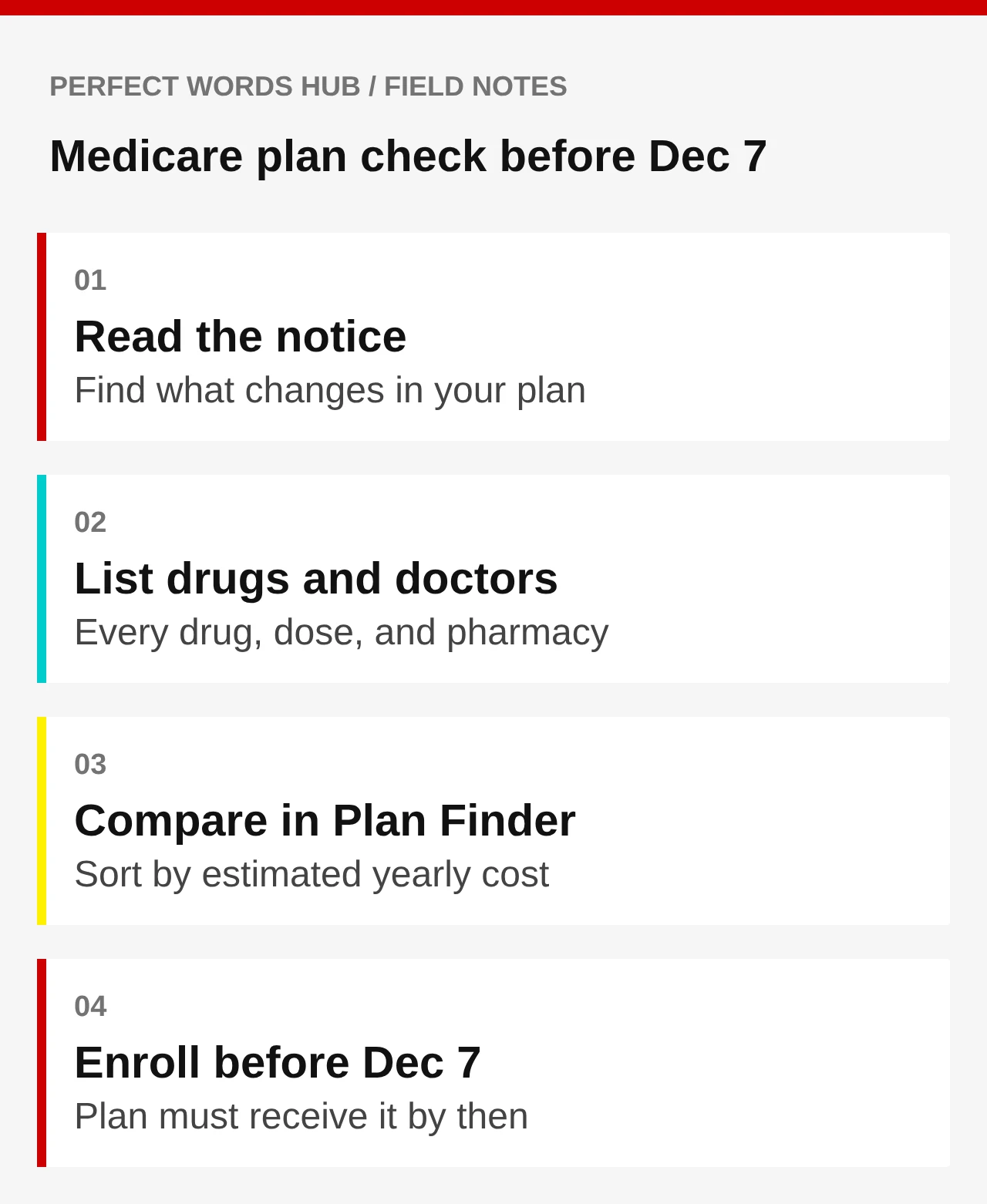
- Gather your medications. Pull every prescription bottle, including the dose and how often you take it. Add the pharmacy you use, and a second one if you ever switch.
- Enter every drug. Choose the exact strength and the quantity per fill. A 30-day supply and a 90-day supply can price differently.
- Compare the estimated yearly cost, not only the monthly premium. The tool estimates your annual total from premiums, deductibles, and drug costs. Sort by that figure first.
- Look at the plan’s details. Confirm your doctors, specialists, and pharmacies are in network, and review the referral and prior authorization rules before you decide.
- Save your result. Write down the plan name and the number of your current plan so you can tell whether staying put really is the cheapest choice.
CMS also says Medicare.gov has added secure sign-in options, ways to search for and save providers, and, from October, more preventive service details and messages about 2027 plan changes. A saved list of your doctors and drugs makes a second comparison next year far faster.
Original Medicare or Medicare Advantage: the trade-offs in plain terms
This is the biggest decision in the process, and it is not primarily about price. The government’s booklet on Medicare Advantage lays out the differences, and the contrasts are practical.
| Question | Original Medicare | Medicare Advantage |
|---|---|---|
| Doctor choice | Not tied to a plan network | Plans may require network doctors, hospitals, and suppliers for non-emergency care |
| Advance approval | Usually not required | May be required for certain services, supplies, or drugs |
| Yearly cap on covered costs | None, unless you have supplemental coverage such as Medigap | Plans set a yearly limit on Part A and Part B services; it varies by plan |
| Drug coverage | Join a separate Part D plan | Most plans include it; HMO and PPO plans without it do not allow a separate drug plan |
| Extra benefits | Not part of the plan structure | Vision, hearing, dental, or fitness may be offered, sometimes at an added cost |
Medigap, or Medicare Supplement Insurance, works only alongside Original Medicare. The booklet says it is illegal for someone to sell you a Medigap policy while you are in a Medicare Advantage plan, unless you are switching back to Original Medicare, and that Medigap cannot pay your Advantage copayments or premiums. If you already have a Medigap policy and join a Medicare Advantage plan, you may want to drop the Medigap policy, but dropping it may mean you cannot get the same policy back later.
For people trying Medicare Advantage for the first time, Medicare describes a 12-month trial right. If you are unhappy, you can return to Original Medicare within 12 months and buy a Medigap policy and a separate drug plan. Some states add more protection, so ask your State Insurance Department before relying on any assumption about switching back.
Neither route is wrong. The plan that suits a person who travels for months at a time, or who has a longstanding relationship with a specialist outside a local network, may not suit someone who lives near a hospital system that most plans include. The right answer comes from your doctors, drugs, travel habits, and tolerance for approval steps.
Check the network, then check it again
A plan’s provider directory can lag behind reality, and an out-of-network visit usually costs more, or may not be covered. Before you commit, search for each of your doctors, your hospital, and any facility you use regularly, such as a dialysis center. Then call the doctor’s billing office and ask whether they will be in the specific plan, by its full name, next year.
Our guide on checking the doctor, the drug, and the details walks through those questions in order, and works for Medicare plans as well as other kinds.
If you are moving between Original Medicare and an Advantage plan, ask about prior authorization too. When a plan denies advance approval, the booklet notes you may be responsible for the full cost of the service. If a denial does happen, turning a denial into next steps shows what to gather and where to start the appeal.
Go beyond doctors. Check how the plan prices your pharmacy, and whether a mail-order option changes the price for medications you take every month.
Penalties, premiums, and help paying for them
If you go without Part D or other creditable drug coverage for a stretch after you first become eligible, you may owe a late enrollment penalty. Medicare.gov gives the formula: 1 percent of the national base beneficiary premium, multiplied by the number of full months you went without coverage, rounded to the nearest ten cents, added to your monthly premium. The base premium is $38.99 in 2026. As an example, 14 uncovered months works out to a 14 percent penalty, or about $5.50 a month using the 2026 base figure ($38.99 times 0.14 is $5.46, rounded to $5.50). The 2027 base premium will differ, so the dollar figure will change.
Medicare.gov says you generally keep paying the penalty for as long as you have Part D coverage, even if you switch plans, and that people with Extra Help do not pay it. That makes delaying drug coverage a poorer bet than it can appear.
If cost is the real obstacle, check whether you qualify for help. Medicare Savings Programs can help pay Medicare premiums and may cover deductibles and copayments. Extra Help assists with Part D premiums, deductibles, and coinsurance, and CMS says people enrolled in a Medicare Savings Program automatically qualify for Extra Help. Your state Medicaid office or Social Security can take applications.
The Part B premium, which most people pay on top of any plan premium, was $202.90 a month in 2026 with a $283 deductible. A 2027 figure was not yet listed on Medicare.gov’s costs page when this was written, so check that page before you total up the year.
Scams spike when the calendar does
Open enrollment is also a season for unwanted calls, mailers, and “free gift” offers. Medicare.gov is direct about it: Medicare will never call you to sell you anything or visit you at your home. It also advises that you not join a plan over the phone unless you called and asked for help.
Protect your Medicare number the way you would protect a card number. Review your statements, and call your provider if a charge looks wrong. To report suspected fraud, call 1-800-MEDICARE (1-800-633-4227), or report online through the Office of Inspector General. Plan members can also call the I-MEDIC at 1-877-772-3379.
Free, unbiased guidance does exist. State Health Insurance Assistance Programs, or SHIPs, offer counseling that is not tied to any insurer and can help you choose a plan, apply for Extra Help, or file a complaint. 1-800-MEDICARE is open around the clock, with live chat available too.
A realistic plan for the next two weeks
You do not need to do this all in one afternoon, but it helps to spread it over a week or two and leave a cushion before December 7.
- This weekend: find your Annual Notice of Change and read the pages on drug coverage, network changes, and premium. Circle anything that moves.
- Early next week: list your medications, doctors, and pharmacy. Run them through Plan Finder and note the three lowest estimated annual totals.
- Midweek: call your key doctors to confirm participation in the plans you are considering. If you want a second opinion, book a free SHIP appointment early.
- By late November: decide, then enroll through Plan Finder, by calling the plan, or by calling 1-800-MEDICARE. If you mail anything, send it early enough to arrive before the deadline.
- In December: keep your confirmation, and watch for your new plan’s welcome materials and member ID. Then verify the first claim in January.
If you decide to stay in your current plan, you are done. If you switch, you have until January to confirm everything works with your pharmacy and doctors, and, if you are in Medicare Advantage, the January 1 to March 31 window is there as a backstop. A careful hour now is worth more than a month of fixing problems later.
Sources & further reading
- CMS: Medicare Advantage and Part D expected to remain stable in 2027
- Medicare.gov: Joining a plan and enrollment periods
- Medicare.gov: What Part D plans cost
- Medicare.gov: Understanding Medicare Advantage Plans
- Medicare.gov: Annual Notice of Change
- Medicare.gov: Reporting Medicare fraud and abuse
Source links checked October 17, 2026. Rules, rates and product terms can change.
General health insurance education, not medical, legal or individual insurance advice. Your plan documents and applicable law control coverage; confirm details with your insurer.