
The useful part, up front
- The Social Security Administration announced a 3.6% cost-of-living adjustment (COLA) for 2027 on October 14, 2026. It first shows up in the benefits paid in January 2027, and SSA says the average retirement benefit rises by about $75 a month.
- The percentage is applied to your own benefit, not to the average. Multiply your current gross benefit by 1.036, then subtract anything that moves the other way: a Medicare Part B premium, income tax on benefits, and your own price increases. The 2027 Medicare premium had not been published in the sources I read, so plan around a range instead of a guess.
- Do the arithmetic now, watch for your official notice in December (or late November online), and treat any call, text or email about your “raise” that asks for personal information as a warning sign. SSA says it will never ask for that by text, email or social media.
The raise is official, and your budget has already moved
If you receive Social Security or SSI, you have probably seen the number by now: 3.6%. It was announced on October 14, 2026, the same morning the Bureau of Labor Statistics published the September price report that the formula depends on. For many households the first reaction is relief. The second reaction, a few days later, is a quieter question: will this actually cover what has gone up?
That question is worth answering with arithmetic rather than a mood. A percentage raise sounds large when it is announced and shrinks when it meets a Medicare deduction, a higher grocery bill or a tax bracket. None of that means the COLA is a bad thing. It means the headline is a starting point, and a few minutes with a calculator will tell you more than any news story about “the average retiree.”
This guide walks through where 3.6% came from, how to turn it into a dollar figure for your own check, why price reports and the COLA do not match exactly, and what can reduce the increase. It also covers the dates you should expect, a scam pattern that tends to appear in COLA season, and a short checklist you can finish in an evening. It is general education, not advice about your specific benefits. SSA, Medicare and the IRS can answer questions about your own record.
Where 3.6% comes from
The COLA is not a decision made in an office. It follows a formula set by law. SSA compares the average of a particular price index, the Consumer Price Index for Urban Wage Earners and Clerical Workers (CPI-W), for the third quarter of this year with the average for the third quarter of the last year a COLA took effect. The increase is rounded to the nearest tenth of a percent. If there is no increase, there is no COLA.
SSA publishes the inputs for this year. The third-quarter average in 2025 was 317.265. The third-quarter average in 2026 was 328.746. Divide the newer number by the older one and you get about 1.0362, an increase of roughly 3.62%, which rounds to 3.6%. The gap between the two averages is 11.481 index points, and 11.481 divided by 317.265 gives the same answer.
Two details matter for planning. First, the formula uses an average of July, August and September, not a single month. Second, it uses the CPI-W, which tracks the spending patterns of urban wage earners and clerical workers. That is a different group from many retirees, and a different basket from the broader index you hear about most often in the news. We will come back to why that matters.
For context, the COLA for 2026 was 2.8%. SSA announced it in October 2025 along with a note that the 2025 adjustment had been 2.5%. A 3.6% increase is therefore a larger step than either of the last two, although a year of price changes is still the thing it is measuring, not a reward or a bonus.
Turn the percentage into your own dollar figure
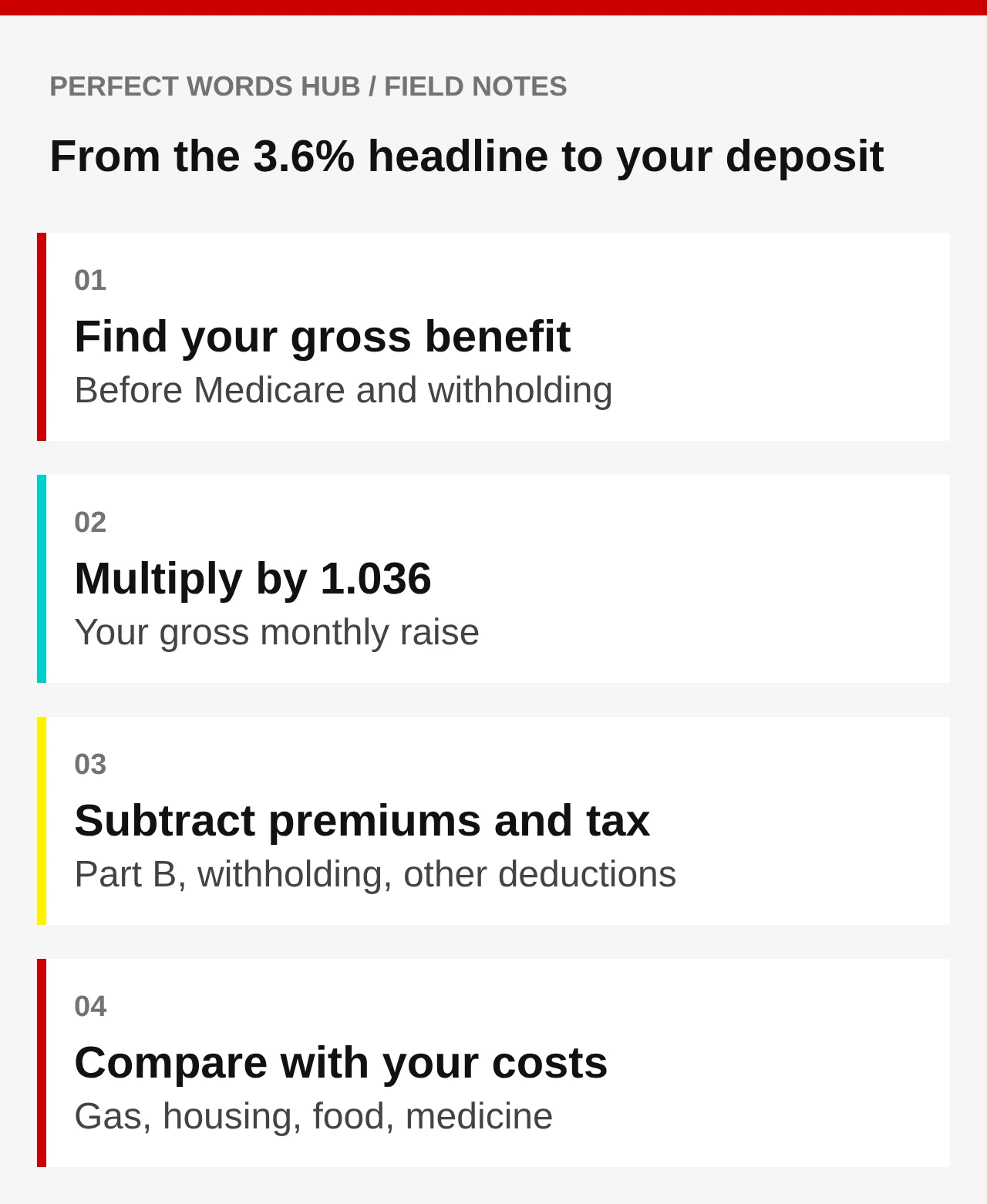
Start with your gross monthly benefit. That is the amount before anything is taken out, and it is the number SSA applies the percentage to. If you have an old award letter or your 2025 benefit statement, the gross figure is printed there. Your my Social Security account also shows it. Your bank deposit is usually a smaller number, because Medicare premiums and any tax withholding have already been subtracted.
Then multiply by 1.036. A gross benefit of $1,800 becomes $1,864.80, which is an increase of $64.80 a month or $777.60 over twelve months. A gross benefit of $1,200 becomes $1,243.20, an increase of $43.20 a month. A gross benefit of $2,600 becomes $2,693.60, an increase of $93.60. The percentage is the same for everyone, so the dollar change is larger for people who have a larger benefit.
| Gross monthly benefit now | After 3.6% | Monthly change | Yearly change |
|---|---|---|---|
| $1,200.00 | $1,243.20 | +$43.20 | +$518.40 |
| $1,800.00 | $1,864.80 | +$64.80 | +$777.60 |
| $2,200.00 | $2,279.20 | +$79.20 | +$950.40 |
| $2,600.00 | $2,693.60 | +$93.60 | +$1,123.20 |
SSA’s own figure for the average retirement benefit is an increase of about $75 a month. If you are well below or well above the average benefit, your number will differ, and that is expected. Rounding can leave your notice a few cents away from your own calculation.
If you also receive SSI, the same 3.6% applies to the SSI payment levels, and SSA says increased SSI payments begin on December 31, 2026. SSI recipients should read their notice carefully, since other income and living arrangements can change SSI amounts independently of the COLA.
Why a 3.6% raise and 3.9% inflation can both be true
Here is where a lot of the frustration comes from. On the same day, the Bureau of Labor Statistics reported that the CPI-W was up 3.9% over the 12 months ending in September, and the broader CPI-U was up 3.7%. So why is the raise 3.6%?
Because they measure different windows. The 12-month figure compares September 2026 with September 2025. The COLA compares the July to September 2026 average with the July to September 2025 average. If prices climb late in the quarter, the average catches only part of that climb. BLS reported that overall prices rose 0.6% in September alone, after 0.4% in August, with gasoline up 9.1% for the month. A jump near the end of a quarter shows up more fully in the next measurement period than in this one.
That does not mean something went wrong. The formula is built to be mechanical and predictable, and it will catch up if prices keep rising. If prices stop rising, a later COLA will be smaller. But it does mean that your household’s experience this winter can feel tighter than the raise suggests, especially for the categories that moved most.
The BLS release gives a few categories that are worth comparing with your own spending. Over 12 months, gasoline was up 34.2%, energy overall was up 20.4%, shelter was up 3.2%, and food was up 2.5%. The core index, which leaves out food and energy, was up 2.6%. Your personal inflation rate depends on what you buy. A retiree who barely drives and rents at a fixed price lives in a different price world from someone who commutes 40 miles a day.
A rough way to test this: take last year’s monthly spending in the big categories, apply each category’s increase, and add them up. If you spent $100 a month on gasoline last year and your usage has not changed, a 34.2% increase turns that into $134.20. That is $34.20 more each month from one line. A household with a $1,800 benefit receives $64.80 more from the COLA, so that single category could absorb more than half of the raise before groceries, utilities or a medicine bill are counted. Your own numbers will be different, which is exactly the reason to run them.
The Medicare deduction can eat part of the raise
If you are enrolled in Medicare Part B, your premium is usually taken straight out of your Social Security payment. That means the deposit you see is your gross benefit minus the premium, and when the premium rises, part of the COLA is used up before it reaches you. The standard Part B premium in 2026 is $202.90 per month, or more for people with higher incomes, and the annual deductible is $283, according to Medicare.gov.
The 2027 premium was not in the SSA announcement I reviewed. SSA says Medicare premium information for 2027 will appear in the my Social Security Message Center starting in late November, with mailed notices in December for people who have not signed up for online messages. Medicare.gov also posts yearly changes. Until then, treat any specific 2027 premium you see quoted as an estimate, not a fact.
To plan without guessing, use a simple range. Suppose your gross benefit is $1,800 and the Part B premium is $202.90. Your deposit before the raise, with no other deductions, is $1,597.10. After a 3.6% COLA the gross benefit is $1,864.80. If the premium were unchanged, the deposit would be $1,661.90, an increase of $64.80. If the premium rose by $15, to $217.90, the deposit would be $1,646.90, an increase of $49.80. If it rose by $30, the increase in your deposit would be $34.80. These premium changes are examples for arithmetic only, not predictions.
The point is that the answer to “how much more will I get” lies between the COLA and the COLA minus whatever the premium does. You will know the real figure once your notice arrives. If you are on a Medicare Advantage plan, Part D drug plan or a Medigap policy, those premiums may change too, and how each one is paid varies, so check each plan’s notice.
Dates and notices to expect
The 3.6% first applies to benefits for December 2026, which are paid in January 2027. For SSI, the higher payment begins on December 31, 2026. Your Social Security payments do not change before the January 2027 payment.
SSA says people with a my Social Security account can see their COLA notice online starting in late November, up to three weeks before the paper notice arrives. People who do not have an account need to create one and sign up for paperless notices by November 18, 2026 to see it that way. Everyone else should expect a paper notice in the mail in December.
If you want the notice early, consider whether paperless is a good fit for you. Online access gives you the figure sooner and puts your new gross benefit, your Medicare premium and any withholding in one place. If you prefer paper, that is a perfectly reasonable choice. Whichever you choose, keep the notice. You will need it to update your budget, and other programs you use may ask for proof of your current monthly income.
If your notice shows a figure that does not match your calculation by more than a few cents, check three things before calling. Did the notice list the gross amount or the net amount? Did your Medicare premium change? Did you change your tax withholding? Those three explain most differences.
Taxes: a bigger benefit can move you across a line
Whether any of your Social Security is taxable depends on your “combined income,” which the IRS describes as your modified adjusted gross income plus half of your Social Security benefits. The IRS says that, for returns covering 2025, the base amounts are $25,000 for a single filer and $32,000 for married filing jointly. Generally up to 50% of benefits can be taxable, and up to 85% can be taxable if combined income is above $34,000 (single) or $44,000 (joint). The IRS publication also covers other filing situations, so check Publication 915 for your own.
Here is why a COLA can matter. Imagine a single filer with a $24,000 yearly benefit and $15,000 of other income. Half the benefit is $12,000, so the starting figure is $27,000, which is already above the $25,000 base. After a 3.6% raise the benefit is $24,864, half of it is $12,432, and the figure becomes $27,432. The raise pushed that figure up by $432. The change in tax may be small, or it may be none, because the rules phase in gradually, but a raise can never lower this number.
If you have never owed tax on your benefits, run the quick check above with next year’s numbers. If you are close to a base amount, a COLA can be the thing that changes the answer. If you want to avoid a surprise at filing time, the IRS explains that you can choose to have federal income tax withheld from your benefits by completing Form W-4V. Many people prefer small, regular withholding to a single payment in April.
Your Form SSA-1099 shows gross benefits in box 3. That is the figure that matters for the tax calculation, not your bank deposit, which is lower once Medicare is subtracted.

If you are still working or have not claimed yet
The COLA touches more than current beneficiaries. If you work while receiving retirement benefits before full retirement age, the earnings test applies. For 2026, SSA says benefits are reduced by $1 for every $2 you earn above $24,480 if you are under full retirement age all year, and by $1 for every $3 above $65,160 in the year you reach it. The 2027 limits were not in the announcement I reviewed, so look for them on SSA’s COLA pages before you plan around a figure. Once you reach full retirement age, SSA recalculates your benefit to credit the months that were withheld.
If you are a worker rather than a retiree, there is one more COLA-linked change. SSA lists the contribution and benefit base, the amount of yearly earnings subject to Social Security tax, as $184,500 in 2026 and $192,300 in 2027. Most workers earn less than either figure and will not notice. People who earn more will pay Social Security tax on a larger slice of income next year.
If you have not claimed benefits yet, the COLA continues to apply as time passes, but the right claiming age depends on your health, your other income, your marital status and your work history. That is a decision to make with SSA’s retirement planner, not a rule of thumb.
A COLA-season scam pattern to watch for
Any time millions of people expect a letter, scammers write a lookalike. The version to watch for this season is a call, text or email that mentions your “new benefit amount,” asks you to “confirm your increase,” or says your payment will be paused unless you verify your identity. A link may take you to a convincing page that asks for your Social Security number or bank login.
SSA’s scam guidance lists the warning signs: unexpected contact asking for personal information or payment, a claimed problem or prize, pressure to act immediately, threats of suspended benefits, and requests for payment by gift card, cryptocurrency, wire transfer or prepaid card. SSA also says it will never ask for sensitive or personal information through social media, email or text message. Its advice for a suspicious contact is to pause, talk to someone you trust, hang up or ignore it, and not click links or open attachments.
The safe route is boring on purpose. Sign in to your own account at ssa.gov by typing the address yourself, and read your notice there. Report a scam to the SSA Office of the Inspector General at oig.ssa.gov/report. If you shared personal information, SSA suggests creating or checking your my Social Security account, asking the three credit bureaus for a fraud alert and reporting identity theft at identitytheft.gov. Our guide on checking a message before you click walks through the same habit in more detail.
A one-evening checklist
You do not need a spreadsheet to handle this. You need about thirty minutes and last month’s bank statement.
- Find your gross monthly benefit. Check your my Social Security account or your latest award letter. Multiply by 1.036 and write down the new figure.
- Subtract the Part B premium you pay now. Then write down a second line using a higher premium, so you can see the range until the 2027 amount is published.
- List your five biggest monthly costs and apply the BLS category changes: gasoline, shelter, food and utilities do not rise at the same rate. Mark anything that is fixed by a lease or contract.
- Run the combined-income check from Publication 915 if you have other income. If you are near a base amount, decide whether to adjust withholding.
- Sign up for paperless notices by November 18, 2026 if you want to see the notice online first. Otherwise, set a reminder for the first week of December.
- Put the extra money somewhere on purpose. A small automatic transfer into a cushion of cash is easier to keep than a vague plan. Our guide to the money you can actually spend shows how to work out what is free after fixed costs, and saving for bills that do not arrive every month shows where to park the extra for insurance, car and holiday costs. If you keep that cushion at a bank or credit union, check how deposit insurance applies.
The COLA is a measure of last year’s price changes. It is not a forecast for next year, and it is not a promise that every bill will fit. A plan built on your own gross benefit, your own deductions and your own spending is the thing that makes the raise useful.
Sources & further reading
- SSA: 2027 cost-of-living adjustment announcement (October 14, 2026)
- SSA Office of the Chief Actuary: how the COLA is determined
- U.S. Bureau of Labor Statistics: Consumer Price Index news release
- IRS Publication 915: Social Security and equivalent railroad retirement benefits
- Medicare.gov: what Medicare costs
- SSA: recognizing Social Security scams
Source links checked October 17, 2026. Rules, rates and product terms can change.
General personal finance education, not individual financial advice. Confirm details with your institution or a qualified professional.