
The useful part, up front
- File the return as soon as you can, even if you cannot pay. The late-filing penalty is ten times the late-payment penalty each month, so filing is the step that saves the most money.
- An extension gave you more time to file, not more time to pay. Interest and the late-payment penalty have been running on any unpaid tax since the April due date.
- If you cannot pay in full, ask the IRS for a payment plan, and ask for penalty relief if you have a clean record or a genuine reason. Neither is automatic, and both start with a filed return.
Thursday came and went, and your return is still not filed
Maybe the forms from a brokerage arrived late. Maybe a family emergency took the whole summer. Maybe you filed the extension in April, felt relieved, and then watched six months disappear. Whatever the reason, the extended due date for most individual federal returns, October 15, has now passed, and you are looking at an unfiled return and a vague dread about what the IRS will do.
Here is the calm version. The IRS does not treat a return that is a few days late the same way it treats one that has been ignored for years. The penalties are calculated by the month, they are capped, and the rules for getting them reduced are published. What turns a manageable problem into an expensive one is time, and the cheapest fix is almost always the same: get the return in.
This guide walks through how the charges are worked out, three examples with real arithmetic, what to do over the next week, and what to expect if you do nothing. It is general education, not advice about your particular return, and the figures come from IRS pages that were current when this was written. Check them again when you file.
What the extension did, and what it never did
An automatic extension, requested on Form 4868 or by making a payment marked as an extension payment, gives you until October 15 to file. The IRS says plainly that this is an extension of time to file and not an extension of time to pay. Any tax you owed was still due in April.
That distinction is the root of most surprises at this stage. A person who extended in April and paid nothing has been accumulating interest on the unpaid amount since the April due date, and the late-payment penalty has been accruing since then too. Neither one waited for October.
A person who extended and paid most of what they owed is in a much better position. The late-payment penalty applies only to the portion that was unpaid, so a small shortfall produces a small charge.
Now the part that matters today. If you did not file by October 15, you are past the extended deadline, and a second penalty, for filing late, begins to apply to whatever tax is still unpaid. You can stop that one from growing by filing.
How the penalties work, in plain numbers
There are two penalties and one interest charge. All three are on IRS pages you can read yourself, and all three are driven by the amount of tax that is unpaid, not by your income or the size of your refund.
- Failure to file: 5% of the unpaid tax for each month or part of a month the return is late, up to a maximum of 25%. A partial month counts as a full month.
- Failure to pay: 0.5% of the unpaid tax for each month or part of a month, also capped at 25%. It keeps building until the tax is paid, even after the filing penalty has stopped.
- Interest: charged on unpaid tax and on penalties, compounded daily. For the quarter that began October 1, 2026, the IRS set the rate for individual underpayments at 7% a year. The rate is reset every quarter, so it can differ from earlier in the year.
When both penalties apply in the same month, the filing penalty is reduced by the payment penalty, so the two together come to 5% a month rather than 5.5%. The filing penalty therefore tops out after five months, while the payment penalty continues.
There is also a floor for long delays. For a return that is more than 60 days late, the IRS lists a minimum penalty: the lesser of a set dollar amount or 100% of the tax owed. For returns due after December 31, 2025, which includes the 2025 returns most people are dealing with now, the set amount is $525. That floor only matters when the tax is small, because a modest balance on a very late return can produce a penalty larger than the percentage math suggests.
Three examples with the arithmetic
These are illustrations, not predictions. They ignore interest except where noted, and they assume the numbers shown.
Example 1: you extended, filed on time, and pay the whole balance this week. You owe $4,000, and it has been unpaid since April. You filed on October 14 and pay it all on October 17. No filing penalty applies. The payment penalty has run for seven partial months, April 16 through October 17, at 0.5% each: 7 × 0.5% = 3.5%, or $140. Interest at 7% for about 185 days on $4,000 comes to roughly $142, if the rate had been 7% the whole time. Rates are reset quarterly, so treat that as a ballpark.
Example 2: you missed October 15 and file on November 20. Same $4,000, still unpaid. Two partial months have passed since October 15, so the filing penalty is 5% × 2 = 10%, reduced by the payment penalty for those months (0.5% × 2 = 1%), leaving 9%, or $360. The payment penalty runs from April: eight partial months at 0.5% is 4%, or $160. Total penalties are $520, plus interest. Filing a month sooner would have trimmed one month of the combined filing charge, 4.5% of $4,000, or $180.
Example 3: a small balance, filed very late. You owe $1,000 and file on January 5. That is about three months late, so the percentage math gives 5% × 3 = 15%, or $150 combined. But the return is more than 60 days past the due date, so the minimum rule applies: the lesser of $525 or 100% of the tax. Here that is $525, which is more than the percentage math. This is why very late returns for small balances can sting, and why not waiting for the 60-day mark matters.
What if you are owed a refund? These penalties are percentages of tax that is unpaid, so a return that results in a refund generally has nothing to charge them against. That is not a reason to delay. The IRS says that to claim a refund of withholding or estimated payments you must file within three years of the return’s due date, and it may hold refunds while other required returns are missing.
Your first week: a short, ordered plan
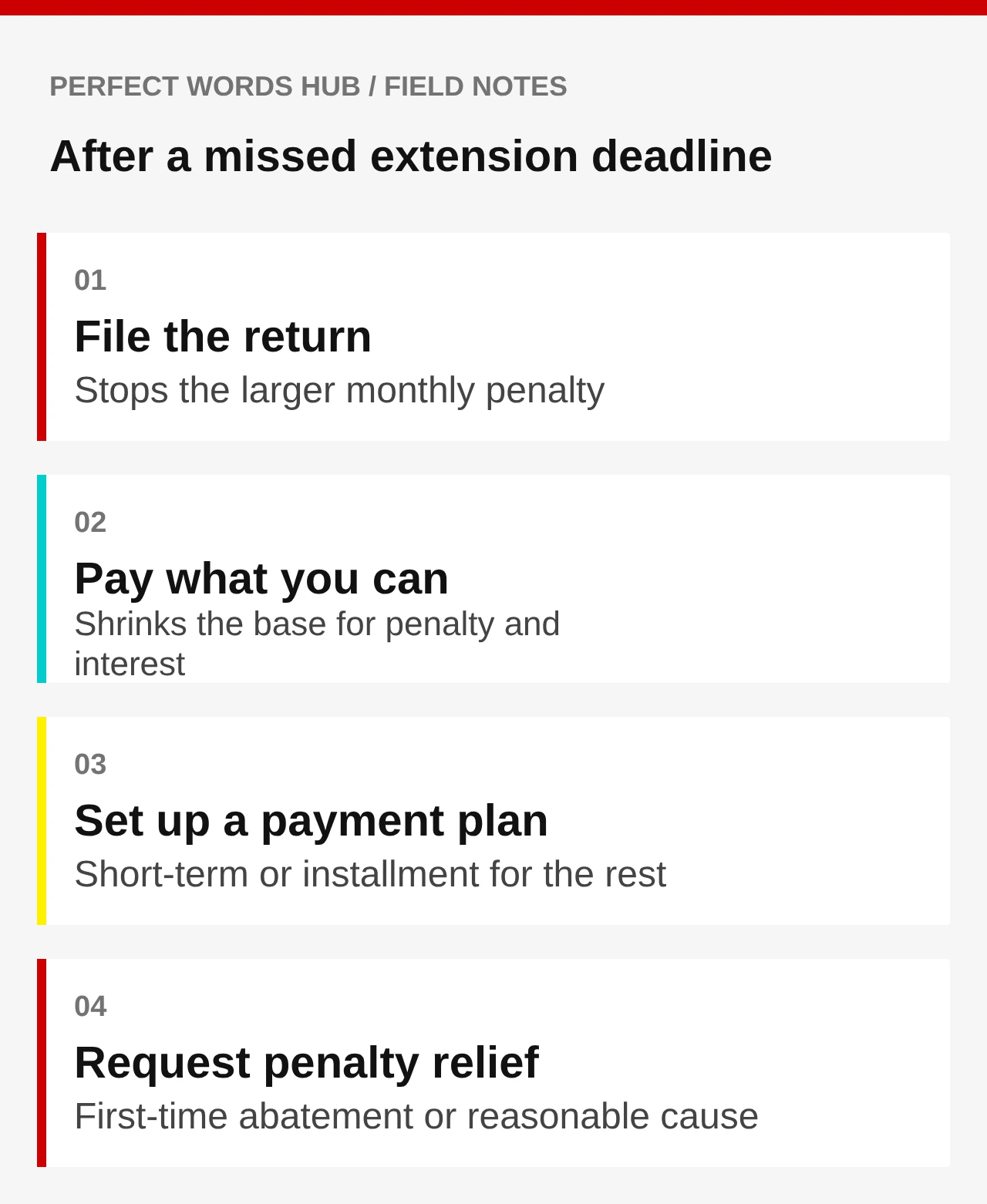
Do these in order. The aim is to stop the larger penalty, then deal with the balance.
- Gather what you have. W-2s, 1099s, brokerage statements, mortgage interest and property tax records, and last year’s return. If something is missing, the IRS suggests asking the payer for a copy, or requesting the information through Form 4506-T. Do not wait for a perfect set of papers if only a minor item is outstanding; you can amend later.
- Estimate the balance. Use last year’s return and your withholding as a rough guide, or run the numbers through tax software before paying for anything.
- File. Use the same method you would have used on time. The IRS says to file all required returns whether or not you can pay in full. Filing and paying promptly limits both interest and the payment penalty.
- Pay what you can. Even a partial payment reduces the base that penalties and interest are calculated on. Direct Pay and your IRS online account are the usual routes.
- Ask for a plan for the rest. Details in the next section.
- Keep proof. Save the filing confirmation, the payment confirmation, and a copy of the return. If you built a folder system, this one is a decent template for next year.
One more check before you file: see whether your area has disaster-related relief. The IRS keeps a list of postponed deadlines tied to federal disaster declarations, and some of them extend beyond October. If your county is on the list, you may not be late at all.
If you cannot pay the whole balance
The IRS publishes two kinds of payment arrangements for individuals. A short-term plan gives you up to 180 days to pay in full. For individuals applying online, the IRS lists no setup fee for it and a balance limit of less than $100,000 in tax, penalties, and interest combined. A longer-term installment agreement, which spreads monthly payments out, can be set up online for balances of $50,000 or less, and the IRS lists a $29 setup fee for direct debit and $69 for other payment methods when applying online. Fees are higher if you apply by phone, mail, or in person, and lower for people who qualify as low-income. Check the current table on the payment plan page before you apply, since fees are updated.
Two cautions. First, interest and penalties keep accruing under both types of plan until the balance is paid in full, so a plan is a way to avoid collection action, not a way to make the charges disappear. Second, the reduced payment penalty rate of 0.25% a month that the IRS describes for approved plans applies only if you filed your return on time as an individual. If you missed October 15, you may not qualify for that lower rate, which is another reason to settle the balance as fast as your budget allows.
If you also made quarterly payments this year or have a side business, it is worth reading how withholding and estimated payments differ, because a late return for one year often hides an underpayment pattern that repeats the next.
Asking for penalty relief
The IRS can remove or reduce penalties in two main ways, and it tells you how to request both.
First-time abatement. If you filed the same type of return on time for the previous three years and had no penalties in that period (other than the estimated tax penalty), or any that were assessed were later removed, the IRS may waive the late-filing and late-payment penalties. You do not have to name it; you can call the toll-free number on your notice, or send a written request or Form 843, and the IRS reviews your account. Under this relief the late-payment penalty can keep growing until the tax is fully paid. The IRS also says it began moving from this process to an automatic exemption in summer 2026, but first-time abatement still applies to the 2025 tax year, so it is likely the route for most people reading this.
Reasonable cause. This is judged case by case. For late filing or payment, you need to show you used ordinary care and prudence and still could not comply. The IRS gives examples that are generally valid: a fire or natural disaster, inability to get needed records, death or serious illness of you or an immediate family member, or system problems that delayed an electronic filing or payment. It lists reasons that generally are not enough: relying on a tax professional, not knowing the rules or deadlines, simple mistakes or oversights, and lack of funds on its own.
If you request relief by phone, have the notice, the penalty you want removed, your explanation, and documents ready. If that does not work, file Form 843 and describe what happened, when, and what you did once the problem ended. A doctor’s letter or hospital record with start and end dates is the kind of paper that helps.
One useful rule: when a penalty is reduced or removed, the related interest on that penalty is reduced or removed with it. Interest on the tax itself generally stays.
What happens if you do nothing
The IRS may prepare a substitute return for you if you do not file. It is built from the income reports it has, and the IRS warns it might not give you credit for deductions and credits you are entitled to. You would then receive a Notice of Deficiency, which gives you 90 days to file your own return or petition the Tax Court, and the IRS says that notice cannot be extended.
Unpaid assessments can lead to collection steps such as levies or federal tax liens. Repeated failure to file can bring additional penalties. None of this typically begins the week after a deadline, and many late filers hear nothing until a notice arrives weeks or months later. But silence is not the same as forgiveness.
If a letter does arrive, read the notice number in the upper right corner, check the response date, and reply by that date, even if you disagree. The IRS notes that acting on time protects your appeal rights. If a letter looks wrong or you cannot find the notice on the IRS site, call the number the IRS lists rather than a number printed in the letter, in case it is a scam.
The habits that keep this from happening again
Most late extension filings come from the same three gaps: no firm date to start, missing documents, and a payment that was never made in April. Each has a cheap fix.
- Put a start date on the calendar for early September, not October. Extensions are a cushion for missing paperwork, not a plan.
- Make a rough tax payment with the extension, even if it is an estimate. Anything you pay in April cuts both the penalty and the interest base.
- If you earn money outside a paycheck, keep running records as you go. Side-income records are the usual reason a return stalls.
- Adjust your withholding or estimated payments after a big year, so the April balance is smaller and the extension does not become a trap.
Being a few days late is not a catastrophe. Being a few months late with a growing balance starts to be one. Put the return together this week, file it, make the best payment you can, and the rest becomes a set of ordinary problems with published solutions.
Sources & further reading
- IRS: Get an extension to file your tax return
- IRS: Failure to file penalty
- IRS: Failure to pay penalty
- IRS: Interest rates remain the same for the fourth quarter of 2026
- IRS: Penalty relief due to reasonable cause
- IRS: Penalty relief due to First Time Abate or other administrative waiver
Source links checked October 17, 2026. Rules, rates and product terms can change.
General US tax education, not individual tax advice. Check irs.gov for current figures or ask a qualified tax professional.