
The useful part, up front
- A denial, a zero payment, and a low offer are three different problems. Work out which one you have before you decide how to respond, because the evidence you need is different for each.
- Ask for the decision in writing, find the exact policy wording the insurer relies on, and keep a dated log of every contact. Those three habits carry most of the weight in any later dispute.
- Your state insurance department takes complaints about delayed, denied, and underpaid claims at no charge. The process varies by state, so look up your own state’s office and rules instead of relying on a general checklist.
The letter that says no
Picture a Tuesday afternoon. A hailstorm took out half your roof three weeks ago, you filed the claim, an adjuster walked the property for forty minutes, and now there is an email with a PDF attached. The claim is closed. The amount paid is $0. The first paragraph uses words like “unable to determine” and “not covered under the terms of your policy,” and you are not sure whether you have been told no, or told nothing.
This is a situation a lot of people are in right now, and it is getting national attention. On October 2, 2026, Senators Elizabeth Warren and Josh Hawley sent a letter to State Farm (the committee’s site lists similar letters to other large insurers) asking it to explain why a growing share of homeowners and auto claims end without a payment to the policyholder. The State Farm letter asks for a response by October 16 and requests ten years of data on claims paid and unpaid, broken down by reason.
That attention is useful context, but it does not change what you should do at your kitchen table. The letter is a set of questions, not a finding. It cites press reporting rather than announcing a verdict, and it asks the insurer to explain the trend. Your claim is decided on your policy, your facts, and your state’s rules. The rest of this guide is about those three things.
What the national numbers do and do not say
The Senate letter to State Farm cites Wall Street Journal reporting that several home insurers paid nothing on 44 percent of the homeowners claims they resolved last year, compared with 36 percent a decade earlier. For auto liability and medical claims, the letter cites reporting that insurers paid nothing on 45 percent of those they resolved, up from about 35 percent in 2016. Those are figures the senators quote from news reporting, not results of a government audit, so treat them as a description of the debate and not as a settled statistic.
They also need careful reading. A claim that closes with no payment is not necessarily a claim that was wrongly refused. Some close because the damage was smaller than the deductible. Some are withdrawn by the policyholder. Some involve events the policy never covered, such as flood under a standard homeowners policy. The letter itself asks State Farm to separate the reasons: below the deductible, an exclusion, a formal denial, a withdrawal, and so on. That is the right question, and it is also the right question for you to ask about your own file.
So the practical takeaway is narrow. Do not assume a no-payment outcome means you were treated unfairly, and do not assume it means you were treated fairly. Find out which category you are in.
Sort your outcome into one of three buckets
Before you write anything, label what happened. Each bucket has a different next move.
- Formal denial. The insurer says the loss, the cause, or the property is not covered. Your task is to compare the stated reason against the policy wording and the facts.
- Payment below the deductible. The insurer accepted that the damage happened but estimates it at less than your deductible, so nothing is owed. Your task is to test the estimate: missing items, underpriced repairs, or damage the adjuster did not see.
- Lowball or partial payment. You received money, but less than your contractor, shop, or documentation supports. Your task is to show, line by line, what is missing or underpriced.
A fourth situation is a claim that is simply stuck. If weeks pass with no decision and no explanation, the issue is delay, which regulators treat as its own category of problem.
The reason this matters: a letter that cites an exclusion calls for a close reading of policy language, while a below-deductible result calls for a better repair estimate. Sending a long complaint about the wrong thing is how good cases go quiet.
Get the decision in writing and read the exact wording
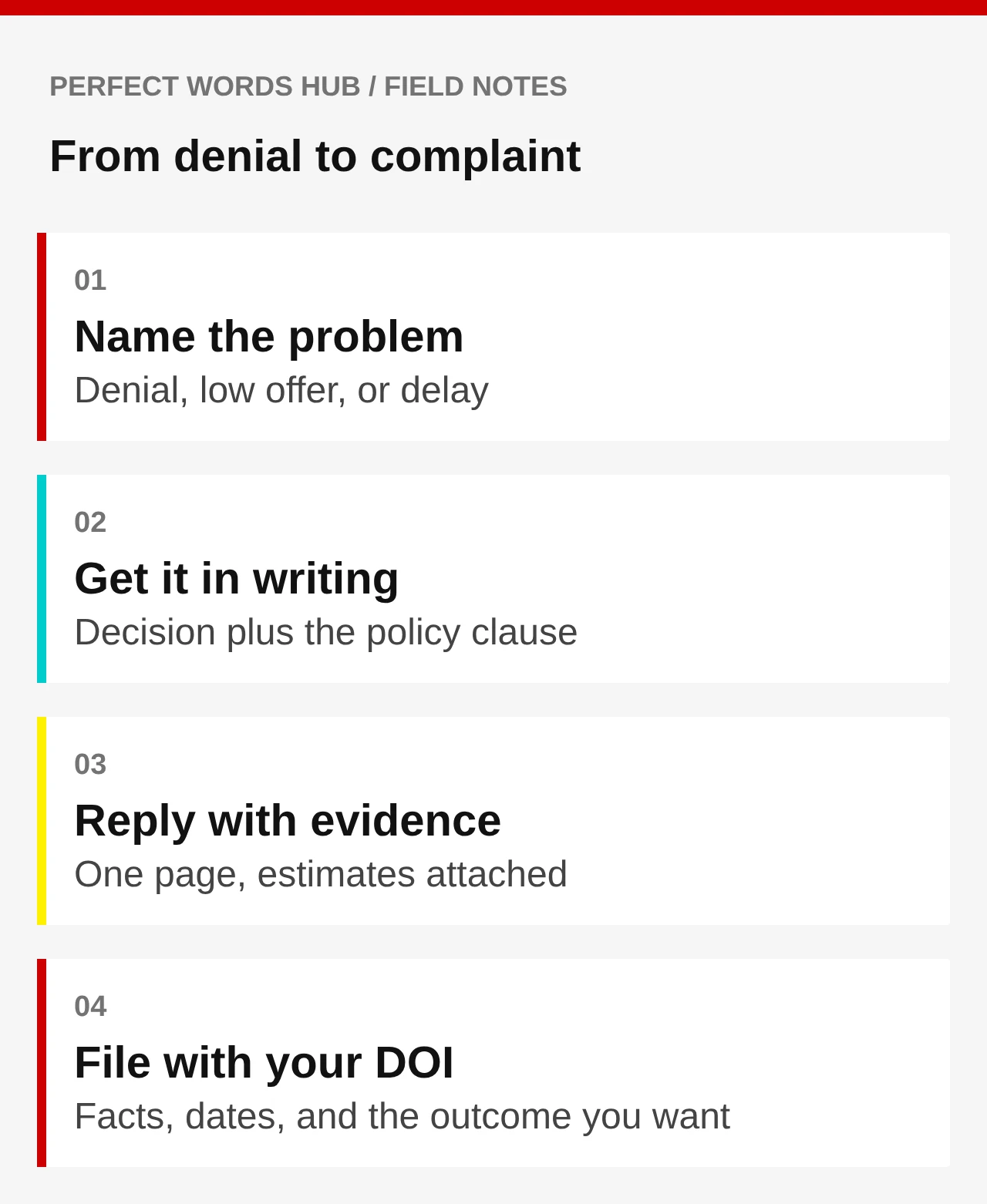
If the insurer called you with the news, ask for the decision in writing and for the specific policy provision it relies on. An NAIC consumer article on settling homeowners claims advises asking for any denial in writing and keeping all paperwork. The NAIC’s model claims-settlement regulation, which many states use as a template, goes further: a denial based on a policy provision, condition, or exclusion should be in writing and refer to that specific provision. Your state’s version may differ in details, but the principle that the insurer should point to its reason is widely shared.
Then do the reading yourself. Pull your policy, including the declarations page and any endorsements, which are add-ons that change the base form. Find the clause the letter cites. Read the definitions, the exclusions, and any exceptions to the exclusions, because policies often take coverage away in one paragraph and hand some back in the next.
Write down, in plain words, the insurer’s reason in one sentence. Then write the fact that would make that reason wrong. For instance: the letter says the roof damage is “wear and tear,” and your facts are that the shingles were replaced six years ago and a storm with documented hail passed over your address on the date of loss. If you cannot write that second sentence, you may not have a strong dispute. If you can, you have the spine of a good response.
One more reading task: check what the policy says about proving a loss, how quickly you must report problems, and whether there is a separate process for disagreements over value. These terms differ from policy to policy and state to state, and some deadlines can be short. If you are unsure, your state insurance department can explain the general rules, and a licensed attorney in your state can advise on your particular policy.
Build the evidence file
A dispute is won or lost on documents. Start one folder, paper or digital, and put these in it.
- The full policy and the declarations page for the policy period in which the loss happened.
- The claim number, the adjuster’s name, and every letter, email, and text from the insurer.
- Photos and video of the damage, ideally with dates, plus anything showing the property’s condition before the loss.
- Written repair estimates from licensed contractors, body shops, or other qualified professionals. If the insurer’s estimate is lower, ask for a copy of its line-item estimate so you can compare it with yours line by line.
- Receipts, invoices, and proof of any emergency steps you took, such as tarping a roof or paying for a hotel.
- Weather reports or other records that tie the damage to a specific event and date.
If belongings are part of the claim, a prior inventory makes a large difference. Our guide on keeping a paper trail for your belongings explains what to record so you are not rebuilding a list from memory after a loss.
Finally, keep a contact log. Every call, with the date, time, the person’s name, and what was said, written the same day. The NAIC’s complaint guidance specifically recommends keeping emails, letters, and notes on phone calls with dates and times.
Go back to the insurer with a short, factual request
Most people skip the step between the denial and the regulator, and it is usually worth taking. The NAIC advises trying to resolve a problem with the insurer first before involving the state. Think of the reply as the first exhibit in the file you may later hand to a regulator.
Keep it to one page. Open with the claim number, the date of loss, and the date of the decision you are disputing. State, in a sentence, what you disagree with. List the new or overlooked facts. Attach your estimate or evidence. End with the specific outcome you want: reinspection, payment of a stated amount, or a written explanation of how the figure was calculated.
Send it in a way that creates a record, such as the insurer’s claims portal with a saved confirmation, email to the adjuster with a copy to the claims supervisor, or certified mail. Then calendar a follow-up date a couple of weeks out.
A useful detail for pushing on estimates: the NAIC model regulation says that on residential property claims paid at actual cash value, insurers should provide depreciation worksheets on request, and that deductions for depreciation or betterment should be itemized and tied to measurable factors. Not every state has adopted every provision, so confirm your own state’s rules, but the request itself is reasonable to make.
What “fair and prompt” looks like on the calendar
Many states have rules about how fast insurers must move. The NAIC’s model regulation gives a sense of the common shape, though your state may use different numbers.
| Step | Timing in the NAIC model |
|---|---|
| Acknowledge a claim notice | Within 15 days, unless payment is made in that time |
| Answer a pertinent message from the claimant | Within 15 days |
| Accept or deny after receiving proof of loss | Within 21 days |
| If more time is needed | Say so within 21 days, give reasons, and send a written update every 45 days |
| Pay the undisputed amount after liability is affirmed | Within 30 days |
Read that table as a map, not a guarantee. These numbers come from a model that states may adopt in whole, in part, or not at all, and the model allows exceptions, including where an insurer has a reasonable, specific basis to suspect the claimant caused or contributed to the loss. The NAIC also notes that complex investigations and severe weather can slow payment. After a regional disaster, many claims arrive at once and regulators sometimes issue guidance for that event.
The point of knowing the shape is simple. If three weeks have passed with no acknowledgment or no explanation, you have something concrete to put in a complaint: dates, and what was or was not communicated.
Filing with your state insurance department
Every state, the District of Columbia, and five U.S. territories has an insurance regulator, which the NAIC counts as 56 jurisdictions in all. Names vary, such as department of insurance, division of insurance, or office of the insurance commissioner. Their services are free to the public, and the NAIC says they take complaints about delayed, denied, or underpaid claims, among other problems.
A complaint generally goes like this, per the NAIC. You submit a form online, by mail, or by phone, depending on the state. The department first checks whether it has authority over the issue. It sends your complaint to the insurer, which must explain its position in writing. The department then reviews whether the insurer acted fairly under your policy and state law, and if it finds the insurer acted improperly, it can require the company to correct the problem. The NAIC also says insurers may not retaliate for a complaint.
Your complaint will be stronger if you prepare it the way the NAIC suggests:
- Include your policy number, claim number, and the records and bills.
- Write a factual account in date order and leave opinions out.
- Quote the policy language that applies.
- State the outcome you want, such as payment of a specific amount.
- Attach the denial letter, your estimates, and your reply to the insurer.
Look up your regulator through the NAIC’s state directory, then read that state’s own consumer pages for deadlines and forms. Expect that the department will judge the claim by your policy and the law, not by sympathy, and know its limits. The NAIC explains that departments do not set insurance prices, do not act as your personal lawyer, and cannot force a company to sell you a policy. Nothing guarantees the outcome you want. The NAIC pages reviewed for this article also do not give timeframes for a department’s review, so ask the department when you file.
When to bring in other help
A state complaint is not the only tool, and sometimes it is not the best one. Some disputes turn on the dollar value of a repair, and the most persuasive thing may be a better estimate or a reinspection. Some turn on how to read policy language, which is where a licensed attorney in your state can tell you what rights and deadlines apply to your particular facts. Some policies carry a separate dispute process for valuation, and your policy or the state department can tell you whether yours does.
Be careful with anyone who approaches you after a storm and offers to take over your claim for a fee. Before you sign anything, check whether your state requires a license for that kind of work and confirm the person is licensed. The NAIC notes that insurance departments verify licenses for companies, agents, and adjusters, and some offer online lookup tools.
If your mortgage lender is named on the checks, ask the lender how it releases repair funds, because those payments often arrive in stages. If the problem is with a lender, not the insurer, the NAIC points to your state’s banking regulator or attorney general and to federal complaint channels. And if the denial involves health coverage, that follows a different set of appeal rules. See our guide to health-plan denials for that path.
Fix the next claim before it happens
Whatever the outcome, use this episode to tighten your setup. Photograph the property and belongings now, while nothing is wrong. Keep a digital copy of your policy outside the home. Learn what your deductible actually is, because some policies set separate, sometimes higher, deductibles for certain perils such as wind or hail, and some express them as a percentage of the home’s insured value. The Senate letter specifically flags percentage-based hurricane and hail deductibles as part of the cost picture.
Use your renewal as the moment to compare. Our piece on treating renewal as a fresh comparison walks through the questions to ask: what changed in the exclusions, what the deductible is for each peril, and whether the home is insured for what it would cost to rebuild. A cheaper premium that carries a larger deductible or narrower coverage may cost more on the day you need it.
A denial can feel final, but it is usually a position, not a verdict. The people who get unstuck tend to be the ones who stay calm, read the wording, document everything, and ask the right office the right question.
Sources & further reading
- U.S. Senate Banking Committee: Oct. 2, 2026 letter to State Farm on claims handling
- NAIC: How Do I File a Complaint Against My Insurance Company?
- NAIC: How to File a Complaint
- NAIC: Need Help with Insurance? Insurance Departments Are Your Trusted Source
- NAIC: What You Should Know About Settling a Homeowners Insurance Claim
- NAIC: Unfair Property/Casualty Claims Settlement Practices Model Regulation (Model 902)
Source links checked October 17, 2026. Rules, rates and product terms can change.
General US insurance education, not individual insurance or legal advice. Your issued policy and applicable law control coverage.