
The useful part, up front
- A nonrenewal means the insurer will not offer another policy term. It is different from a cancellation in the middle of a term, and the notice rules differ by state.
- Your first goal is to avoid a gap in coverage. Mortgage lenders can require continuous coverage, and a lapse can lead to expensive lender-placed insurance.
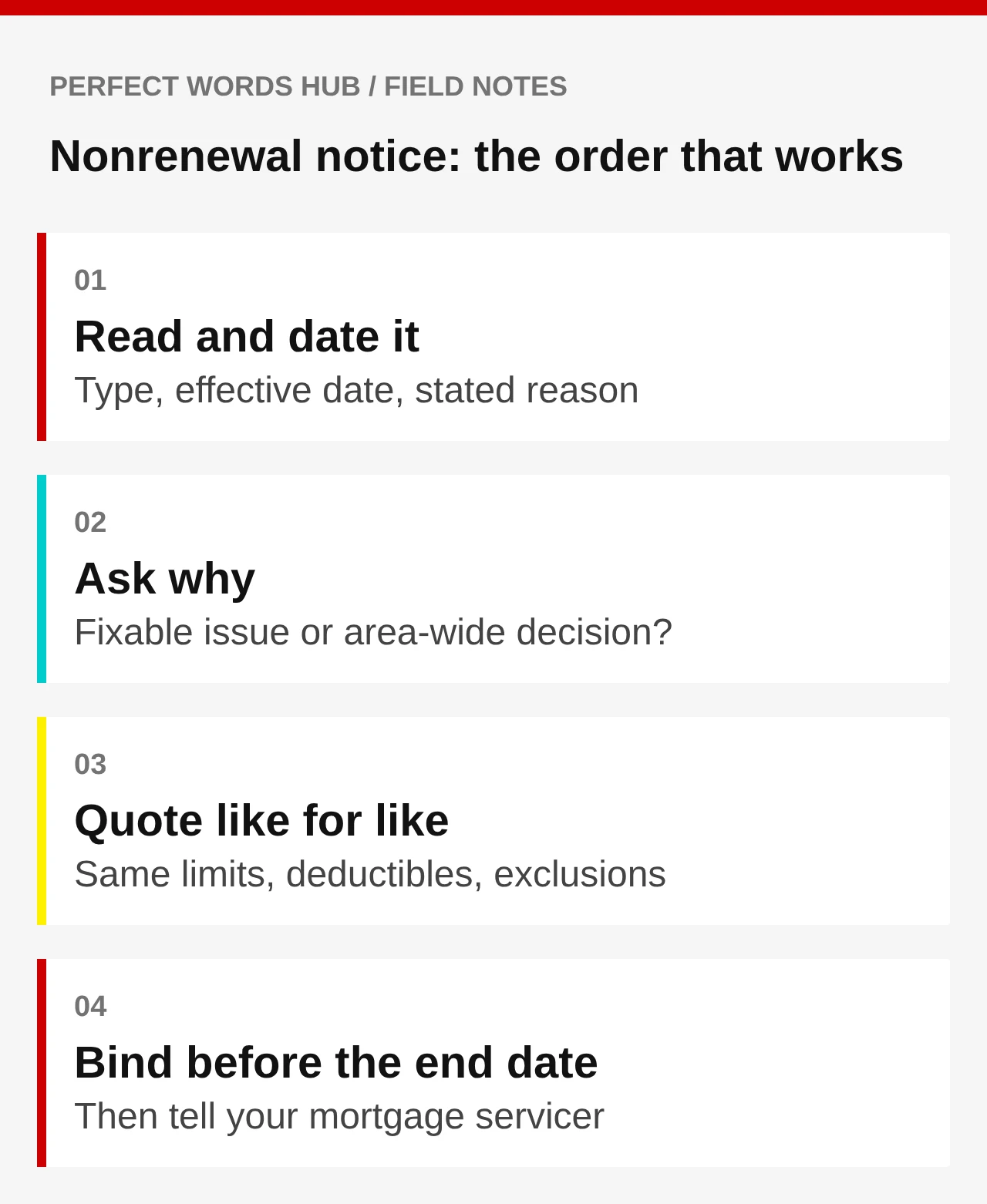
- Compare quotes using the same coverage amounts, deductibles, and exclusions, so a lower price does not simply mean less protection.
Read the notice before you react to it
Homeowners insurance companies send several kinds of letters that look alike. Sorting yours into the right type changes what you do next.
- A renewal with a higher premium. The policy continues, and the price or terms change.
- A nonrenewal. The insurer will not offer another term when the current one ends. Your coverage normally continues through the end date.
- A cancellation. The insurer ends coverage before the term is over. State law usually limits the reasons, such as non-payment or material misrepresentation, and requires specific notice.
- A conditional renewal. The insurer may continue coverage if you fix something, such as an aging roof or a damaged fence, by a deadline.
Find the effective date, the reason if one is stated, and any instructions for responding or fixing a condition. Put the dates in your calendar right now. Many people lose weeks by assuming they have longer than they do.
State insurance departments set the minimum notice period, and it varies. Some require a month or more, others less for certain reasons. Look for your state’s rules on your department of insurance website, which you can find through the National Association of Insurance Commissioners.
Protect the coverage date first
The most expensive outcome is not a higher premium. It is a gap, even a short one, between the old policy and the new one. If your home has a mortgage, your loan documents almost certainly require continuous homeowners coverage. If the servicer learns that your policy ended, it can buy insurance on your behalf, often called lender-placed or force-placed insurance, and bill you for it. That coverage typically protects the lender’s interest more than yours and can cost far more.
So set a simple internal deadline: have a replacement policy ready at least two weeks before the old one ends. That leaves time for the new insurer to issue a declarations page, for your mortgage servicer to be told, and for you to correct mistakes.
If your lender pays your insurance from escrow, contact your servicer once you pick a new policy. They will need the new insurer’s name, policy number, and the premium bill.
Ask the current insurer two direct questions
Call or write to your current insurer, and keep a note of who you spoke with and when. Ask:
- What is the specific reason for the nonrenewal or increase?
- Is there anything I can fix, document, or change so the decision is reconsidered?
Common answers include roof age or condition, claims history, trees touching the structure, an unfenced pool, and regional risk decisions that have nothing to do with you personally. Some of these are fixable. A roof inspection that documents remaining life, new hurricane straps, or a replaced water heater can sometimes change the underwriter’s view. If the reason is a company-wide pullback from an area, there may be nothing to fix, and your time is better spent on alternatives.
Ask for the reason in writing if it is not stated. In many states, consumers have the right to know the reason, and written reasons help if you later dispute a decision or fill out a new application.
Keep the tone practical. The person answering the phone rarely made the decision, and a calm request for the reason and the appeal process gets better results than frustration. If the insurer offers a way to request reconsideration, ask for the deadline, the form, and the email address for sending documents, and send everything in a way that creates a timestamp.
It also helps to find out whether the decision applies only to your policy or to a broader group of policies in your area. If it is a broad withdrawal, other homeowners nearby are facing the same problem, and local agents will already know which companies are still writing new business. That knowledge can save you several rounds of quotes.
Get quotes you can actually compare
A quote is only comparable when the coverage is the same. Take your current declarations page, the one-to-two page summary at the front of your policy, and copy these items into a simple table.
- Dwelling coverage amount, and whether it is replacement cost or actual cash value.
- Personal property coverage, and whether it is replacement cost or depreciated value.
- Liability limit and medical payments limit.
- Deductibles, including any separate percentage deductible for wind, hail, or named storms.
- Endorsements such as water backup, scheduled valuables, and ordinance or law coverage.
- Exclusions you know about, such as flood and earth movement, which are usually not in a standard homeowners policy.
Then request the same figures from each insurer or independent agent. An independent agent can quote several companies at once. A direct writer quotes only itself. Using both gives you a fuller picture.
Be careful with the lowest price. A quote that is hundreds of dollars cheaper often hides a higher deductible, lower dwelling limit, or actual cash value roof payment that leaves you holding the cost of an old roof after a storm. Our guide on comparing insurance beyond the premium walks through how a cheaper premium can move cost somewhere else.
Know the backup options in your state
If several insurers decline you, most states have a backup market. Names vary: FAIR Plans, windstorm pools, or a residual market. These plans are insurers of last resort. They usually offer more limited coverage, charge more, and sometimes require that you apply after trying the regular market.
Treat a FAIR Plan policy as a bridge. Read what it covers, because many basic policies cover fire and a short list of perils and leave out theft, liability, or water damage unless you add a companion policy. Your state’s insurance department page or the NAIC can tell you whether a plan exists in your state and how to apply.
The backup option is better than no coverage, and it can keep a mortgage servicer satisfied while you rebuild your standing in the regular market. Many homeowners use it for a year or two, then shop again after fixing the underlying issues.
Lower the risk the insurer is pricing
Underwriters price what they can see. Over a few months, you may be able to improve what they see. Examples:
- Replace or document the condition of an older roof.
- Trim branches touching or overhanging the house, and clear gutters.
- Update old wiring, plumbing, or a water heater near the end of its life, and keep receipts.
- Install a water leak detector or automatic shut-off valve, where an insurer offers a discount.
- Add storm shutters, impact-rated windows, or roof straps in regions where wind is the main concern.
- Raise a deductible only if you can pay it comfortably out of savings. See our note on where emergency savings should sit.
Ask each insurer what discounts they offer, and ask in writing which improvements they would credit. Do not assume a discount appears automatically.

Check your claims history and your property record
Insurers use claims databases to see prior losses at an address and under your name. In the U.S., consumers can usually request a free copy of their claims history report once a year from the reporting company. Read it. Errors do occur, including claims that were opened but never paid or that belong to a previous owner of the property.
If you find a mistake, dispute it with the reporting company in writing. A corrected report can change a quote. Also keep an updated home inventory. If you have not made one, our guide on building a home inventory before a claim is a good weekend project that also helps when you compare personal property limits.
A two-week timeline you can copy
If your effective date is a month away, this timeline keeps you out of trouble.
- Day 1: Read the notice, note the dates, and ask the current insurer for the reason in writing.
- Days 2 to 4: Pull your declarations page and build the comparison table.
- Days 3 to 10: Request quotes from at least three sources, including one independent agent.
- Days 10 to 14: Choose a policy, pay the first premium, and get the new declarations page.
- Days 14 to 18: Send the new policy details to your mortgage servicer and confirm they have recorded them.
- Before the end date: Keep the old policy active until the new one is confirmed in effect. Never cancel first.
If you cannot find coverage by the deadline, contact your state insurance department. Many of them have consumer assistance lines for situations like yours, and they can explain the residual market in your area.
If you think the decision is unfair
Insurers are allowed to decline risks, but they must follow state rules about how and why. If a notice cites a reason that seems mistaken, such as an incorrect roof age or a claim that is not yours, ask the insurer to reconsider with documentation. If that fails, you can file a complaint with your state department of insurance. Include the notice, your correspondence, and the evidence of the error. You are not guaranteed a reversal, but a documented complaint can sometimes uncover a mistake or lead to a review.
Sources & further reading
- NAIC: Consumer information and state insurance departments
- CFPB: Consumer advisory on cancelled or costlier home insurance
- Insurance Information Institute: Homeowners insurance basics
- FloodSmart.gov: Flood insurance basics from FEMA
- CFPB: Lender-placed (force-placed) insurance
Source links checked October 17, 2026. Rules, rates and product terms can change.
General US insurance education, not individual insurance or legal advice. Your issued policy and applicable law control coverage.