
The useful part, up front
- Compare matching policy periods and coverage amounts.
- A deductible shifts part of a covered loss back to you.
- Confirm exclusions and special limits before treating quotes as equivalent.
Make the quotes comparable first
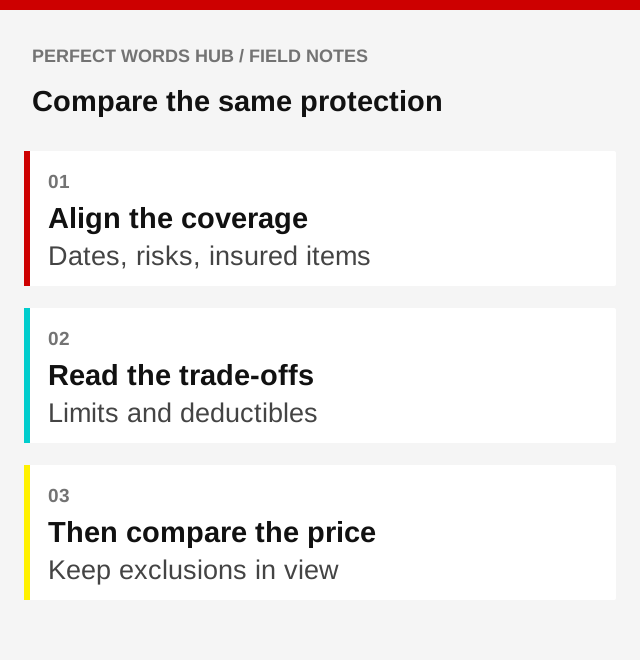
A lower price is meaningful only when you know what changed. Put two property-insurance quotes side by side and check that they describe the same address, people, coverage dates, limits, and optional additions. A six-month price and a twelve-month price are not directly comparable.
Quotes are also not the final policy. Before purchasing, ask what information could change the offered terms and request the documents that describe the coverage. Save the version you reviewed so that a later conversation is about the same proposal.
Follow the deductible through one loss
A deductible is the portion of a covered loss you are responsible for under the policy. Some are stated in dollars; others use percentages or vary by event. Ask what a percentage is calculated against rather than assuming it applies to the size of the claim.
A simplified comparison: suppose Quote A costs $1,200 a year with a $500 deductible, while Quote B costs $1,020 with a $1,500 deductible. B saves $180 in annual premium but adds $1,000 of deductible exposure for a loss to which that deductible applies. These invented numbers isolate one trade-off; they do not predict claims or identify a better policy.
The cash-flow question is practical: could you meet that deductible when needed? The probability and circumstances of a future loss remain uncertain.
Look for differences that do not fit on the price tag
Property limits, special limits on valuables, additional living expenses, and liability coverage can differ. The valuation basis matters too. Actual cash value can reflect depreciation, while replacement-cost coverage has its own terms and conditions.
Read exclusions and endorsements together. An endorsement can alter the base coverage. Standard homeowners and renters policies commonly exclude flood and earthquake losses, so a broad phrase such as “home protection” should not be treated as a complete description.
Ask specific questions in writing
“Is this good coverage?” is hard to answer. “Does this quote cover my bicycle away from home, and what limit and deductible apply?” is much clearer. Use examples that reflect the property you actually own and the risks you are trying to understand.
- Which deductible applies to this example?
- Is there a special limit within the total limit?
- What evidence would a claim require?
- Does any endorsement change that answer?
Keep the comparison useful
Separate confirmed facts from unresolved questions on your comparison sheet. Include the policy period and the date you obtained each quote. If you replace coverage, confirm the new policy’s effective date and conditions before assuming continuous protection.
A licensed insurance professional or your state insurance department can help explain unfamiliar terms. The purpose of the comparison is not to chase the smallest price automatically. It is to understand the agreement attached to that price.
Sources & further reading
- NAIC: Annual policy review and deductibles (opens in a new tab)
- NAIC: Coverage gaps and policy limits (opens in a new tab)
- NAIC: Renters insurance and valuation (opens in a new tab)
Source links checked September 30, 2026. Requirements and guidance may change.
For general education in a U.S. context. This is not financial, insurance, legal, tax, or medical advice. Examples are illustrative. Check current rules and relevant policy documents, and seek qualified help for your circumstances.
Can you read between the policy lines?
Put the ideas into practice with 12 questions and explanations.
Take the quiz