The useful part, up front
- Standard homeowners policies generally cover water damage from a sudden and accidental pipe discharge, but the insurer can push back if the home was left unheated or the plumbing was neglected. Your policy language controls, so read the freezing and vacancy conditions now.
- Water damage and freezing made up 22.6% of homeowners losses in 2023, according to Triple-I, with an average claim of about $15,400 over 2019 to 2023. The deductible comes off the top of every one of those checks.
- The first hour is about stopping the water and documenting the damage. Photograph before you clean up, keep every receipt, and do not sign a repair contract or a direction-to-pay form until you know what the insurer is paying for.
The call that nobody plans for
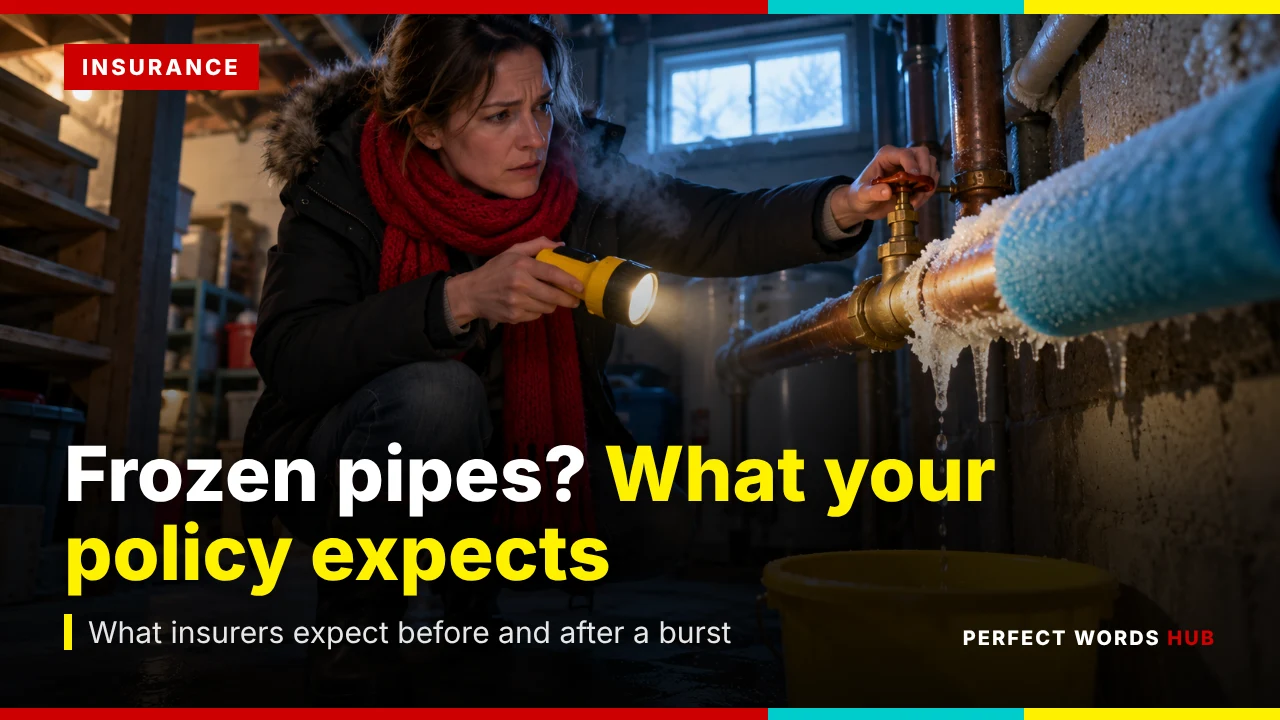
Picture a cold morning in the first real freeze of the season. You come downstairs and the kitchen ceiling is sagging, or you open the basement door and hear water running where no water should be. Maybe you were away for a long weekend. Maybe the furnace quit overnight. Either way, the next several hours will decide how large the repair is, and a few of the decisions will also shape how smoothly the insurance claim goes.
This is a good week to think about it, not because the weather today demands it, but because the work that matters most is done before the first hard freeze, and the freeze date varies enormously by region. In some places it is a few weeks away. In others the pipes along exterior walls are already at risk on a clear, calm night.
Below, you will find what a standard policy tends to say about burst pipes, what insurers look at when they decide whether you took reasonable care, how to cut the odds with a few inexpensive jobs, and the order of steps if a pipe does let go. None of this replaces your own policy. Endorsements, state rules and company forms differ, and the only version that binds you is the one in your policy documents.
What a standard policy usually says about burst pipes
The National Association of Insurance Commissioners (NAIC) explains that homeowners policies generally cover water damage caused by a sudden and accidental discharge from a plumbing system. Insurers often pay for the resulting damage when frozen pipes burst, provided the homeowner took reasonable steps to maintain the pipes and prevent them from freezing.
Notice the shape of that rule. It is not a promise that every burst pipe is paid. It is a coverage for a sudden event, tied to an expectation that you looked after the house. The NAIC adds that policies generally require you to keep the home at a minimum temperature, and that if the home is vacant you may be required to shut off the water supply. If the insurer concludes you neglected the plumbing by skipping obvious preventive steps, the burst-pipe damage may not be covered.
Triple-I, an insurance research and education organization, makes a related point about the whole winter season: standard homeowners policies cover damage from wind, snow and ice to the property and personal possessions, while flood damage is excluded. Melting snow that seeps into a home from the ground up is a flood question, not a burst-pipe question, and it needs separate flood coverage through the National Flood Insurance Program or a private insurer. If that distinction matters where you live, our guide to the flood insurance waiting period explains why waiting until the water is rising is too late.
Two more exclusions are worth knowing by name. Triple-I lists routine wear and tear among the things standard homeowners policies do not cover, so a pipe that failed from age or corrosion is a different conversation from a pipe that froze and split. And sewer backup is not covered under standard homeowners or renters policies; it is typically added with an endorsement or bought as a separate product. Melting snow can overload sewer systems, so spring is when some people discover that gap.
How much can this cost? The numbers worth knowing
Burst pipes are not rare. Triple-I reports, using data from the insurance data firm ISO, that the water damage and freezing category accounted for 22.6% of homeowners losses in 2023, down from 25.8% in 2022. Over the five years from 2019 to 2023 the frequency averaged 1.50 claims per 100 house-years, and the average claim size was about $15,400. The category also includes mold damage, when that is covered, so it is broader than frozen pipes alone.
Those are averages across the country, and a burst pipe in a finished basement can look nothing like one in an unfinished crawl space. But the figure gives you a sense of scale: for a typical household, a water loss is a five-figure event, not a nuisance.
Here is the arithmetic that matters at your kitchen table. Suppose a pipe bursts and the covered loss, after the adjuster's review, comes to $15,400. With a flat $1,000 deductible, the payment is $14,400, and you cover the first $1,000. If your policy instead carries a percentage deductible, the math changes. Triple-I's own example is a home insured for $100,000 with a 2 percent deductible: $2,000 comes off any claim, so a $10,000 loss pays $8,000. Scale that to a home insured for $400,000 at 1 percent, and the deductible is $4,000 before the insurer pays anything.
Triple-I also notes that a deductible applies to each claim you file, not once per year, and that percentage deductibles generally appear on homeowners policies rather than auto policies. Look at your declarations page now and write the deductible down. A person who believes the deductible is $500 and finds out it is $4,000 on the day of the loss has lost the chance to plan for it.
Before the freeze: eight jobs that also strengthen a claim
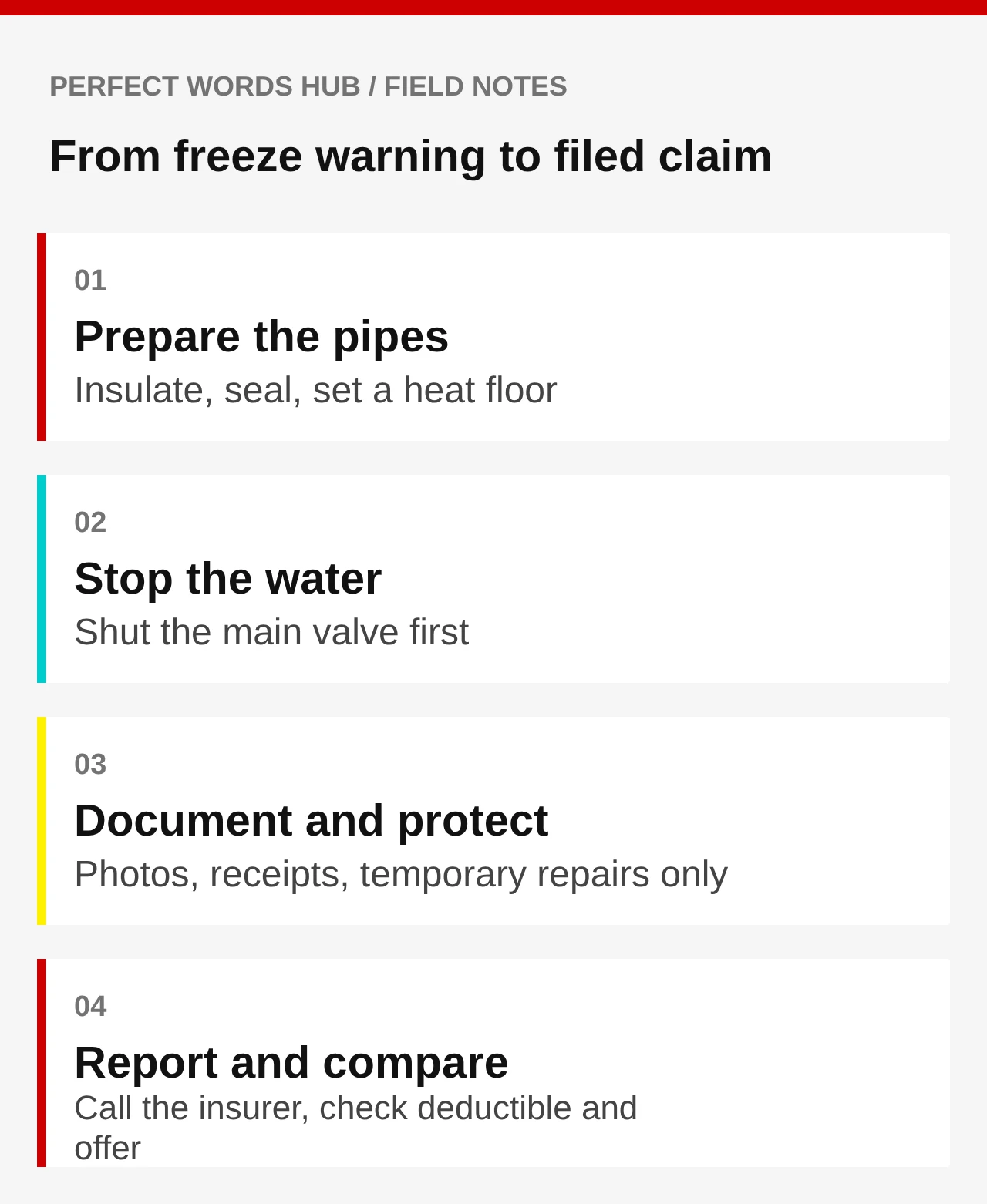
The Insurance Institute for Business & Home Safety (IBHS) publishes a winter-readiness guide with a consistent set of low-cost steps. Most of them take an afternoon. The side benefit is that each one is also evidence that you maintained the property, which is exactly the standard insurers refer to when they ask whether a freezing loss was preventable.
- Insulate exposed pipes. Focus on attics, crawl spaces and pipes along exterior-facing walls, especially in unheated or minimally heated areas. Foam tubes, wrap or tape all work.
- Seal the gaps. Caulk cracks and openings in the exterior, and add weather-stripping around doors and operable windows. Cold air blowing across a pipe does more harm than a low outdoor temperature alone.
- Deal with outdoor faucets. Disconnect garden hoses, shut off and insulate the valves for outdoor faucets, and winterize irrigation systems. IBHS notes that homes built before 2010 typically lack frostproof outdoor faucets.
- Set a heating floor. IBHS recommends a thermostat setting no lower than 55°F even when nobody is home. Triple-I suggests keeping the home at least 65 degrees to help keep pipes inside walls from freezing. Pick the higher number when the forecast is severe, and check your policy for any stated minimum.
- Know your main shut-off valve. Find it today, make sure it turns, and make sure everyone in the household knows where it is. Speed is the whole game when a pipe splits.
- Plan for long absences. If you will be away for more than a week while subfreezing temperatures are occurring or forecast, IBHS says to close the main valve slowly and then slowly drain a couple of faucets on the lowest floor. Ask your insurer whether your policy has a vacancy or unoccupancy clause that applies to a long trip.
- Replace old hoses. IBHS recommends replacing washing machine and dishwasher supply hoses that are more than 10 years old, since fittings and rubber gaskets degrade and can leak. This is not freeze-related, but it is the same type of claim.
- Build the home inventory. Take a geo-tagged video of your belongings and store it in the cloud. The steps are in our guide to building a home inventory before you need it.
On the coldest nights and during power cuts
Preparation does not stop when the weather arrives. On very cold days, and during an outage, IBHS suggests opening cabinet doors so heat can reach pipes along exterior walls, and letting faucets drip so water keeps moving. Triple-I gives the same advice about letting hot and cold faucets drip.
Backup power matters more than people expect, because a freeze often comes with a power loss. Triple-I advises having a reliable backup power source so heat and a battery-operated sump pump keep working during an outage, and it says to follow all safe-operation guidelines for a portable generator. A generator belongs outdoors and away from the house, which is a safety matter first and an insurance matter second.
You can also give vulnerable pipes active help. Triple-I says exposed pipes in attics and crawl spaces can be protected with insulation or a plug-in heating cable, and that you should choose UL-listed cable with a built-in thermostat and follow the manufacturer's instructions. The same article suggests an emergency pressure release valve, which it says protects the system from the pressure caused by freezing pipes and can help prevent bursts. Whether either one is right for your plumbing is a question for a licensed plumber.
One practical habit: when a hard freeze is forecast, walk the house the evening before. Check the coldest corners, the cabinets on exterior walls, the garage, and any room you keep shut. Fifteen minutes is enough. Write down what you did in a note on your phone. It costs nothing, and if an adjuster ever asks what steps you took, you will have a dated answer rather than a vague memory.
The first hour after a pipe lets go
If you hear running water or see a ceiling bulge, move in this order.
- Stop the water. Close the main shut-off valve. Triple-I stresses that speed is critical, whether you shut it off yourself or direct a plumber to the problem. If water is near outlets, appliances or the electrical panel, stay clear and call for help rather than wading in.
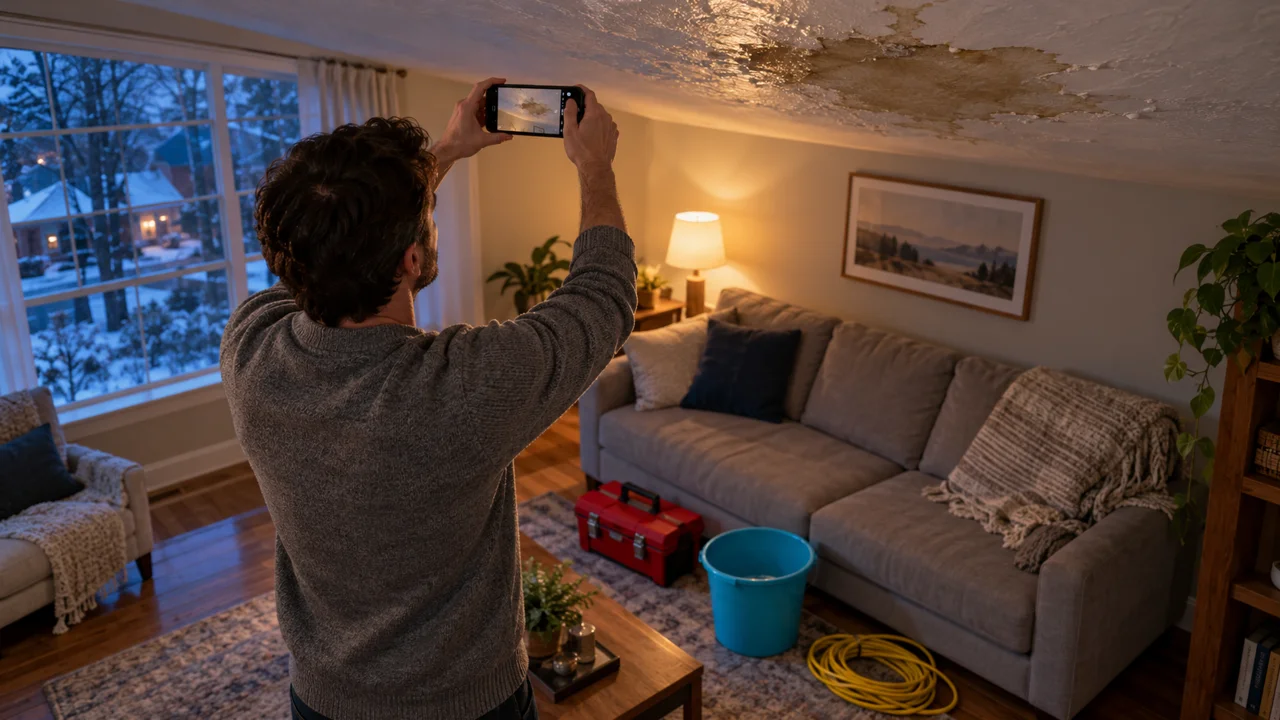
- Photograph and video the damage before you touch it. Get wide shots of each room, close shots of the burst section if you can see it, wet ceilings, soaked flooring, and every damaged item. The Texas Department of Insurance advises taking photos and video and not throwing anything away until the adjuster says it is okay.
- Limit further damage. The same agency's storm guidance says to make temporary repairs, such as removing standing water and covering openings, and to log every repair and save all receipts. Moving belongings out of the wet area, running fans and putting towels down are reasonable. Tearing out walls is not something to do on your own before the insurer has had a look.
- Call a licensed plumber. A plumber can repair the break and tell you in writing what failed and where. That report is useful evidence about whether the pipe froze, which is different from a pipe that wore out.
- Call your insurer or agent promptly. The NAIC's claims guidance says to notify your insurer promptly, noting that reporting deadlines vary by state. Give your policy number, name, address and phone number, and describe what happened and how far the damage extends.
The reason to avoid permanent repairs at this stage is simple. The Texas guidance tells policyholders not to make permanent repairs until the adjuster has seen the damage. Emergency measures protect the house and your claim. Rebuilding before the inspection can leave you arguing about what was there.
Filing the claim: what to say, what to keep
Before you report anything, check your deductible. The NAIC points out that minor damage may be cheaper to handle yourself, and that filing makes more sense when repairs will exceed your deductible or the damage is extensive. That is a real decision, because claims can affect your coverage and pricing at renewal; a short conversation with your agent about your options can help. Our guide to treating a renewal as a fresh comparison covers what to look at when the next notice arrives.
If you do file, treat the call like a short interview. Describe the facts plainly: when you discovered the leak, what the indoor temperature was and how it was being heated, whether anyone had been away, what you did to stop the water, and what you have already documented. Keep a written note of who you spoke with, the date and what they said. Do not guess about the cause of the break. A statement like "I found it at 7:15 and shut the main off at 7:20" is stronger than "it probably froze overnight."
List all damaged property, room by room, and bring that list when you meet the adjuster. The NAIC says to have the list ready for the adjuster meeting and notes that your contractor may attend. If you have no inventory, it suggests working from memory, reviewing photos on phones, and searching online retailers to estimate costs. Keep receipts for emergency repairs and for replacement purchases.
Ask about three things before you hang up: whether an advance payment is available, whether your policy has additional living expenses (ALE) coverage if the house becomes unlivable, and what documents the insurer wants. The Texas guidance notes that many policies cover some costs when covered damage makes a home unlivable, and Triple-I's overview describes ALE as extra living costs such as hotels and restaurant meals, with some policies limiting it by time. If you must leave, keep every receipt for the extra costs, not the whole grocery bill.
How the money moves: checks, depreciation and contractors
Triple-I's explanation of the payment process is worth reading before the first check arrives. An adjuster inspects the damage and offers a sum for repairs based on your policy terms and limits. The first payment is often an advance, and Triple-I says the initial payment is not final, so you can reopen the claim if more damage turns up. You may receive separate checks for the structure, belongings and ALE.
The structure check is generally made out to you and your mortgage lender, because lenders are usually named on the policy. The lender may hold the funds and release them as work is completed. The ALE check should be made out to you alone.
Belongings add another wrinkle. Triple-I explains that the first payment for belongings is based on actual cash value, which is the depreciated value based on age, even with a replacement-value policy. To collect the full replacement cost you generally must actually replace the items and submit receipts, and you generally have "several months" from the first payment to do so. Check the exact timeframe with your agent. An illustration with invented numbers: a couch that costs $1,200 to replace but has depreciated by half would produce a first payment of $600; after you buy the new one and send the receipt, the remaining $600 may be released, subject to the policy terms.
On contractors, get multiple bids and compare them with the adjuster's report before you settle. The Texas guidance also recommends saving proof that you paid your deductible. Triple-I warns that if a contractor asks you to sign a direction-to-pay form, you should read it carefully and not assign your entire claim to the contractor. Texas law makes it illegal for contractors to waive your deductible or promise a rebate, and the state's regulator flags this as a scam to watch for. Ask your own state's insurance department whether similar rules apply where you live. The NAIC adds that you should not feel rushed into repair decisions you are not comfortable with.
When the claim is denied or the offer is low
Sometimes the insurer says the damage was not sudden, was caused by neglect, falls under an exclusion, or is below the deductible. Ask for the decision in writing and for the specific policy language it relies on. Then compare that language to your own timeline: the heating records, the plumber's report, your photographs and your notes.
If the insurer's reading and yours do not match, you have options beyond arguing on the phone. The NAIC says your state department of insurance can help if you need assistance with your policy. Our full walkthrough, what to do when a claim is denied or pays nothing, covers the order to push back and how a regulator complaint works.
Timing matters throughout. Triple-I says most policies require claims to be filed within one year of the disaster date, and recommends checking with your state insurance department for the rules in your area. Do not wait on that clock, since the practical risk of delay is that evidence disappears and the damage grows.
A one-page plan to finish this weekend
Do these in order, and keep the results in one folder you can open from your phone.
- Read the freezing, vacancy and water-damage language in your policy, and write down any minimum heat requirement.
- Copy your deductible from the declarations page, and calculate the dollar figure if it is a percentage.
- Find the main shut-off valve and tag it. Teach everyone in the house.
- Insulate exposed pipes, seal obvious drafts, and deal with the outdoor faucets.
- Set a winter heat floor, and plan what you will do if you travel.
- Video your belongings room by room and upload it to the cloud.
- Save your agent's phone number and your insurer's claim line in your phone, along with a plumber you trust.
- Put aside enough cash or savings to cover your deductible, even if you hope never to use it.
The pattern is the same across everything above. Insurance responds well to a sudden accident that you tried to prevent and can document. You cannot control a cold snap, but you can control what the file looks like on the day you need it.
Sources & further reading
- NAIC: Will my homeowners insurance policy cover water damage from a burst pipe?
- Triple-I: Protect your home from winter weather
- Triple-I: Understanding the insurance claims payment process
- Triple-I: Facts and statistics on homeowners and renters insurance
- Texas Department of Insurance: Help after a storm
- IBHS: Winter Weather Ready guide
Source links checked October 17, 2026. Rules, rates and product terms can change.
General US insurance education, not individual insurance or legal advice. Your issued policy and applicable law control coverage.