The useful part, up front
- On September 16, 2026, the Federal Reserve raised its target range for the federal funds rate by a quarter point, to 3.75 to 4 percent. Variable-rate credit cards can follow that move upward. Savings accounts often follow slowly, or not much.
- A quarter-point change moves a typical card bill by a few dollars a year. The bigger driver of holiday interest is the balance you carry and how long you carry it, which you control.
- The national average savings rate was 0.37 percent in the FDIC's latest posted survey. On $10,000, the gap between that and a 4 percent account is about $363 a year, so a few minutes of checking can matter more than the Fed's last move.
You may be about to feel this twice
Picture an ordinary weekend in mid-October. You open your banking app and see a savings balance that barely moved last month. Then you open the card you used for August's car repair and see a balance that is still there, with interest attached. Two numbers, one cause. When the Federal Reserve moves its policy rate, the effect reaches borrowers and savers at different speeds, and not always in the way a headline suggests.
This piece sticks to what the primary data show. It covers what the Fed did and when, what that has to do with a credit card's annual percentage rate (APR), why savings accounts behave differently, and a few simple checks that cost nothing. It is general education, not a recommendation about where to put your money. Rates change often, so treat every figure here as a snapshot dated in the text.
With the holidays coming and many households about to swipe a card more than usual, the timing is practical rather than academic.
What the Fed actually did
The Federal Open Market Committee, the Fed's policy-setting group, met on September 15 and 16. In its statement it said it would raise the target range for the federal funds rate by one quarter of a percentage point, to 3-3/4 to 4 percent. The vote was 12 to 0. The statement described inflation as elevated and said the move would support a timelier return to the 2 percent goal.
Before that, the Committee had held the range at 3-1/2 to 3-3/4 percent at its June and July meetings, according to the Fed's published statements. July's vote was 9 to 3, so the September decision was not a foregone conclusion from the inside.
The federal funds rate is what banks charge one another for overnight loans. The Fed sets a target range, and the rate actually observed lands within it. In the Fed's daily table, the effective rate was 3.88 percent on each day from October 9 through October 15. The same table lists the bank prime rate at 7.00 percent, which is three full points above the top of the target range. That prime rate matters in a moment, because many consumer loans and credit cards are priced off it.
The Committee's calendar shows two more meetings this year, October 27 to 28 and December 8 to 9. Whether it raises, holds, or lowers is anyone's guess, and I will not guess. The useful point is that rates are a moving target, and any plan you make should hold up in either direction.
How a Fed move reaches your accounts
Think of the Fed's target as a wholesale price. Banks and card issuers build the retail price you see by adding margins on top of it. Some retail prices are tied to the wholesale one by contract and move quickly. Others are set by competition and move when a bank decides to move them.
Variable-rate borrowing is the fast lane. The Consumer Financial Protection Bureau explains that a variable APR changes with an index, such as the prime rate, and that your cardholder agreement spells out how. Rates on fixed-rate debt, such as an ordinary fixed-rate mortgage, do not move with the Fed's decisions on a loan already in place.
Savings rates are the slow lane. A bank is under no contract to raise its savings rate when the Fed raises its own. The CFPB, in an archived 2022 post written during an earlier round of increases, noted that large banks are often quick to raise what they charge borrowers and slower to raise what they pay on deposits. The post suggested looking at banks and credit unions that may offer higher rates, moving money in pieces rather than all at once, and tracking any automatic debits before you close or drain an account.
Short-term Treasury yields sit in between. They are set in the market and tend to track expectations about the Fed closely. In the Fed's daily table on October 15, secondary-market yields were about 4.00 percent for 4-week bills, 4.10 percent for 3-month bills, 4.21 percent for 6-month bills, and 4.27 percent for 1-year bills. Those are quoted market yields, not an offer to you, but they show where short-term safe money was being priced.
Your credit card: the numbers
Start with the averages. The Federal Reserve's consumer credit report, released October 7, shows the average APR on commercial bank credit card accounts at 21.19 percent in August across all accounts. For accounts that were actually assessed interest, the figure was 22.36 percent. For context, the report's yearly column for 2021 shows 14.60 percent and 16.45 percent for the same two measures. The August readings pre-date the September rate decision, so they do not yet show the effect of the hike.
The report also notes that revolving credit, a category that includes credit cards, shrank at an annual rate of 4.2 percent in August. That is one month of data, so avoid reading too much into it. It does suggest that cardholders were not all piling on debt going into fall.
Here is the arithmetic of a rate bump. Say you carry a $3,000 balance at the 22.36 percent average for interest-paying accounts, and you make no new purchases and no payments for a year, which is a simplification. Interest would be about $3,000 × 0.2236 = $670.80 for the year, or $55.90 a month. If your APR were tied to prime and rose by the same quarter point, it would cost about $3,000 × 0.0025 = $7.50 more over the year, or about 62 cents a month.
That is not nothing, but it is small next to the base cost. A 22 percent card is expensive before any rate change, and the quarter point is a rounding error on top of it. The lever with the most force is the balance.
What the rules allow is also worth knowing. The CFPB says issuers generally must give 45 days of advance notice before raising your rate on new purchases, and generally cannot raise the rate on an existing balance, with listed exceptions. One of them is a variable rate whose underlying index, such as prime, has gone up. Another is the end of a temporary promotional rate, which has to last at least six months. So an index-linked increase is allowed without being a surprise policy change. Look at your card agreement and your next statement to see how, and when, your own rate moves.
The holiday balance, worked through
Let's make it seasonal. Suppose you put $1,500 of gifts and travel on a card in December and carry the whole balance into the new year, with an APR of 22.36 percent. Then you pay $150 a month with no new purchases. Using simple monthly interest, the first month's interest is about $27.95. It takes 12 payments to clear it, and total interest comes to roughly $176.
Now give the same card a quarter-point higher APR, 22.61 percent. The payoff still takes 12 payments, and total interest rises to roughly $178. In other words, the Fed's move added about $2 to a $176 cost.
Compare that to what the payment did. At $150 a month, you were paying down the principal by about $122 in the first month. At $300 a month, you would clear the same $1,500 in about six months, with total interest of roughly $90 on the same simple math. Doubling your payment cut the interest bill roughly in half. That's the real lever: how quickly you reduce the balance, not whether the Fed moved a quarter point.
These are illustrations. Issuers calculate interest daily on the average balance, and the exact figures depend on how your statement cycle falls. For a clear explanation of how the statement balance, the minimum payment, and the due date fit together, see our guide on three credit card numbers worth reading together. If you plan to split holiday purchases into installments instead, put every due date on one page before you check out.
Savings: where the gap really is
Now the other side of the ledger. The FDIC publishes national average deposit rates each month. The table posted on September 21, 2026, using data from the end of the previous month, shows these averages:
| Account type | National average rate |
|---|---|
| Savings | 0.37% |
| Interest checking | 0.07% |
| Money market | 0.63% |
| 12-month CD | 1.73% |
| 24-month CD | 1.61% |
| 60-month CD | 1.38% |
These averages include banks and credit unions, are weighted by deposits, and are based on information from before the September hike. The savings figure reflects accounts with a $2,500 balance tier. They are averages, so plenty of institutions pay more and plenty pay less. I am not listing specific accounts or promotional rates because they change weekly and rate-comparison pages can be paid placements. The point is the order of magnitude.
Now do the arithmetic on $10,000 held for a year, ignoring compounding and taxes. At 0.37 percent, interest is $37. At the 12-month CD average of 1.73 percent, it is $173. At a hypothetical 4 percent, it is $400. At the October 15 one-year Treasury yield of 4.27 percent, it is $427. The distance between the first and the third is $363 a year on a single $10,000.
The same FDIC table has a revealing detail. At the end of August, the one-year Treasury yield it records was 4.16 percent, while the average 12-month CD paid 1.73 percent. The gap tells you that the market for safe money was already paying a lot more than the average bank was passing on, before the Fed moved. A better yield is often available. Nothing says you will get it by default.
Moving savings without making a mess
Chasing a higher rate is only a good idea if you do not trade away safety, access, or simplicity. A short list of questions helps.
- Is it a deposit in an insured institution? Standard deposit insurance is $250,000 per depositor, per insured bank, per ownership category. Our guide on where emergency savings sit explains how to check who actually holds the money, which is not always the app you see on your phone.
- Is the rate fixed, or can it drop? Savings and money market rates are usually variable. A CD locks a rate for a term, but the disclosure statement should state any early-withdrawal penalty, so read that line before you commit emergency money to a term.
- Does the rate apply to your whole balance? Some accounts pay the headline rate only above or below certain balances or while a promotional period lasts. Read the account terms.
- Can you get to the money when you need it? For an emergency fund, easy access usually outranks the last half-point of yield.
- What breaks if you move it? The CFPB's advice on tracking automatic debits applies. A bill that bounces during a transfer can cost more than the interest gained.
Short-term Treasury bills are another option some savers consider. The Treasury sells bills directly through TreasuryDirect, in terms from four weeks to 52 weeks. Bills are sold at a discount, and you receive the face value at maturity. They are not bank deposits, so they follow different rules than the insurance covered above, and prices can change if you sell before maturity. Learn how they work before you buy any.
What to do with a carried balance and cash at the same time
Many households have both a card balance and a savings cushion. That raises a fair question: should the savings be used to pay down the card? There is no universal answer, since an emergency fund exists to prevent the next surprise from landing on the card at 22 percent. But it is worth putting the two numbers side by side. If a savings account pays well under 2 percent and a card charges over 20, every dollar sitting in the first while the second balance is carried costs the gap.
One approach educators describe is to keep a small starter cushion, then direct extra cash toward the high-rate debt, then rebuild savings. Another is to split extra money between the two. What fits depends on job stability, other debts, and how much a surprise expense would cost you. For help working out how much of your income is truly free, our guide on money after the bills shows how to separate the two.
Whatever you choose, avoid new card balances while you are paying one down. The fastest way to undo a payoff plan is a second season of purchases on the same card.
A 20-minute checklist
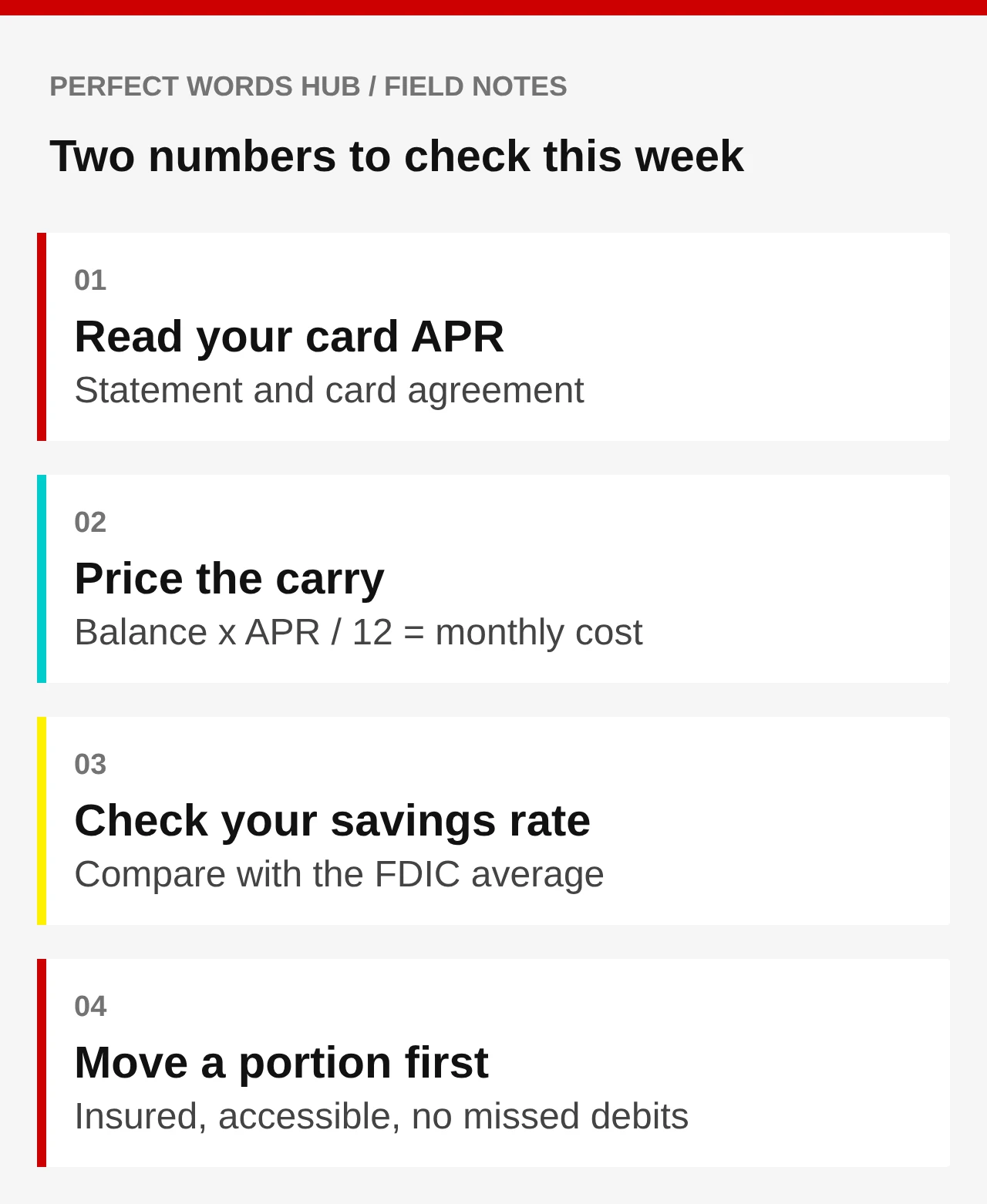
- Open your latest card statement. Find the APR for purchases and any other balances, and note whether the card agreement says the rate is variable.
- Multiply your balance by the APR, then divide by 12. That is a rough monthly interest cost. Write it down.
- Decide on a payment above the minimum, and check the due date against your pay schedule.
- Look at the rate on every savings account you have. Compare it with the FDIC averages above, and note any account that has not changed in a long time.
- If a better rate is worth pursuing, confirm the institution is insured, read the fee and withdrawal terms, and move a portion first.
- Before holiday spending, set a card limit for yourself that you can pay off within a few months, and add the date to your calendar.
- Mark October 27 to 28 and December 8 to 9. A new decision may change the numbers again, so recheck your rates after each.
None of this requires predicting what the Fed does next. It only requires reading two numbers on two statements and deciding whether each one still earns its place.
Sources & further reading
- Federal Reserve: FOMC statement, September 16, 2026
- Federal Reserve: Selected Interest Rates (H.15)
- Federal Reserve: Consumer Credit (G.19), released October 7, 2026
- FDIC: National rates and rate caps
- CFPB: When can my credit card company increase my interest rate?
- CFPB (archived): The Fed is raising interest rates. What does that mean for borrowers and savers?
Source links checked October 17, 2026. Rules, rates and product terms can change.
General personal finance education, not individual financial advice. Confirm details with your institution or a qualified professional.