
The useful part, up front
- A health savings account (HSA) can only be paired with a qualifying high-deductible health plan. A flexible spending account (FSA) is a separate employer benefit with a use-it-or-lose-it design.
- For 2027 the IRS set HSA limits of $4,500 for self-only coverage and $9,000 for family coverage, plus a $1,000 catch-up at age 55 and older.
- Compare total yearly cost, not premium alone: what you pay in premiums, plus what you would pay for care you expect, plus the worst case if you get sick.
The decision is smaller than it looks and larger than you think
Most workers meet this choice the same way. An email arrives with a deadline, the portal lists two or three medical plans with names like “Choice PPO” and “HSA Saver,” and somewhere on page four you are asked whether to add a health FSA. People often pick the lowest paycheck deduction, or the same plan as last year, and click through.
That works if nothing changed. But employers adjust premiums, deductibles, and networks annually, you may have had a birth, a diagnosis, or a new medication, and the account rules reward people who plan ahead. A short sit-down with your last year of medical spending and a calculator usually reveals which plan fits.
This is education, not a recommendation for any particular plan. Your employer’s numbers, your health, and your savings cushion drive the answer. A benefits specialist at work or a tax professional can look at details this article cannot.
Three things people mix up
These labels get used as if they were interchangeable, and they are not.
- A PPO is a type of health plan. HealthCare.gov describes a preferred provider organization as one where you pay less when you use providers in the plan’s network, and you may go out of network without a referral for an additional cost.
- A high-deductible health plan (HDHP) is a health plan with a higher deductible and, in return, usually a lower premium. Some HDHPs are also PPOs. The label says how the plan prices care, not which doctors it covers.
- An HSA is a savings account, not insurance. You can contribute only if you are covered by a qualifying HDHP. HealthCare.gov notes the money can pay deductibles, copayments, and coinsurance, and that it generally cannot pay premiums.
- An FSA is an employer-sponsored account that lets you pay many out-of-pocket medical costs with pre-tax money. It is not tied to a particular plan.
So the real choice is between plan designs (a lower-deductible PPO, or a qualifying high-deductible plan that unlocks an HSA), and then separately whether to add an FSA. They interact, and not always the way people hope.
The 2027 HSA numbers
The IRS published the 2027 inflation-adjusted amounts in Revenue Procedure 2026-24. For plan years in 2027, the contribution limits are $4,500 for self-only coverage and $9,000 for family coverage. If you are 55 or older by year-end, the limit rises by $1,000, a figure set by statute that does not change. When both spouses are 55 or older and not enrolled in Medicare, each can add the catch-up, but each must put it in their own HSA.
The plan itself must also qualify. For 2027, a high-deductible health plan needs a minimum annual deductible of $1,750 for self-only coverage or $3,500 for family coverage. The plan’s annual out-of-pocket limit, which excludes premiums, cannot exceed $8,700 for self-only or $17,400 for family.
- Employer contributions count toward your limit. IRS Publication 969 explains that your limit is reduced by employer contributions that are excluded from your income, including amounts made through a cafeteria plan. If your employer puts $600 into your account, your own room is $600 smaller.
- Unused HSA money carries forward from year to year, and the account stays with you if you change jobs.
- Spending HSA money on non-medical items is taxable and may carry an additional 20 percent tax. That extra tax does not apply after you become disabled, reach 65, or die.
These ceilings are maximums on what the law allows. Your plan’s real deductible may be higher, and your employer may offer a smaller plan than the legal limit.
Who cannot use an HSA
The tax advantages come with eligibility conditions, and a mistake can be expensive. According to IRS Publication 969, to contribute for a given month you generally must be covered by a qualifying HDHP on the first day of the month, have no other health coverage apart from permitted exceptions, not be enrolled in Medicare, and not be claimed as a dependent on someone else’s tax return.
Two details deserve extra attention.
- A general-purpose FSA can block HSA contributions. An employee covered by an HDHP and a health FSA generally cannot contribute to an HSA. The IRS describes a workaround: a limited-purpose FSA, which covers things like vision and dental, or a post-deductible FSA, which waits until the HDHP deductible is met. Ask whether your employer offers one, and whether anyone else in your household has other coverage that could affect eligibility.
- The December 1 rule has a catch. If you are an eligible individual on December 1, the IRS says you are treated as eligible for the whole year, which lets you contribute the full annual amount. But there is a testing period that runs through the end of the following year. If you stop being eligible during it, other than through death or disability, the contributions that the rule allowed are added to your income, along with a 10 percent additional tax. Someone who joins a plan late in the year and leaves the job in March can be surprised.
People who turn 65 and enroll in Medicare lose the ability to contribute, though the money they saved remains theirs to spend on qualified expenses.
What changed recently in the HSA rules
The IRS and Treasury have issued guidance on several HSA changes. According to the IRS announcement of Notice 2026-05, people can receive telehealth and other remote care before meeting the HDHP deductible and still contribute to an HSA, a change described as permanent for plan years starting on or after January 1, 2025.
Starting January 1, 2026, bronze and catastrophic plans available through an Exchange are treated as HSA-compatible even if they do not meet the usual HDHP definition, and the notice clarifies that they do not have to be bought through an Exchange to qualify. Also from January 1, 2026, people in certain direct primary care arrangements may contribute to an HSA and may pay the periodic fees with HSA funds.
The Rev. Proc. for 2027 adds that a direct primary care arrangement is not treated as a health plan for this purpose if monthly fees do not exceed $150 per person, or $300 if it covers more than one person. These are details most employees never need, but they matter if you use a membership-style primary care practice. If you do, ask your plan administrator how it handles the arrangement.
How the FSA works, and where it bites
An FSA is set up through your employer, often as part of a cafeteria plan. You pick an annual amount when you enroll, and your pay is reduced a bit each pay period. The IRS explains that the contributions are not subject to federal income or employment taxes, and the full annual election is generally available to you early in the plan year, even before you have contributed it all.
The limit for health FSAs is $3,400 for 2026, with a carryover of up to $680 if the plan permits it. The IRS adjusts it each year, and no official 2027 figure was available in the sources checked for this article, so ask your benefits team for the amount for your plan year.
The trade-off is the forfeiture rule. FSAs are generally use-it-or-lose-it. A plan may offer either a grace period of up to two and a half months after year-end or a carryover, never both for a health FSA, and anything above the carryover limit is lost. Your election is also hard to change mid-year. The IRS says you can change or revoke it only if the law and your plan specifically allow it, which usually means a qualifying life event.
That points to a sensible way to size the election. Add up only the costs you are nearly sure to have: recurring prescriptions, planned dental or vision work, copayments for ongoing therapy. Stay under that figure. The pre-tax savings can make a bigger election tempting, but money you fail to spend is gone.
Eligible expenses include things many people forget: copayments, deductibles, and insulin, and, according to the IRS, over-the-counter medicine and menstrual care products. FSA money cannot pay premiums.
A worked example with made-up numbers
These figures are invented to show the method. Substitute your plan’s actual numbers from the Summary of Benefits and Coverage. Imagine one employee with self-only coverage choosing between two in-network plans.
- PPO: $220 a month premium share ($2,640 a year), $500 deductible, 20 percent coinsurance after that, $4,000 out-of-pocket maximum.
- HSA-eligible plan: $125 a month premium share ($1,500 a year), $2,000 deductible, 20 percent coinsurance after that, $5,000 out-of-pocket maximum.
The yearly total is premiums plus whatever you pay for care, up to the maximum. For the PPO, that is $2,640 plus $500, plus 20 percent of anything above $500. For the HSA plan, $1,500 plus $2,000, plus 20 percent of anything above $2,000.
| Total cost of care that year | PPO total | HSA plan total |
|---|---|---|
| $0 (preventive only) | $2,640 | $1,500 |
| $1,000 | $3,240 | $2,500 |
| $3,000 | $3,640 | $3,700 |
| $10,000 | $5,040 | $5,100 |
| $25,000 | $6,640 | $6,500 |
Check the $3,000 row. PPO: $2,640 plus $500 deductible plus 20 percent of $2,500 ($500) equals $3,640. HSA plan: $1,500 plus $2,000 deductible plus 20 percent of $1,000 ($200) equals $3,700. The break-even is near $1,925 in care, where the lower premium stops outweighing the higher deductible.
Notice what decides it. The $1,140 premium gap does most of the work for lighter users, while for moderate and heavy users the two plans end up within about a hundred dollars of each other. Then add the pieces the table leaves out. If the employer puts money into your HSA, or if you would save pre-tax dollars you would otherwise have spent anyway, that tilts toward the HSA plan. If an expensive month would strain your cash, the lower deductible of the PPO is worth something, because a $2,000 deductible does not feel the same to everyone.
Questions to ask before you choose
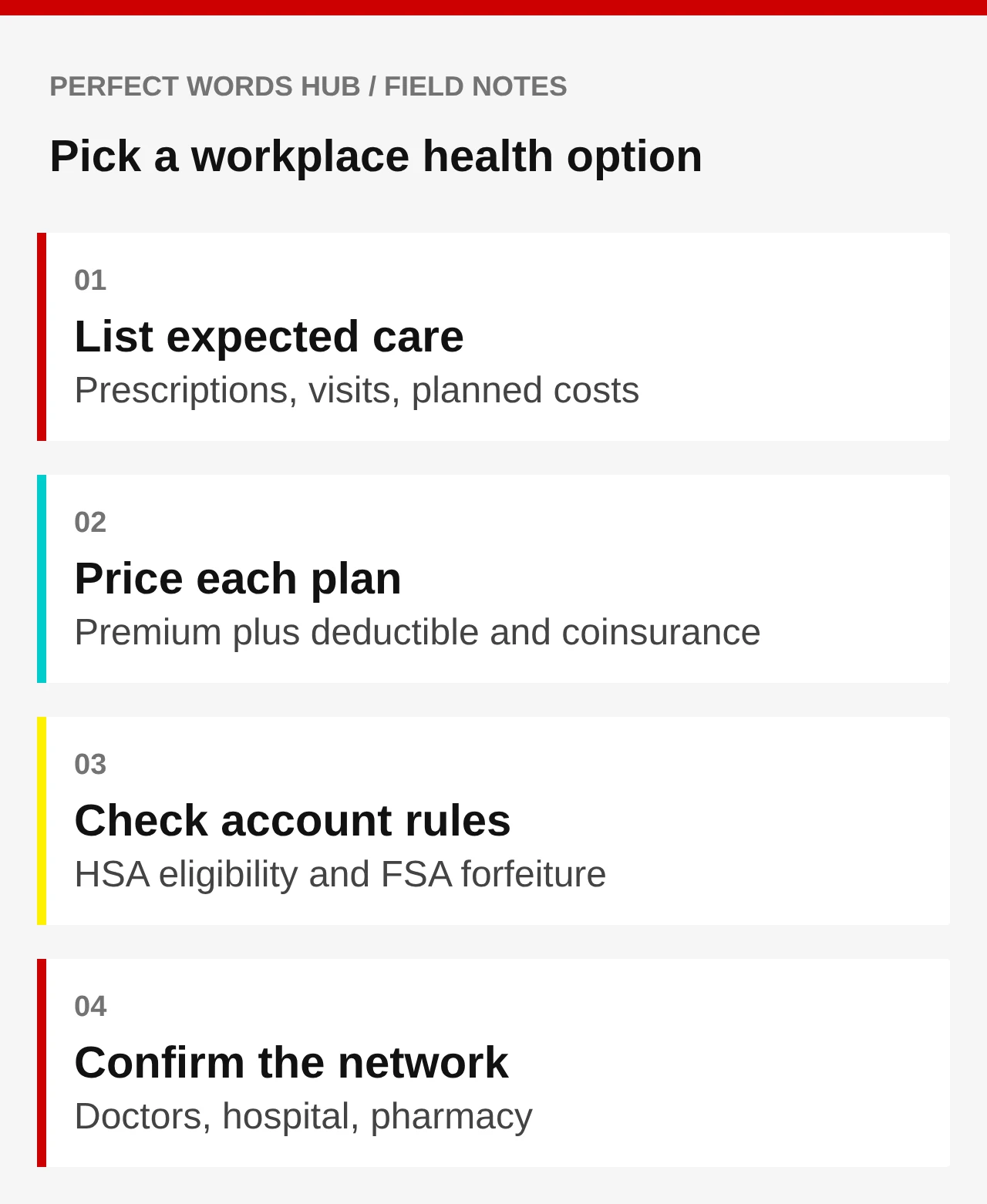
Numbers on a screen skip the questions about how the plan works for you. Our guide on the monthly price being only the first line covers the broader framework, and the checklist below adds the pieces specific to account-based plans.
- Are my doctors, hospital, and pharmacy in the network? A cheaper plan with a smaller network is not cheaper if you leave it. See checking the doctor, the drug, and the details.
- Does my regular medication sit behind the deductible, or does the plan cover it with a copayment first? This can change the HSA plan math completely.
- Will my employer contribute to an HSA, and does it match what I contribute?
- Do I have enough cash outside the HSA to cover the full deductible in a bad month?
- Is a limited-purpose FSA offered if I choose the HSA plan?
- Is the plan’s family deductible embedded, meaning one person can hit an individual limit first, or aggregate, meaning the whole family deductible must be met? The answer changes the risk for households.
Pregnancy, a planned surgery, a new chronic medication, or a child’s braces point to known costs that you can price now. A year with no expected care points to the other end of the table.
Make it stick: after you click submit
Open enrollment decisions are generally locked in for the year. Save the confirmation page or email, and read the final summary for the plan and tier, any dependents, and your FSA or HSA election amounts. If anything is wrong, tell HR before the window closes.
Once the year starts, watch the paperwork. Compare each explanation of benefits to your bill before paying; an explanation of benefits is a checkpoint, not a bill. Keep receipts and statements for FSA and HSA spending in one folder, since you may be asked to substantiate an FSA claim and may need to show that HSA withdrawals paid qualified expenses.
If you are an HSA contributor, set a calendar reminder for December 1 to check your eligibility status and your year-to-date contributions, including any employer deposits. And if you are choosing a plan for the first time since a life change, such as marriage, a move, or a job switch, remember that you may also qualify to change plans mid-year, which your plan documents will spell out.
Sources & further reading
- IRS: Revenue Procedure 2026-24 (2027 HSA and HDHP amounts)
- IRS: Publication 969, Health Savings Accounts and Other Tax-Favored Health Plans
- IRS: Guidance on new HSA benefits under the 2025 tax law
- IRS: Revenue Procedure 2025-32 (2026 health FSA limit)
- HealthCare.gov: Health insurance plan types
- HealthCare.gov: Health savings account (HSA)
Source links checked October 17, 2026. Rules, rates and product terms can change.
General health insurance education, not medical, legal or individual insurance advice. Your plan documents and applicable law control coverage; confirm details with your insurer.