
The useful part, up front
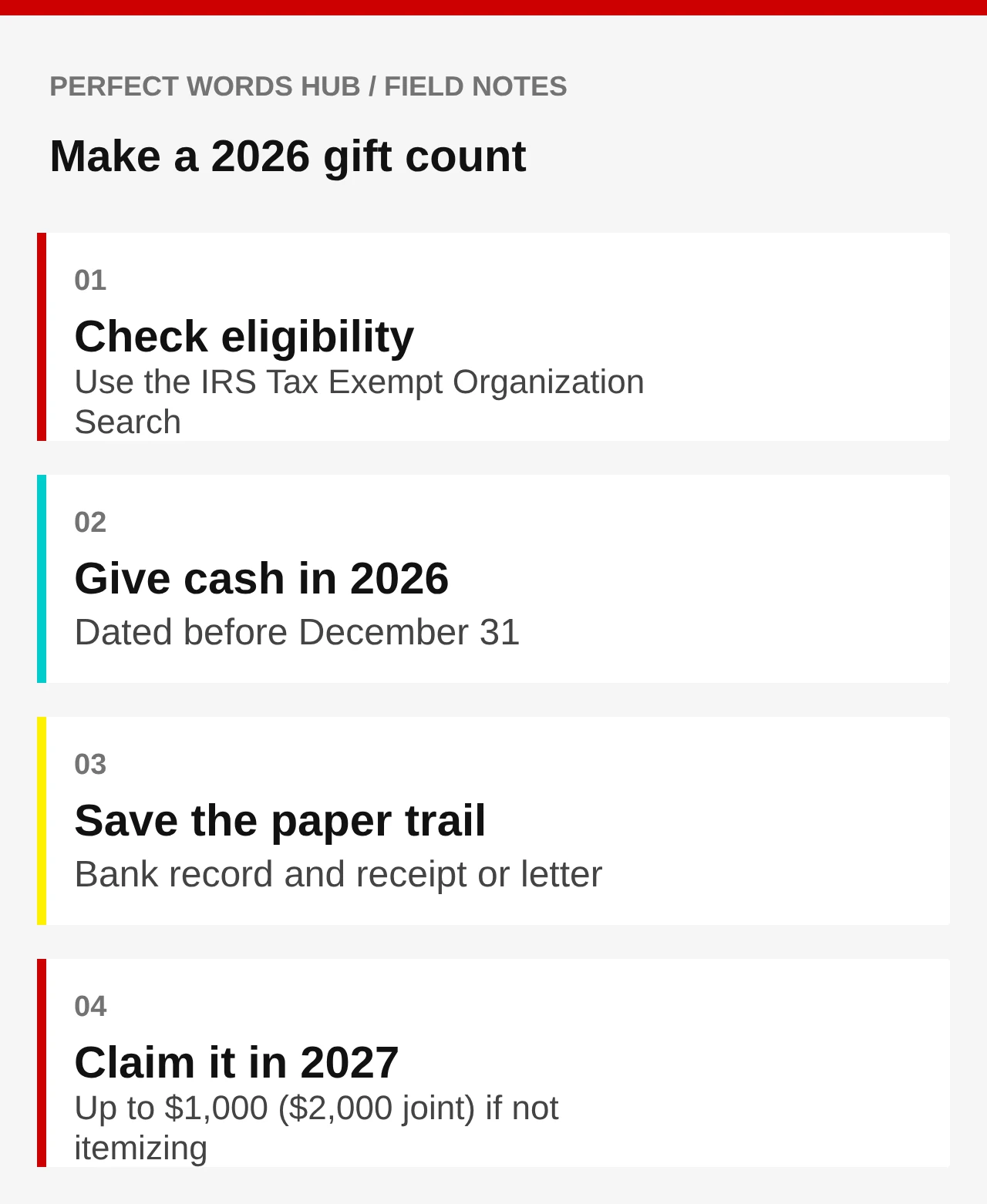
- Beginning with tax year 2026, the IRS says people who do not itemize can deduct up to $1,000 of qualifying cash gifts to charity, or $2,000 on a joint return.
- Only cash gifts made during 2026 to eligible charities count. Gifts of clothing or furniture, gifts to individuals, and gifts to donor-advised funds generally do not.
- The deduction is claimed on the return you file in 2027, so the work to do now is choosing the right organizations and saving the right records before December 31.
You give every year, and your return never noticed
Maybe you drop a check in the offering plate every week. Maybe you give a little each month to a food bank, or you round up at the grocery register, or you donated to a school fundraiser and a disaster appeal this autumn. Then tax season arrived, your software asked about itemizing, and the honest answer was that the standard deduction was bigger than everything you could list. The gifts mattered to someone. On your return, they counted for nothing.
For 2026, the IRS has told taxpayers that part of this changes. Its Publication 6196, written for people who do not itemize, says that eligible non-itemizers may deduct up to $1,000 of qualifying cash contributions, and up to $2,000 if married filing jointly. IRS Topic 506 on charitable contributions says the same thing and notes that it begins with tax year 2026.
This article explains what the rule covers, what it leaves out, how to tell whether it is worth planning around, and what to keep so that a December gift is easy to claim next spring. It is general information, not tax advice for your situation.
What the IRS actually says
Here is the rule in the IRS’s own terms, paraphrased. To claim the deduction you must not itemize, which means you take the standard deduction. You must have made cash contributions during 2026. The gift must go to an eligible charitable organization. And you must keep records such as receipts, canceled checks, or bank records.
The ceiling is a per-return figure, not a per-gift one. A single filer's total of qualifying cash gifts for the year, up to $1,000, can be deducted. A married couple filing jointly can deduct up to $2,000 in total. The deduction applies to the first dollars you give, so a person who gave $400 in 2026 would be looking at a $400 deduction, not $1,000.
If you are married filing separately, read the publication itself before counting on a number. It does not walk through that status in the summary we relied on, and the details can depend on whether your spouse itemizes.
One reminder about what a deduction does. It lowers the income that is taxed; it does not hand you the amount back. Our guide to the difference between a deduction and a credit shows why a $1,000 deduction is worth far less than $1,000 off your tax bill.
Does the deduction matter for you? A quick test
Every taxpayer takes either the standard deduction or itemizes, whichever is better. The IRS’s 2026 inflation adjustments list the standard deduction at $16,100 for single filers and married individuals filing separately, $32,200 for married couples filing jointly, and $24,150 for heads of household. The IRS page carrying those figures is now marked as historical content, so confirm them on the current standard deduction pages or in the 2026 Form 1040 instructions before you rely on them.
If your deductible expenses that you could itemize, such as mortgage interest, state and local taxes within the allowed limit, and gifts, add up to less than your standard deduction, you are a non-itemizer and this rule is for you. If they add up to more, you will itemize and your gifts get deducted on Schedule A, subject to the usual limits.
Consider a married couple filing jointly. Their mortgage interest and taxes total $24,000, and they gave $5,000 in cash to charity in 2026. Itemizing would give $29,000, which is less than the $32,200 standard deduction, so they take the standard deduction. Before the new rule, the $5,000 would have changed nothing. Under the rule, the IRS says up to $2,000 of it may be deductible.
Now a different couple. Their mortgage interest and taxes total $34,000, and they gave $5,000. Itemizing gives $39,000, which beats $32,200 by $6,800. They itemize, and the new non-itemizer deduction is not relevant to them.
For a rough sense of value, suppose a filer's top federal tax bracket were 12%. A $1,000 deduction would reduce federal tax by about $120. That bracket is a stand-in for the illustration; your own bracket, and any state tax effects, will differ. For some households the best reason to give is simply to give; the tax effect is a modest bonus.
There is a middle zone worth watching: people whose itemized total lands within a few thousand dollars of the standard deduction. For them, the added non-itemizer deduction can make the standard route a little better than it already was, so run the comparison both ways once your year-end gifts are known.
Which gifts count, and which do not
The condition that trips people up is the word cash. The IRS ties this deduction to cash contributions made during 2026. It describes the records for them as receipts, canceled checks, or bank records, which tells you that a check or electronic transfer sits comfortably in the category. A bag of clothes dropped at a donation center, a used car, or stock are different kinds of gifts, and the IRS document describing this deduction does not extend it to them. Noncash gifts are handled under other rules, and if you itemize they can be deducted at fair market value, with Form 8283 required when the deduction for noncash property is over $500.
Three other limits from the IRS material are worth stating plainly.
- Gifts to individuals are not deductible. Topic 506 says only qualified organizations can receive deductible contributions. Helping a neighbor, a relative, or a person on a crowdfunding page for their own expenses does not count, however worthy it is.
- Donor-advised funds generally do not qualify. Publication 6196 says contributions to them generally are not eligible for this particular deduction.
- The organization must be eligible. The IRS points taxpayers to its Tax Exempt Organization Search tool to check. Some eligible groups, such as certain churches and government bodies, may not show up there separately, so a missing name is a reason to ask, not proof of a problem.
If you receive something in return, such as a dinner ticket at a benefit or an item at an auction, only the amount above the fair market value of what you got is deductible. A $150 gala ticket for a meal and entertainment worth $60 supports a deduction of $90, not $150.
Checking the charity before you give
The IRS search tool is where you confirm that an organization is eligible to receive deductible gifts. The publication notes that organizations with deductibility codes such as “50% (60% for cash contributions),” PC, POF, or FED are generally eligible. You do not need to memorize codes. Search by name or EIN, see whether the organization is listed as eligible to receive deductible contributions, and take a screenshot or note the date you checked.
This also helps in the busiest giving weeks of the year, when text solicitations, social media appeals, and unfamiliar callers multiply. A name that sounds close to a well-known charity is not the same thing as that charity. Use the organization’s own website, typed in yourself, rather than a link in a message.
The IRS donor-advised fund page adds a caution of its own, warning that arrangements promoted as donor-advised funds but built mainly to create improper deductions or personal benefits may have their deductions disallowed. If someone is pitching a giving vehicle that sounds too good, slow down.
The records that make a gift easy to claim
The IRS wants two layers of paperwork, and the rules do not change just because the new deduction exists. For any cash, check, or other monetary gift, regardless of amount, keep a bank record or a written communication from the charity showing its name, the amount, and the date. Publication 1771 lists accepted bank records as statements from a financial institution, electronic fund transfer receipts, canceled checks, and credit card statements. Receipts, letters, and emails from the charity are accepted written communications.
For any single contribution of $250 or more, you also need a written acknowledgment from the organization. It must include the organization’s name, the cash amount, and a statement of whether the charity gave you goods or services in return, with a description and good-faith value if it did. Publication 1771 says you must have it on or before the earlier of the date you file your return or its due date, including extensions. Charities often send year-end summaries by the end of January.
Separate gifts under $250 are not added together to cross that line, even if the year’s total is higher. Weekly $20 gifts to the same congregation do not each need an acknowledgment, though your bank records still should be in order. A single $300 gift does.
Where a payment is partly a gift and partly a purchase and exceeds $75, the charity is supposed to give you a written disclosure estimating the value of what you received. Keep it with the receipt.
If you give through payroll deduction, Publication 1771 allows a pledge card plus a pay stub, Form W-2, or other employer record showing the amount withheld. Keep both.
A simple structure works well. Create one folder for 2026 giving, save every receipt and acknowledgment in it as the gift happens, and add a one-line list at year-end: charity, date, amount, how paid, document saved. A basic tax record system already built for the year makes this a five-minute habit rather than an April scramble.
Timing: what December 31 does and does not decide
The IRS says contributions must be paid before the close of the tax year to be deductible for that year. For this new deduction, the IRS says the cash must be given during 2026. That makes the calendar year, not the filing date, the cutoff.
The practical question is when a gift counts as made. The IRS pages we reviewed do not lay out the rules for every payment method in detail. If you want a gift to count for 2026, do not leave it to the last hours. Give early enough in December that your bank or the charity’s receipt clearly shows a 2026 date, and ask the charity if you are unsure how it dates different kinds of gifts.
This ties in with other year-end moves that expire on December 31 and those that wait until April. Our guide to those deadlines sorts them out. Charitable giving is firmly in the first group: by January 1 it is too late for 2026.
If you tend to give in lumps, you can also decide whether to give sooner in the year than usual. A person who ordinarily gives $2,500 at year-end might compare the itemizing math with the standard deduction math. Groups of gifts can swing the outcome in either direction, so it pays to know your estimate before you act.
What this article cannot tell you
Two parts of the 2026 charitable picture are outside what the IRS pages we reviewed could confirm today. First, other changes for people who itemize starting in 2026. Several news and professional summaries discuss new limits for itemizers, but we could not verify specific percentages on the IRS pages we read, so we are not quoting them. If you itemize, check the 2026 edition of Publication 526 and the 2026 Schedule A instructions when they are published. The 2025 Publication 526 we reviewed still describes a general 60% of adjusted gross income limit on certain cash gifts, but it is written for 2025 returns.
Second, state rules. State income tax treatment of charitable gifts differs from federal, and some states have their own credits or limits. Check your state tax agency.
Also remember that Congress and the IRS can issue further guidance. Publication 6196 is dated October 2026, and forms and instructions for 2026 returns will be released over the coming months. The safest course is to give with the confidence that your records are sound, and then confirm the final rule on the day you file.
A short checklist for the next six weeks
Use this as a working list.
- Decide your giving plan for the rest of 2026 and compare it with your usual pattern.
- Estimate whether you will itemize or take the standard deduction. If you are not sure, use last year’s return as a start and update it.
- For each charity, confirm eligibility using the IRS search tool, and note the date.
- Prefer traceable payments, a check or electronic transfer, over loose cash.
- Save every receipt, acknowledgment, and bank record in one 2026 folder.
- For any gift of $250 or more, make sure you will get an acknowledgment, and ask for it in January if it does not arrive.
- Set aside noncash donations in a separate pile. They follow different rules.
- When you file in 2027, use the IRS’s then-current instructions to see how the non-itemizer deduction is reported.
Giving is worth doing for its own sake. If it happens to lower your tax, a clean paper trail is what turns that possibility into a line on your return.
Sources & further reading
- IRS Publication 6196: Charitable contribution deduction tips for non-itemizers
- IRS Topic 506: Charitable contributions
- IRS: Charitable contribution deductions
- IRS: Charitable contributions, written acknowledgments
- IRS Publication 1771: Substantiation and disclosure requirements
- IRS: 2026 tax inflation adjustments (standard deduction)
Source links checked October 17, 2026. Rules, rates and product terms can change.
General US tax education, not individual tax advice. Check irs.gov for current figures or ask a qualified tax professional.