
The useful part, up front
- An assessment is an estimate of value. Your tax bill also depends on exemptions, local tax rates, and how your home compares with every other property in your community.
- Appeal windows are set locally and are often only weeks long. The date printed on your notice, or on your assessor’s calendar, is the one that counts.
- Check the facts on your property record first, then gather recent comparable sales and repair documentation. A claim that the number is simply too high rarely goes far without evidence.
A reassessment notice is not a bill, but the deadline is real
You open an envelope from the county assessor and see a new estimated value for your house. It is higher than you expected. Maybe much higher. Your first instinct might be to call, complain, or pay a company to fight it for you. Your second, calmer instinct should be to find the date.
Appeal windows differ by place, and they can be short. This month is a good example. Cook County, Illinois, is reassessing the south and west suburbs in 2026 and mails notices township by township. As of the assessor’s calendar page, updated October 15, 2026, several townships were still open for appeals, with last filing dates running from mid-October to late November. Orland Township, for example, was open until November 6, and Thornton Township until November 23. Elsewhere the calendar looks entirely different, which is the point: your own county’s date is the only one that matters.
The rest of this guide is meant to work anywhere. The examples come from three official sources in three states, and I will say which is which. Your county assessor or appraisal district will have its own rules, forms, and calendar.
Value, assessment, and bill are three different things
People use these words as if they were interchangeable. They are not. Cook County’s assessor separates the estimated market value, which is what the office believes homes like yours would sell for, from the assessed value, which is the amount used to calculate property taxes. For residential property in Cook County the assessed value is usually 10% of the estimated market value. Other places use other percentages.
Then comes the part that surprises people. The assessor does not set tax rates or bills. The Cook County Assessor says plainly that a change in your assessment does not cause the same percentage change in your taxes. Your bill reflects your property’s exemptions, the total assessed value of your community, and the amounts that local taxing bodies, such as schools and municipalities, decide to collect. If everyone’s values rise together, your share may stay about the same. If your neighbors’ values rise more than yours, your share can shrink even when your own number goes up.
Our guide to costs beyond the mortgage payment explains why property tax belongs in your budget. Here, the takeaway is narrower: a higher estimate can be a warning light, but it is not a final bill, so look at the whole picture before reacting.
Three places, three calendars
To see how much timing varies, compare what three official sources say.
- Cook County, Illinois. Properties are reassessed on a three-year cycle by township. The assessor’s appeals page says you typically have about 30 days after receiving your reassessment notice, and the last date is printed on the notice. Appeals can be filed with the Assessor and later with the Board of Review, each with its own dates.
- Texas. The Comptroller explains that you protest to your county’s appraisal review board. If your appraised value rose, the appraisal district must send a notice of appraised value by May 1, or April 1 for a residence homestead, or as soon as practical afterward. In most cases you have until May 15 or 30 days after the notice was mailed, whichever is later.
- San Mateo County, California. The county says the deadline for a regular assessment appeal for 2026, such as a decline-in-value or base-year-value request, is November 30, 2026. Appeals tied to supplemental or escape assessments, or roll corrections, run on a different clock: 60 days from the mailing date on the notice. Each application carries a $30 non-refundable fee, and one application is needed per parcel per roll year.
Three states, three rhythms. If you remember one habit, make it this one: the day the notice arrives, find the filing deadline and put it on your calendar before you do anything else. A strong case filed late is usually no case at all.
Run the numbers before you spend an evening on it
Not every high estimate deserves an appeal. The Cook County Assessor offers a useful rule of thumb. If the property characteristics on your notice are correct and the estimated market value is within about 10% of what you think your home is worth, an appeal is unlikely to change your assessed value enough to matter for your bill.
Here is an illustration with made-up numbers. Suppose the estimate is $400,000 and you believe a fair price is $380,000. The gap is $20,000, or 5%. Now suppose your taxes work out to roughly 2% of market value in your area. That rate is an assumption for the example; find yours on a recent tax bill. Then the estimated bill on $400,000 is $8,000 and on $380,000 is $7,600, a difference of $400 a year. If the gap is $40,000, the difference is $800.
Whether that is worth your time depends on you. Filing in some places is quick. Cook County says its online appeal can take as little as 20 minutes and is free. But a decision can also come back unchanged, and in some places the process can stretch out. San Mateo County notes that a full appeal can take up to two years from filing. Do the arithmetic with your own bill, then decide.
Start with the cheap fixes: errors and exemptions
The easiest appeals are not arguments about value at all. They are corrections. Pull up your property record online and read it as if you were checking a car title.
- Square footage, number of bedrooms and bathrooms, lot size, and year built.
- Features that do not exist, such as a finished basement, a garage, or a pool.
- The property class or type, and whether any recent renovation is shown that did not happen.
- Your name, parcel number, and mailing address.
The Cook County Assessor lists incorrect property characteristics as one of the two main reasons to file an appeal; the other is a market value well above what you think the home could sell for. A wrong detail can feed straight into the estimate, so fixing it can move the number without a debate.
Separately, look at your exemptions. Cook County’s FAQ, for instance, lists a homeowner exemption and exemptions for seniors, veterans with disabilities, and others. Exemptions are applications, not appeals, and they follow their own rules and deadlines. If you recently bought, moved, or turned a certain age, check with your local office whether you need to apply or renew.
Build an evidence file that can be understood in five minutes
The Texas Comptroller is unusually direct about this: you cannot show up at the hearing and just say the appraisal district is wrong. It is up to you to bring what proves your case. The same logic applies almost anywhere.
Its list of useful material includes photographs of your property and of comparable ones, receipts or estimates for repairs, sales price documentation such as listings or closing statements, and, if you are arguing that you are taxed unequally compared with similar properties, the supporting calculations. It also names affidavits, property surveys, engineering reports, deed records, and architectural drawings. For a typical house, the strongest set is simple:
- Three to five recent sales of homes similar to yours in size, age, condition, and location, with dates, addresses, and prices.
- Photographs and written estimates that document problems the assessor’s model would not know about, such as a foundation crack, a failing roof, water damage, or a dated kitchen.
- A one-page summary: what the record says, what you believe is correct, and the single number you are asking for.
A word on your purchase price. Cook County’s assessor says the price you paid is sometimes, but not always, a reflection of market value, because prices depend on the buyer, the seller, and even the time of year. A recent sale is useful evidence, but do not assume it ends the argument.
What the process looks like once you file
Most systems start with a conversation. In Texas, the notice of appraised value explains how to file and offers an informal conference with the appraisal district before the formal hearing. If it does not settle, you continue to the appraisal review board, which must give at least 15 days’ notice of the hearing. The board hears both you and the district. You can attend in person, by phone or video, or file a written affidavit. The board’s decision applies only to the tax year in question. If the board rules for you, the taxing units adjust the roll, and if you already paid, they send a refund.
Cook County follows a different sequence, with an appeal to the Assessor first and another window at the Board of Review. The assessor notes that once you have appealed your reassessment, you generally do not need to do it every year unless the property changes significantly, such as through new construction or demolition. A missed reassessment window can be revisited when your township next opens for appeals.
California’s San Mateo County assigns each accepted application an appeal number, schedules a pre-hearing conference, and then an evidentiary hearing; it promises notice at least 45 days before the hearing date. These steps can sound formal. They are mostly structured conversations, but you have to show up and be ready.
If a company offers to appeal for you
After a reassessment, many owners receive mail from firms that offer to file an appeal and take a share of any savings. The Cook County Assessor addresses this directly: you do not need to hire anyone, and notices from such firms do not come from the assessor’s office. The office notes that these firms charge fees based on their own estimates of potential savings, and those estimates may or may not be accurate.
That does not mean every representative is a bad choice. Some owners do prefer to hire help, particularly for complex or commercial property. In Texas, you can appoint an agent on a state form. But read the fee terms before you sign, ask what happens if no savings result, and compare the cost with what you could do yourself in an evening.
Pay on time, expect a lag, and mind the tax return
An appeal does not automatically pause your bill. In Cook County, the assessor’s FAQ says to pay the bill you receive even if an appeal is pending, because property taxes are paid in arrears and changes from an appeal are reflected in a later installment. Rules differ by location, so follow the instructions printed on your own bill and ask the local treasurer or collector if you are unsure.
Then there is the federal return. The IRS says deductible real property taxes are generally state or local taxes on real property levied for the general public welfare, charged at a uniform rate across the jurisdiction. It also says the combined deduction for state and local taxes on Schedule A is limited to $40,000 ($20,000 if married filing separately), subject to an income-based limit and not reduced below $10,000. That only helps if you itemize, and the IRS page (updated September 24, 2026) is the place to confirm the current rule. For a calendar of other year-end moves, see our piece on which tax moves expire December 31 and which wait for April.
A one-evening plan
If your notice just arrived, here is a way to use the next few hours well.
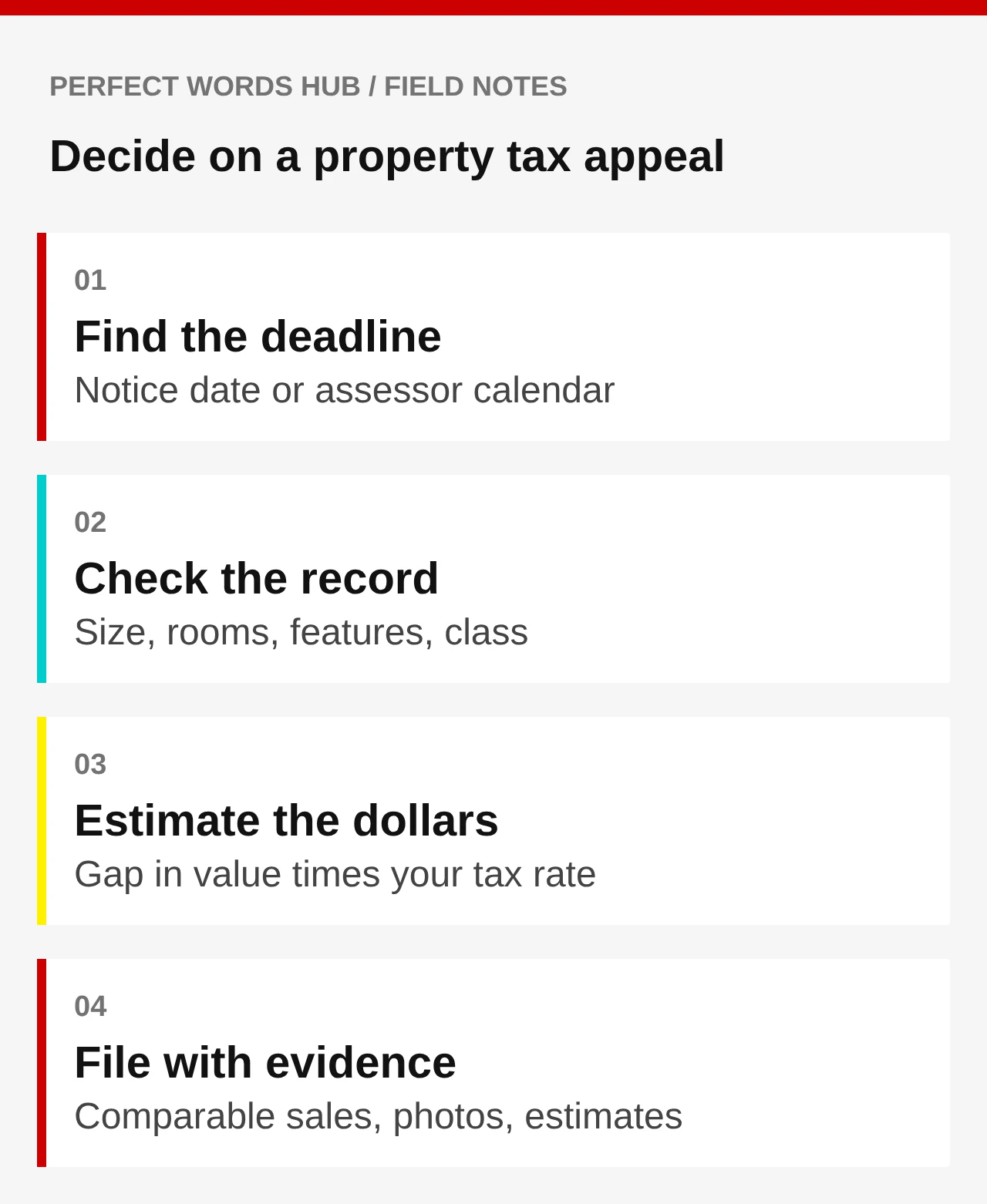
- Find the deadline on the notice or your assessor’s website. Write it down, and add a reminder a week earlier.
- Compare every detail of your property record with reality. Note errors with photos or measurements.
- Find recent sales of similar homes nearby. Save addresses, dates, and prices from public records or listings.
- Estimate the dollar effect using your last tax bill, then decide whether it is worth filing.
- File through the official channel, keep the confirmation, and put the hearing date on your calendar when it arrives.
- Pay your bill on time unless your local office tells you otherwise.
An appeal is a fact-check with a deadline. Done calmly, it can correct a mistake. Done late or without evidence, it usually cannot.
Sources & further reading
- Cook County Assessor: Assessment and appeal calendar (updated October 15, 2026)
- Cook County Assessor: Appeals overview and FAQ
- Cook County Assessor: Frequently asked questions
- Texas Comptroller: Property tax protests and appeals
- San Mateo County: Assessment appeals
- IRS: Topic no. 503, Deductible taxes
Source links checked October 17, 2026. Rules, rates and product terms can change.
General real estate and mortgage education, not financial or legal advice. Rates change often; confirm current terms with licensed lenders.