The useful part, up front
- Most states recognize an implied duty to keep rental housing livable, and heat is commonly part of that. The exact rules, deadlines, and remedies are set locally.
- Tell your landlord in writing, keep a dated record, and give a reasonable time to fix it before taking stronger steps.
- Do not stop paying rent or deduct repair costs without checking your local rules first. A wrong move can put you at risk of an eviction case.
Handle safety first, rights second
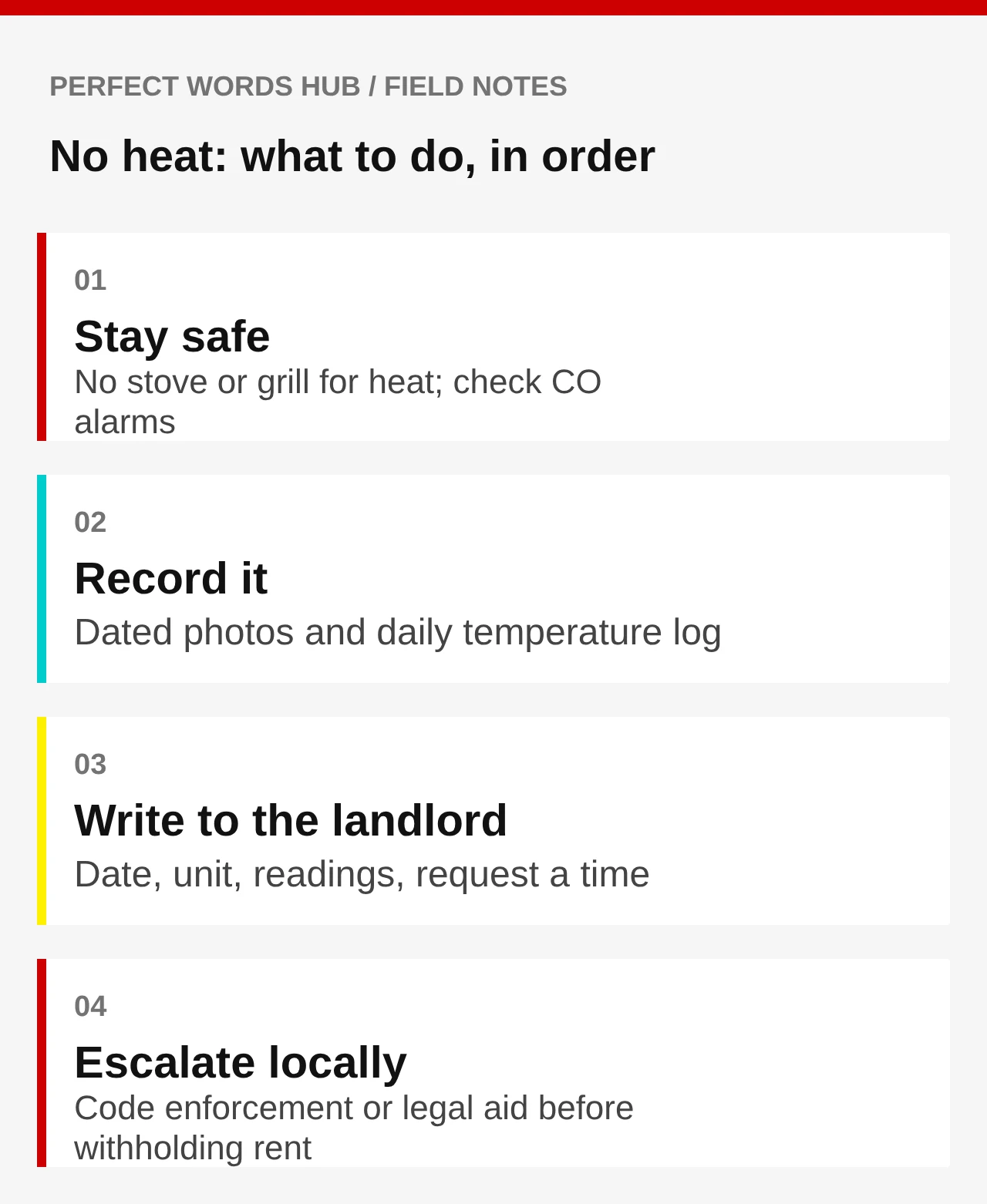
If the heat is off and the weather is severe, the first priority is staying safe. Indoor cold can be dangerous for infants, older adults, people with certain medical conditions, and anyone who cannot easily leave the home. If anyone in the home is unwell, or the temperature is dangerously low, call a doctor or emergency services and consider staying with a friend, relative, or at a shelter or warming center while you sort out the repair.
Check on neighbors who may be at higher risk, such as older adults living alone, and let a friend or relative know about the situation. A repair that takes days is manageable when you are warm and supported, and much harder when you are alone and cold.
Be careful with temporary heat. Never use a gas stove or oven to heat a home, and never run a generator or grill indoors. These can cause carbon monoxide poisoning, which has no smell and can be fatal. If you use an electric space heater, plug it directly into a wall outlet, keep it away from curtains and bedding, and never leave it running while you sleep or when you leave. Fire safety groups such as the NFPA publish plain checklists on safe heater use.
Carbon monoxide alarms are cheap and can save lives. If your home has fuel-burning appliances and you do not have a working alarm, ask your landlord to install one and keep a record of that request too.
Confirm the problem is the building, not just your unit
Before you write the landlord, spend ten minutes checking basics. If you have a thermostat, make sure it is on heat mode, set above the room temperature, and has working batteries. Check whether the circuit breaker has tripped. Ask a neighbor whether their heat is out too. If the whole building is cold, the problem is probably the boiler or the central system. If only your unit is cold, it may be your own radiator, a bleed valve issue, or a thermostat.
These checks matter for two reasons. They can sometimes solve the problem in minutes. And if you report a problem, your landlord’s first response will probably be to ask whether you tried the basics. Having already done it, and noting that you did, makes your report more credible.
Document before you demand
Start a simple record the same day. It does not need to be fancy.
- Take dated photos or video of the thermostat reading and of a separate thermometer in the room.
- Write down the temperature at the same times each day, for example morning, afternoon, and night.
- Save screenshots of any texts or emails with the landlord or property manager.
- Note the date and time you first noticed the problem, and when you first told someone.
Why record the temperature? Some cities and states set minimum indoor temperatures during certain months, often measured at specific hours. Even without such a rule, a log is persuasive evidence of how long the problem lasted and how serious it was. Our guide on building a paper trail when a repair request goes unanswered covers how to keep these records in a way you can hand to a code inspector or a lawyer.
Ask in writing, and keep the message simple
Phone calls are quick, but a written message creates proof. Use email or text, or use the landlord’s official maintenance portal if there is one. If your lease says repair requests must be made a certain way, follow that method and also send a message by email.
A short message works best:
Hello, the heat in unit 4B has not worked since the evening of [date]. Indoor temperatures are around [number] degrees. Please arrange a repair today and let me know when a technician will come. I am available [times]. Thank you.
Keep it factual and polite, and send it to every contact you have: the property manager, the maintenance email, and the owner if you know how to reach them. Avoid threats, insults, or long stories. Include your unit number, the date the problem began, and a way to reach you. Ask for a time frame, and note any response. If someone promises a visit, write down the date and name.
If you do not get a response within a day or so in cold weather, send a second message that references the first, and then escalate. Escalation might mean the property manager’s supervisor, the owner’s emergency line, or the management company’s corporate contact.
Find out what your local rules say
Habitability law is mostly state and local, so the same situation can lead to different options in different places. Search for your state or city’s tenant handbook, which many state attorney general offices, housing agencies, and legal aid groups publish. Look for answers to these questions:
- Is there a minimum indoor temperature, and during which months or hours does it apply?
- How long does the landlord have to repair after receiving notice?
- Who can I report to: a city housing department, code enforcement office, or health department?
- What remedies exist if repairs do not happen, such as a rent reduction, repair and deduct, or terminating the lease?
- Are there steps I must take first to use those remedies, like giving a written notice and waiting a set number of days?
The U.S. Department of Housing and Urban Development has a tenant rights page that links to resources by state. Legal aid organizations and sites like LawHelp.org can direct you to free or low-cost help, including tenant hotlines in many cities.
Call code enforcement when the landlord does not respond
If the landlord cannot be reached or does not fix the problem within a reasonable time, contact the local housing or code enforcement office. Many cities will send an inspector, document the violation, and issue a notice to the landlord with a deadline. An official violation record can be powerful in later disputes, and the possibility of fines often motivates faster repairs.
When you call, have your address, your landlord’s name and contact information, the dates, and your temperature log ready. Ask whether you need to be home for the inspection, and whether a written complaint is required. Keep the complaint number or case reference.
If your building is subsidized or participates in a federal program, there may be additional inspection standards. The agency or property manager can tell you which standards apply.
Be careful with rent withholding and repair-and-deduct
Online advice often says tenants can stop paying rent when there is no heat. In some places this is allowed under strict conditions. In many others it is not, and tenants who withhold rent without following the exact legal steps can be sued for non-payment even if the landlord was wrong about the repair. The risk is lopsided: a mistake can lead to an eviction filing on your record.
Repair-and-deduct, which lets a tenant pay for a repair and subtract the cost from rent, has its own limits. Some states cap the amount, require written notice, and set a waiting period. Some places do not allow it at all. If you are tempted to use either remedy, get advice from a legal aid office or tenant organization before acting. Many offer free consultations.
A safer middle path in some areas is paying rent into an escrow account or to the court, which can show good faith while preserving your rights. Again, local law decides whether that is possible.
Keep paying attention to retaliation rules
Many states prohibit landlords from retaliating against a tenant who complains about housing conditions or contacts a code enforcement office, for example by raising rent, cutting services, or starting an eviction without a legitimate reason. Protections differ in scope and timing. If you notice an adverse action soon after you reported a repair issue, write down the dates and consult a tenant advocate. Your documentation of when you first reported the problem will help.
Costs, extra expenses, and the end of the problem
Keep every receipt for costs caused by the outage, such as space heaters, hotel stays, or extra laundry. In some places, tenants can ask for a rent reduction or reimbursement for these losses, particularly when the outage lasts long or the repair is repeatedly delayed. Even if you do not seek compensation right away, the receipts preserve your options.
Once the heat is back on, send a short message confirming the date and time it was restored and asking the landlord to confirm in writing. That closes the loop and prevents later disagreement about how long the outage lasted.
If heat problems keep returning, ask about permanent repair or replacement of the system, and consider asking for a written plan. Repeated failures that never get fixed matter for lease renewal decisions. Our lease renewal checklist can help you decide what to ask for before you sign another term.
Sources & further reading
- HUD: Tenant rights, laws, and protections
- LawHelp.org: Find free legal help by state
- Legal Services Corporation: Get legal help
- NFPA: Electric portable space heater safety
- CDC: Carbon monoxide poisoning prevention
Source links checked October 17, 2026. Rules, rates and product terms can change.
General education about tenant rights, not legal advice. Rules differ by state and city; check local law or ask a legal aid office.