The useful part, up front
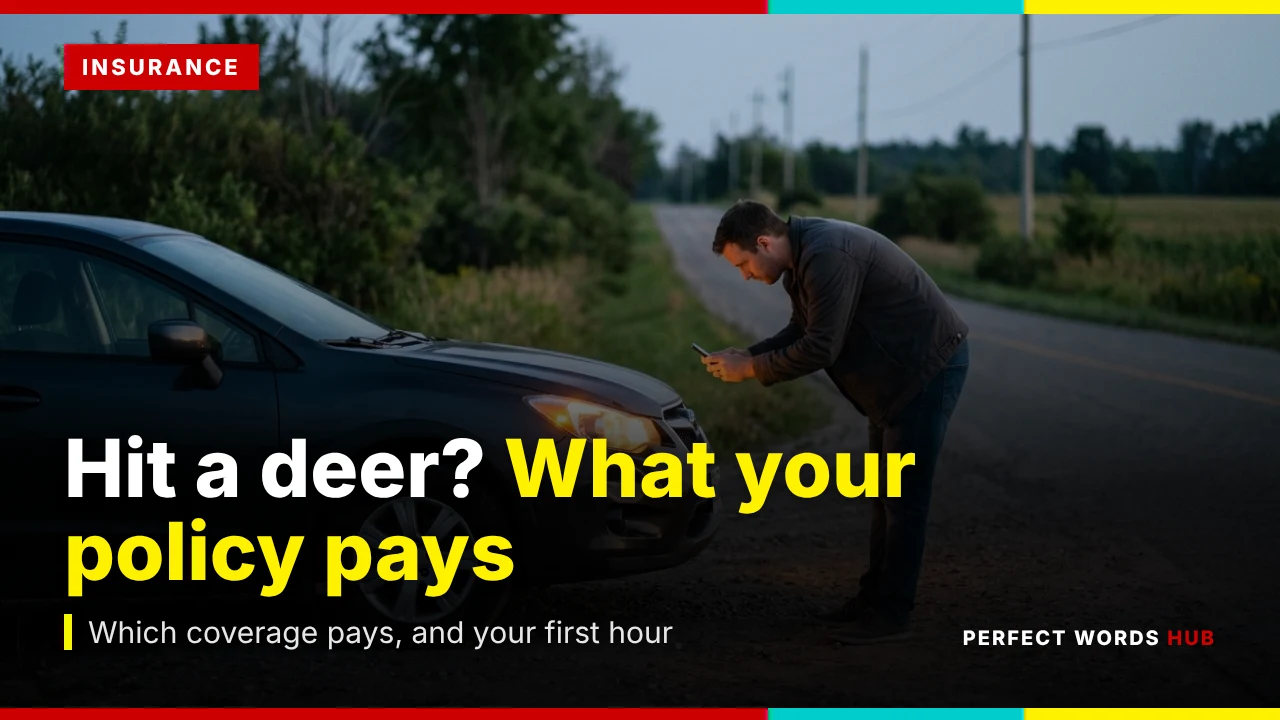
- Damage from hitting an animal is generally a comprehensive coverage claim. Swerving and hitting a car, pole, or guardrail instead usually moves the claim to collision, so check that you carry both.
- You pay the deductible first. On a $3,200 repair with a $500 deductible, the insurer pays $2,700. With a $1,000 deductible, it pays $2,200.
- At the scene, safety comes first, then photographs, a police report if the situation calls for it, and a prompt call to your insurer. Do not approach an injured animal.
Dusk, a two-lane road, and a pair of eyes
You are twenty minutes from home. The light is going, the road has a shallow curve, and something at the edge of the shoulder lifts its head. There is a half-second in which you decide whether to brake, swerve, or hold your line. Then it is over, and you are sitting on the shoulder with your hazards blinking, wondering two things: is everyone okay, and what is this going to cost?
The second question has a more straightforward answer than most people expect, and the answer depends on a few lines in a policy you probably have not read since you bought it. This guide walks through those lines. It is written for the stretch of the year when deer move the most, and when the claims pile up.
Why this is a fall problem
State Farm’s latest animal-collision analysis, published September 15, 2026 and covering July 1, 2025 through June 30, 2026, estimates more than 1.6 million animal-vehicle collision claims across the country. That is down from about 1.7 million in the prior period. The company says the national odds of a collision were 1 in 145 for the year, compared with 1 in 139 the year before. It reports paying $1.9 billion in related claim costs. Treat these as one insurer’s estimates, not a census, but the scale is clear.
The odds depend heavily on where you live. In that analysis, West Virginia had the highest likelihood at 1 in 46, followed by Montana at 1 in 54, Wisconsin at 1 in 62, Pennsylvania at 1 in 64, and Michigan at 1 in 68. Pennsylvania had the largest estimated number of claims, about 141,000.
Timing matters too. Wisconsin’s Department of Transportation identifies October and November, the deer mating season known as the rut, as one of the two peak periods of the year, with the other in May and June. In its 2024 data, Wisconsin recorded 17,432 deer crashes, and the hours around dawn and dusk were the highest-risk times of day. State Farm’s release makes a similar point about fall and the dusk-to-dawn window.
One more statistic worth knowing, because it shows what is at stake besides money: the State Farm release reports that the Insurance Institute for Highway Safety counted 210 people killed in motor vehicle crashes involving animal collisions in 2024. Wisconsin’s data adds a sharper detail. Of its 2024 deer crashes, 221 involved motorcycles, and those accounted for 7 of the state’s 9 deer-crash deaths.
Which coverage pays: comprehensive, collision, or neither
Auto policies are built from separate coverages, and each answers a different kind of loss. The NAIC describes collision as coverage that pays to repair your car after it hits an object or another vehicle, and comprehensive as coverage for non-collision damage such as fire, storms, vandalism, flooding, theft, and glass. State Farm states that comprehensive coverage typically handles animal collision repairs after the deductible, subject to policy terms.
In plain terms, here is how the common outcomes line up.
| What happened | Coverage that usually responds |
|---|---|
| Your car strikes a deer | Comprehensive |
| You swerve and hit a guardrail, tree, or another vehicle | Collision, and possibly liability if someone else’s property is damaged |
| Injuries to you or passengers | Medical payments or personal injury protection if you carry it, then your health coverage |
| You carry liability only | Liability does not pay for your own car |
The second row is the one that surprises people. Progressive’s consumer guidance explains that if you swerve to avoid an animal and hit something else, your own car’s damage is a collision matter, and if the swerve damages another person’s property you could be found at fault. That is the insurance reason, on top of the safety reason, that traffic-safety agencies advise against swerving. Wisconsin’s transportation department says that if a collision is unavoidable, you should brake firmly and stay in your lane, since swerving can lead to a more serious crash. State Farm’s guidance says the same: brake firmly, stay in your lane, and do not swerve.
The last row matters most to drivers with older cars who dropped optional coverage to save money. Liability pays for damage you cause to others. It does not repair your own vehicle after a deer strike. If you carry liability only, the repair bill is yours.
The deductible arithmetic
The deductible is the amount you pay first on a covered claim. Progressive notes that comprehensive deductibles typically fall somewhere between $100 and $2,000, and that when you buy the coverage you choose the figure. The insurer then covers the rest, up to what the policy allows. Here is what that looks like on a repair of $3,200.
| Deductible | You pay | Insurer pays |
|---|---|---|
| $250 | $250 | $2,950 |
| $500 | $500 | $2,700 |
| $1,000 | $1,000 | $2,200 |
Now run the same logic backward, because it explains a decision many drivers make at renewal. Say raising your comprehensive deductible from $500 to $1,000 saves you a modest amount per year. If that saving is $60, you would need more than eight claim-free years just to recover the extra $500 you would owe in a single loss. That is a trade, and it can be a fine one if you have the cash on hand. It is a bad one if a $1,000 surprise would go on a credit card at a high interest rate. The $60 is an example, not a quote; the actual difference depends on your insurer, car, and location.
Small damage raises a different question. If the repair estimate is $600 and your deductible is $500, you would collect $100 and may have a claim on your record for little gain. Whether that claim affects your future price depends on your state and insurer. Progressive says that in some states rates may not rise after a deer claim because the driver is generally not treated as at fault, but a premium increase is not ruled out. The honest answer is to ask your agent or insurer about claim effects before filing a marginal one, and to revisit the question at renewal using our guide to treating an insurance renewal as a fresh comparison.
Total loss and the value of an older car
Sometimes the repair is not worth making. The NAIC notes that on an older car, the cost to repair can quickly exceed what the car is worth. In that case the insurer may pay you the car’s value rather than fix it.
How is that value set? According to the NAIC, adjusters generally base it on what similar used cars have sold for locally. The Blue Book is only a guide, and you can research the value yourself, for instance by collecting listings or sales for matching vehicles near you. The NAIC adds that insurers may pay less than a Blue Book figure if local sales support it. Under the NAIC’s model claims regulation, an insurer that values a total loss by a method other than comparable vehicles should explain it fully and support any deductions with itemized, measurable factors.
A simple example with made-up numbers: your car’s local market value comes in at $9,000, your comprehensive deductible is $500, and the insurer declares a total loss. Before taxes, fees, and any state-specific adjustments, you would expect roughly $8,500. If you still owe $10,500 on a loan, that leaves a $2,000 gap that the claim payment does not cover. Some loans come with optional gap coverage meant for exactly this situation, so check your loan paperwork before you need it.
The NAIC also points out that the insurer can take the title after paying a total-loss claim and keep any salvage value, and that you may negotiate to buy the car back at the agreed salvage value. Lienholders are generally named on checks, so expect your lender to be involved if you are still paying off the car.
The first hour: a scene checklist
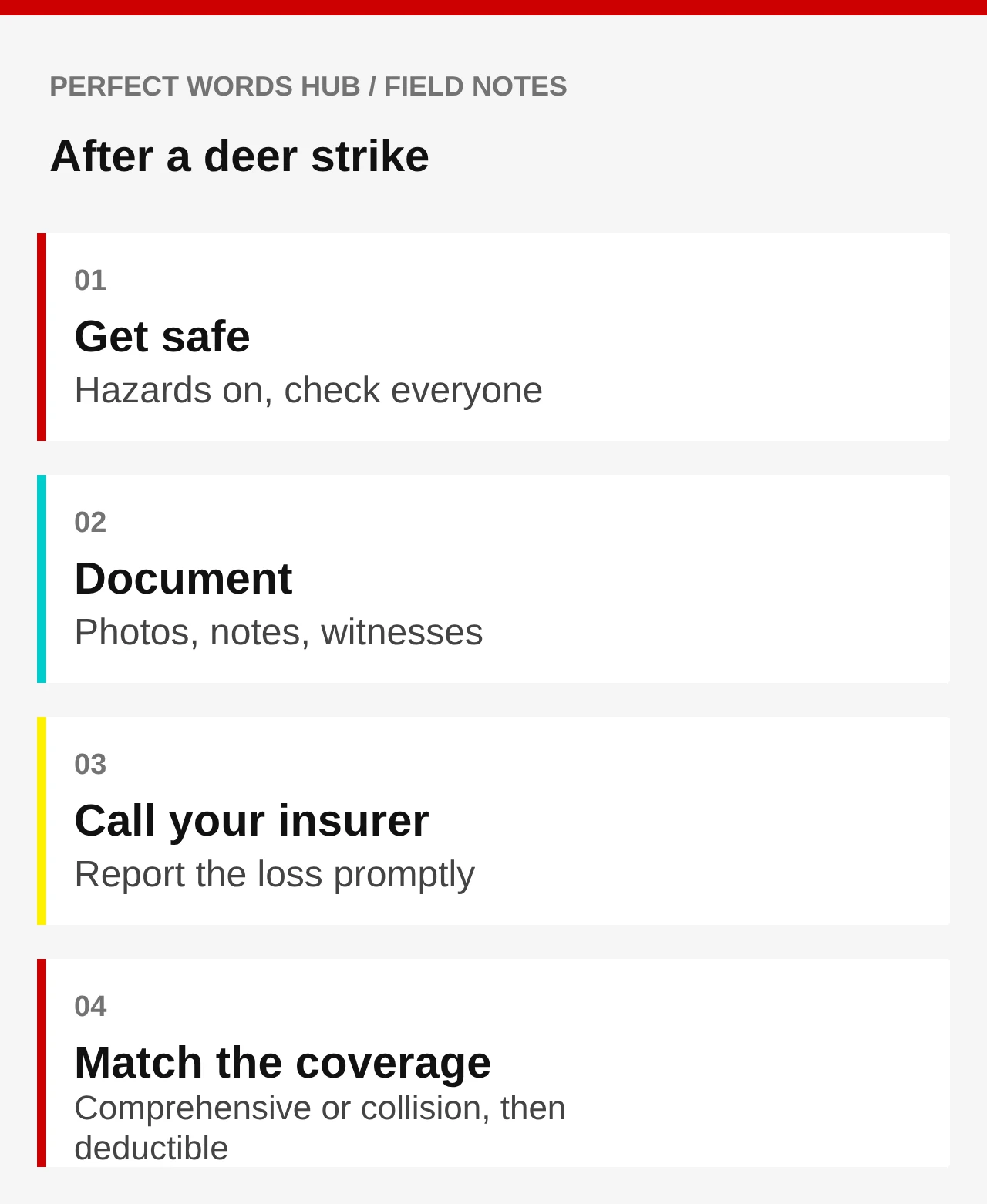
What you do in the first sixty minutes shapes the claim. Combine the advice from State Farm, Progressive, and the Wisconsin Department of Transportation, and the sequence looks like this.
- Get safe. Stay buckled until traffic is clear. If the car can move, pull to the shoulder and turn on your hazard lights. Do not stand in a travel lane.
- Check people first. Call 911 if anyone is hurt or if a large animal remains in the road.
- Keep your distance from the deer. An injured animal can be dangerous. Leave it to authorities and do not try to move it.
- Photograph everything you safely can. Wide shots of the road, close-ups of damage, the license plate, and any fur, blood, or debris on the car. If there are witnesses, get their contact details.
- Scan the car for leaks, broken lights, flat tires, or a hood that will not latch. If any of these are present, or you are unsure, arrange a tow instead of driving.
- Call the police when the situation calls for it. Wisconsin’s guidance is to call law enforcement after hitting a deer. A police report can help document the event, though whether one is required varies by state and by local rules.
- Call your insurer. Report the loss promptly and ask how photos and estimates should be submitted.
Write down the time, location, and road conditions while they are fresh. If the claim becomes complicated, those notes will be worth more than your memory three weeks later.
Repairs, rentals, and what to ask the adjuster
Once the claim opens, expect an adjuster or a photo-estimate process. A few questions are worth asking up front.
- Does my policy include rental reimbursement, and what are the daily and total limits? The NAIC explains that for a claim against your own policy, rental coverage applies only if you bought it, subject to its limits.
- Can I choose my own repair shop, and does the estimate cover hidden damage found after the car is taken apart?
- Are the repairs using new, used, or aftermarket parts, and does my policy say anything about that?
- Is a safety sensor, camera, or radar unit affected? Deer strikes often hit the front of the car, where sensors or cameras may be mounted on newer cars, so ask the shop and the insurer how any needed recalibration is handled.
If you disagree with the estimate, the same method applies as in any claim: get a second written estimate, ask for the insurer’s line items, and keep a log of calls. If the dispute drags on, your state insurance department accepts complaints about delayed, denied, or underpaid claims. Find yours through the NAIC’s state directory, and expect the department to judge the claim by your policy and state law.
Check your policy before the next drive
A ten-minute review now is better than a surprise later. Pull up your declarations page, the summary page that lists your coverages and limits, and look for four things.
- Is comprehensive listed? If you only see liability, a deer strike will not be paid by your policy for your own car.
- What is the comprehensive deductible? Compare it with the cash you could put your hands on this week.
- Do you have collision? It matters if you swerve, and a lender or lessor may require it on a financed or leased car.
- Is rental reimbursement included? If not, decide whether the cost of adding it is worth the protection.
For drivers with older cars, the question is whether the coverage is worth its price. A useful rule of thumb is to compare the annual cost of comprehensive and collision with the car’s likely market value, then weigh your ability to replace the car out of savings. There is no universal right answer, and the NAIC reminds shoppers to give each insurer identical details, so quotes are comparable. Our piece on comparing insurance beyond the premium offers a framework for that.
Driving the next two months
None of this replaces avoiding the collision in the first place. The advice from State Farm, Wisconsin DOT, and others is consistent. Slow down on roads where deer are known to cross and heed the warning signs. Remember that deer rarely travel alone, so if you see one, expect another. Be most alert between dusk and dawn, use high beams when it is safe and appropriate, and keep your phone out of your hand. Wear your seatbelt every time. If an animal enters your path, brake firmly and hold your lane.
Motorcyclists deserve a separate warning. Wisconsin’s 2024 data shows that about 42 percent of motorcycle-deer crashes there caused a death or serious injury, compared with under 0.1 percent for passenger-vehicle deer crashes. That is a state-level figure, but it makes the point that a rider has far less margin.
There is also a hopeful note in the research. State Farm cites early monitoring on a Colorado highway where wildlife crossings and fencing reduced collisions by about 90 percent. The lesson for drivers is modest but real: some of the risk is built into the road, and local transportation agencies track where the crashes cluster.
For now, the plan is simple. Know which coverage you have. Know your deductible in dollars. Keep your phone charged and your insurer’s claim number saved in it. Then, when the road curves at dusk, you are ready for the worst moment without being surprised by its aftermath.
Sources & further reading
- State Farm Newsroom: Animal collision data and driver safety (Sept. 15, 2026)
- Wisconsin DOT: Deer crashes in Wisconsin, 2024 fact sheet
- NAIC: Auto insurance consumer guide
- NAIC: Unfair Property/Casualty Claims Settlement Practices Model Regulation (Model 902)
- Progressive: Does insurance cover hitting a deer?
- NAIC: Need Help with Insurance? Insurance Departments Are Your Trusted Source
Source links checked October 17, 2026. Rules, rates and product terms can change.
General US insurance education, not individual insurance or legal advice. Your issued policy and applicable law control coverage.