The useful part, up front
- On October 15, 2026, the FBI warned that scammers are using the November midterms to sell fake donations, fake merchandise, and fake voter-registration alerts.
- A message that says you are not registered to vote is a prompt to check on your own, through your state election office, not to tap the link in the message.
- A donation is not an investment, and a registered-looking committee can still be a scam. Look the committee up on the FEC website before you give.
The text arrives while you are making dinner
It says your voter registration could not be confirmed, or that you can lock in a matching gift to a candidate you actually like, or that a limited-run campaign hat is yours for twelve dollars. It looks local. It might use a candidate’s name, a logo, even a slogan you have seen on yard signs. And it arrives in the weeks when your phone is already full of real political messages.
That overlap is the whole trick. When genuine campaigns, parties, pollsters, and advocacy groups are all contacting you, one more message does not feel out of place. You do not have to become suspicious of everything. You need a short routine that works on any message in under a minute, and a clear idea of what the common schemes look like.
This guide is built around that routine. It draws mainly on a public service announcement the FBI’s Internet Crime Complaint Center (IC3) published on October 15, 2026, along with guidance from the Federal Election Commission (FEC), the Federal Communications Commission (FCC), the Federal Trade Commission (FTC), and USAGov. Nothing here tells you whom to vote for or whether to give. It only helps you tell a real request from a fake one.
What the FBI is warning about this time
The October 15 announcement updates an earlier FBI warning from October 2024, written for the previous general election. The new version says scammers may use the 2026 midterms to commit financial fraud. Two tactics run through every scheme it describes.
First, scammers borrow the identity of candidates and campaigns: names, images, logos, and slogans, used to ask for donations, sell merchandise, or collect personal information. Second, the FBI says they may use artificial intelligence to produce realistic voices, images, and messages that imitate candidates, campaigns, government bodies, and people you know. That second point matters for how you judge evidence. A voicemail that sounds exactly like a public figure, or a photo that looks authentic, is no longer proof of anything by itself.
The practical lesson is to stop judging a message by how convincing it feels and start judging it by where it asks you to go and what it asks you to hand over.
Four schemes, in plain language
The FBI describes four schemes. Knowing their shapes makes them easier to spot, even when the wording changes.
- Campaign investment pool. You are promised a guaranteed return if you contribute to a pool that pays out after a candidate wins, and you are encouraged to recruit others to raise your share. A contribution to a campaign is not a financial product. The FBI’s own guidance is that donations are not investments, will not grow in value, and will not be refunded. Any pitch that promises a payout, and rewards you for bringing in friends, is a red flag on its face.
- Scam PACs. You think you are giving to a political action committee, a Super PAC, or a candidate committee, but the people soliciting you have no connection to it and keep the money.
- Online purchase. A seller advertises political merchandise, takes your payment, and never ships. This is an ordinary non-delivery scam wearing a campaign’s colors.
- Voter registration. You get a text or email saying you are not registered, with a link to a fake state registration page that collects your personal information for identity theft and other fraud.
Notice what the four share. Each one creates a small, plausible reason to act right now, and each one ends at a page or a payment you did not look for yourself.
The “you are not registered” message
This one deserves its own section because it hits people who are doing everything right. You registered years ago. A message says there is a problem. Anxiety about losing your vote is a powerful reason to click.
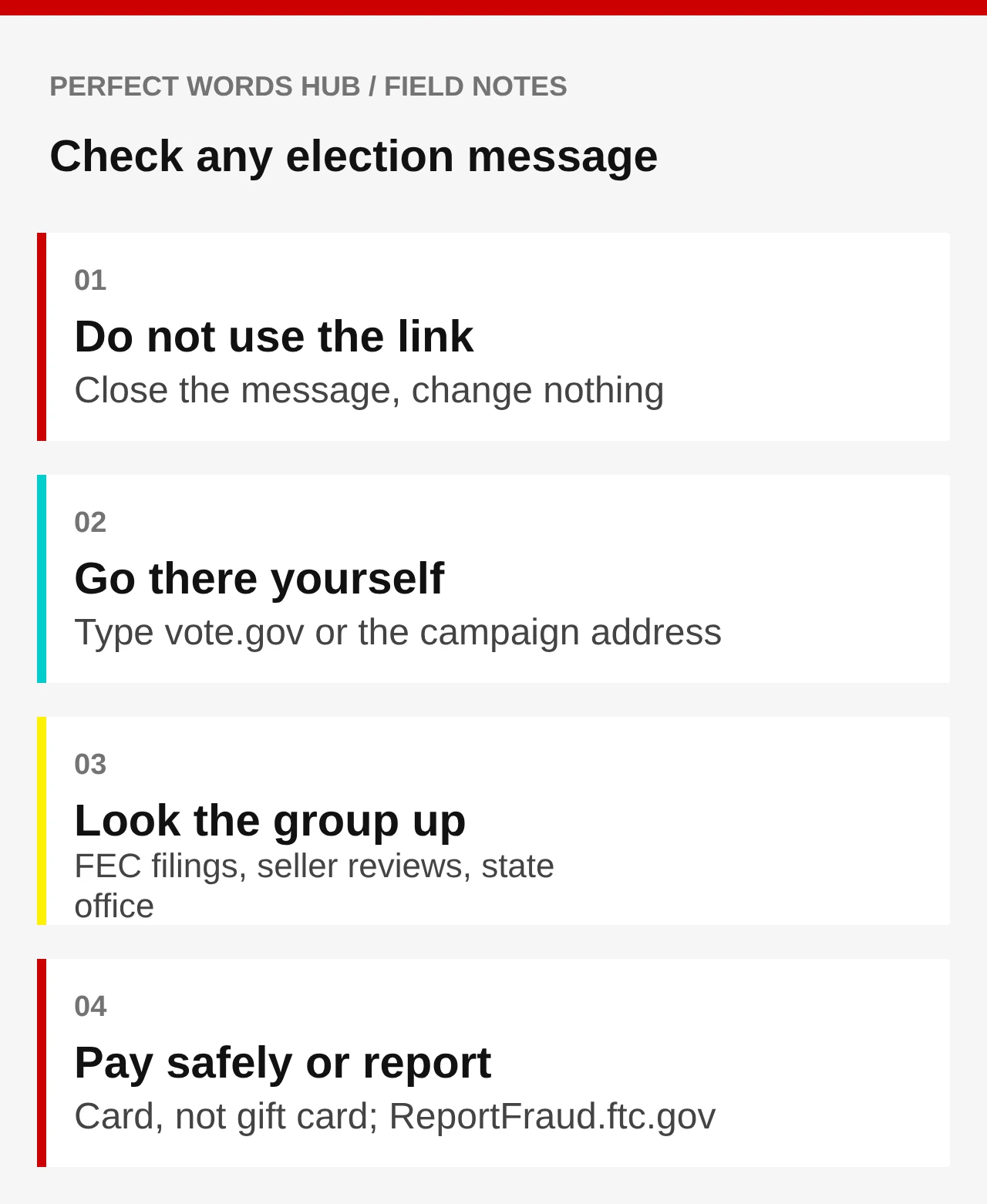
Do not use the link. Instead, check your status from a route you start yourself. The FBI’s announcement suggests verifying your registration at vote.gov, the federal government’s voter information site. USAGov also points voters to their state or local election office, and its page on finding a polling place says polling places are assigned by home address, can change between elections, and should be confirmed with your state’s election office before Election Day.
A simple order of operations looks like this:
- Close the message without replying. Do not tap anything, including a “STOP” link inside a message you do not recognize.
- Open your browser and type vote.gov, or search for your state’s election office through USAGov. Do not use a search ad.
- Check your registration status through the state’s official page that vote.gov or USAGov leads you to.
- If everything is in order, you are done. If something looks wrong, call or visit the election office using contact details from its official site, not from the text.
Two details help you tell a fake page from a real one. As a rule of thumb, a status lookup should not ask for a payment or a “verification fee,” and the FBI lists a fake registration page as a way to harvest personal information. If a page asks for more than the state’s own site does, close it.
Check a committee before you give
If you want to donate, you do not have to rely on a link in a message at all. Go to the candidate’s or committee’s website by typing the address or finding it yourself, and check the committee first.
The FEC publishes a free public database. Its guidance on researching PACs, parties, and other committees describes two ways in: browse lists of committees, or search by keyword when you know only part of the committee’s name or its treasurer’s name. For a specific committee, you can see its filings, a financial summary of receipts and disbursements, cash on hand and debts, and any FEC enforcement matters, audits, or advisory opinions involving it.
One warning from the FBI changes how you should read the result: scam PACs can appear to be registered. Being listed is a starting point, not a verdict. The FBI points to spending patterns as a clue, saying high fundraising, consulting, compliance, or administrative expenses may signal a scam.
Here is an illustration, not real data. Suppose a committee’s filings show it raised $100,000 and spent $85,000 on fundraising, consulting, and administration. That leaves $15,000, or 15 cents of every dollar, for anything else. Compare that with a committee that raised the same amount and spent $30,000 on those categories, leaving $70,000. Neither number proves anything alone, and legitimate committees have real costs, but a committee that spends most of what it raises on its own overhead deserves a harder look before you give.
Also confirm that the name on the filing matches the name that contacted you. The FBI advises checking that contact details in an unsolicited message match the organization it claims to represent.
Real campaigns text, too
It helps to know what is legal, because the existence of political texts does not mean they are scams. The FCC’s consumer guide on political campaign robocalls and robotexts says autodialed or prerecorded political calls and autodialed texts to cell phones generally require the recipient’s prior express consent, while texts sent manually do not. Campaign calls and texts are exempt from the National Do Not Call Registry, which is why signing up for that list does not stop them.
You can withdraw consent. The FCC says consent can be revoked at any time and in any reasonable way, such as replying STOP, and campaigns must honor the request. The same guide says calls made with AI-generated voices count as “artificial” under the relevant law, which is why voice-cloned robocalls are illegal in many cases.
A reasonable rule follows from this. Replying STOP to a campaign you recognize is fine and is your legal right. Replying to a number you do not recognize may only confirm that someone reads the messages, so for those it is usually safer to delete the message after forwarding it to 7726 (SPAM), the reporting shortcut the FCC and FTC both mention. If you want to file a complaint, the FCC accepts them online at fcc.gov/complaints.
Merchandise, payment, and what you can undo
Political merchandise scams work like any other non-delivery scam, so treat them that way. Before you buy, search the seller’s name along with the word “complaints,” and look at reviews on sites you already trust. The FBI recommends researching sellers through reviews and complaints before you buy.
The way you pay matters more than any other choice. According to the FTC’s guidance on what to do if you were scammed, you can contact a credit card issuer using the number on the back of your card to ask for a refund, and federal law limits your losses from unauthorized use. Debit cards carry protections too. Payment apps, wire transfers, gift cards, and cryptocurrency are harder to recover, and the FTC notes that recovery is harder with crypto because it lacks the protections that cards have. A seller that insists on one of those methods is telling you something.
The same logic applies to donations. A real campaign takes card payments. If a message asks you to donate by gift card, crypto, or a wire, treat the request itself as the warning.
If you already clicked, replied, or paid
Tapping a bad link is not the same as handing over your money or identity, and what you do next depends on what you shared. Match your steps to that.
- You only tapped the link. Close the page, update your phone, and run a security scan. The FTC’s phishing guidance recommends updating security software and scanning if a click may have installed malware.
- You typed a password. Change it right away, change it anywhere else you reused it, and turn on two-factor authentication. If you are locked out, see our guide to building a backup door into your online accounts.
- You typed a Social Security number, card number, or bank details. Go to IdentityTheft.gov for a recovery plan matched to what you shared. Consider a credit freeze or fraud alert, and read your credit reports using the approach in our credit report review routine.
- You paid. Contact your card issuer, bank, or payment app immediately and say you were tricked.
Then report. The FBI asks victims to contact their local FBI field office or file at ic3.gov, and to include names, contact details, payment details and method, how contact began, and what you were told and gave. The FTC takes reports at ReportFraud.ftc.gov. Reports do not always bring money back, but they help investigators see patterns.
A fifteen-minute routine before Election Day
You can do most of this in one sitting, ahead of the rush. Check your registration through your state’s election office. Confirm your polling place, hours, and any early or mail voting rules in your state, since those vary and USAGov directs you to your state or local office for them. Write down the official website addresses you trust, so you never need to hunt for them under pressure.
The FBI also urges voters to rely on trustworthy election information, consider who produced it and why, and verify when, where, and how to vote. Its separate announcement on election crimes lists deliberately misstating the time, place, or method of voting as a federal crime, and it asks voters to report that kind of disinformation. It also reminds people never to accept payment in exchange for voting a certain way.
Finally, decide your own rule for giving. For example: “I only donate by typing the campaign’s address myself, I look up unfamiliar committees on the FEC site, and I pay by credit card.” A rule you made in advance is far easier to follow than a decision made while a countdown timer ticks.
If a message is hard to evaluate, our guide to verifying a message before you click walks through the same habit with other kinds of lures. The point is always the same: you choose where to go next. The message does not.
Sources & further reading
- FBI IC3: Scammers Exploit 2026 U.S. Midterm Election to Perpetrate Multiple Fraud Schemes (Oct. 15, 2026)
- FBI IC3: FBI Warns Voters on Election Crimes Ahead of the November 2026 Midterm Election
- FEC: Researching PACs, parties, and other committees
- FCC: Political Campaign Robocalls and Robotexts Rules (consumer guide, PDF)
- USAGov: Find your polling place
- FTC: What To Do if You Were Scammed
Source links checked October 17, 2026. Rules, rates and product terms can change.
General online safety education. Check official sources and your own institutions for current guidance.