
The useful part, up front
- A court order ended the SAVE plan in March 2026. Servicers began sending notices on July 1, 2026, and each borrower gets 90 days from their own notice to choose a different plan, followed by a final 30-day notice.
- If you make no choice, the servicer places you in a fixed-payment plan (Standard or Tiered Standard). That payment can be much higher than an income-based one, and Tiered Standard payments do not count toward Public Service Loan Forgiveness.
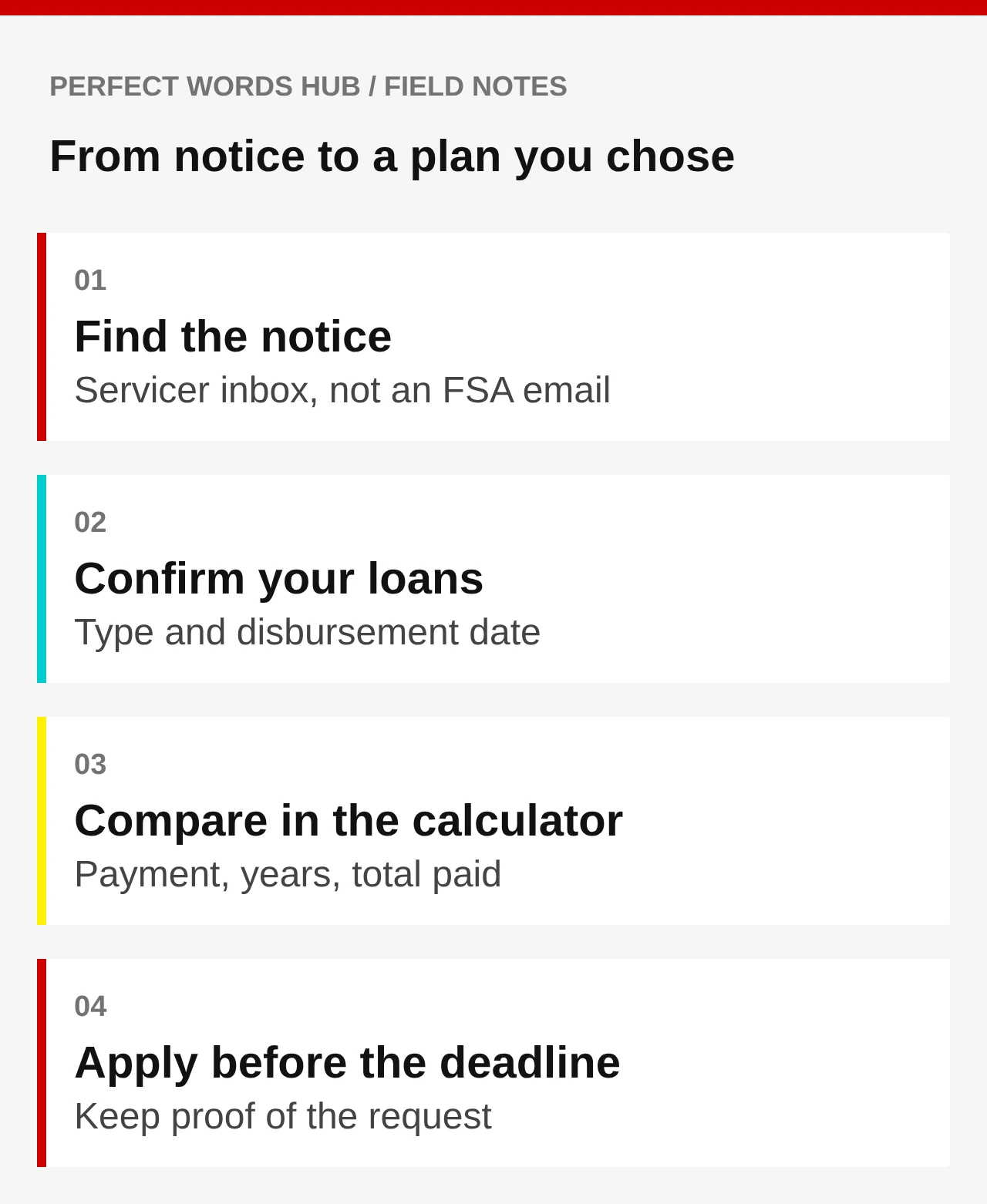
- Your deadline depends on the date printed on your servicer’s notice, not on a government email or a news article. Find that notice first, then compare plans with the official calculator.
Start with the notice you may have been ignoring
Maybe it arrived in July and you filed it under “deal with later.” Maybe it landed in a spam folder, or in an inbox you check twice a year. Maybe you heard that SAVE was over and assumed somebody, somewhere, would sort out your payment automatically. Somebody will, in a sense. But it will be a servicer’s default setting, not a decision you made.
This article is for borrowers who were enrolled in the SAVE plan, or who had a SAVE application pending, and who have not yet picked a new plan. It is general education built on the Department of Education’s own guidance for SAVE borrowers, which was published this month. It is not advice for your particular loans. Your balance, interest rates, loan types, income, and career path decide which plan makes sense, and the official tools can run those numbers for you.
The short version: the decision belongs to you until your final deadline passes. After that, a fixed-payment plan is chosen for you. Everything below is meant to help you use the time you have left.
What actually happened to SAVE
SAVE, short for Saving on a Valuable Education, was an income-driven repayment plan. According to Federal Student Aid, a court order ended it in March 2026. Because the plan no longer exists, nobody can stay in it, and everyone who was in it has to move to something else.
Moving is not instant. Servicers are notifying borrowers in groups, which is why two people with the same servicer can have different deadlines. The Department says every SAVE borrower will be notified before the end of 2026. So if you have heard nothing yet, your notice is probably still coming, and it is worth confirming your email address and mailing address with your servicer now so the notice does not go astray.
One more detail that surprises people: if you never applied for SAVE, or you were in school, in a grace period, or holding a loan taken out on or after July 1, 2026 that has not entered repayment, the guidance says you do not need to take action over this particular change.
Find your own deadline
The clock starts when your loan servicer sends the notice. Federal Student Aid is explicit that its own emails do not start your 90 days. That matters, because many borrowers received general emails from the agency months ago and assumed they had already missed or beaten some date.
Look for one of two subject lines in your servicer’s inbox or in your own email: “You Have 90 Days to Select a New Repayment Plan” or “Final Notice – You will be Placed into a New Repayment Plan in 30 Days.” The federal guidance lists the sending addresses for the five servicers it names: Aidvantage, CRI, Edfinancial, MOHELA, and Nelnet, all on studentaid.gov email domains. If a message claims to be from your servicer but comes from somewhere else, treat it with suspicion and log in to the servicer’s site directly instead of clicking.
Then do the date arithmetic. The official example is a notice dated July 1, 2026, which gave a deadline of September 29, 2026. The table below uses the same 90-day count for other sample notice dates. These are my calculations from the 90-day rule, not dates published by the Department, so confirm against the dates in your own notice.
| Notice dated | 90 days later | If a 30-day final notice follows immediately |
|---|---|---|
| July 1, 2026 | September 29, 2026 | about October 29, 2026 |
| August 3, 2026 | November 1, 2026 | about December 1, 2026 |
| August 15, 2026 | November 13, 2026 | about December 13, 2026 |
| September 15, 2026 | December 14, 2026 | about January 13, 2027 |
The last column is a rough guide only. The guidance says a final 30-day notice goes out if you miss the 90-day window, but it does not promise how many days pass before that notice is sent. If your 90 days have already ended, do not wait to see whether the final notice shows up. Treat today as the deadline.
What happens if you do nothing
If you do not choose before the final deadline, you are enrolled automatically in a fixed-payment plan. Which one depends on your loan dates. If you have no loans disbursed on or after July 1, 2026, you land in the Standard Repayment Plan. If you have a newer loan that has entered repayment, you land in the Tiered Standard Plan.
Fixed plans do not look at your income. They look at your balance, your interest rates, and the number of years. To see how large the gap can get, here is an illustration with made-up numbers: a $40,000 balance at a 6 percent interest rate on a standard 10-year schedule works out to about $444 a month. A borrower whose income-based payment would be a fraction of that is suddenly looking at a bill that may not fit the budget. Your own numbers will differ, but the shape of the problem is the same.
There is a safeguard in the timing. Your servicer must notify you of the new payment amount at least 21 days before the first due date on the new plan, and if you use automatic payments, the withdrawal amount will rise with the new payment. That notice is your last warning, not a substitute for choosing a plan in advance.
Two other consequences are easy to miss. First, Federal Student Aid says payments made under the Tiered Standard Plan do not count toward Public Service Loan Forgiveness, so anyone working toward PSLF should avoid ending up there by default. Second, being placed in a plan does not erase the option to change later, but a missed payment on the wrong plan still counts as a missed payment.
Which plans you can actually choose
Eligibility depends on the type of federal loans you hold and when they were first paid out. Log in to your StudentAid.gov dashboard to see both, because many people are surprised by what they find. Here is the official picture in summary form.
- Loans disbursed before July 1, 2026: fixed options are Standard, Graduated, and Extended. Income-driven options are Income-Based Repayment (IBR), the Repayment Assistance Plan (RAP), and, until they end no later than July 1, 2028, Income-Contingent Repayment (ICR) and Pay As You Earn (PAYE).
- Loans disbursed on or after July 1, 2026: the only fixed option is the Tiered Standard Plan, and Direct Loans are eligible for RAP.
- Direct Subsidized, Direct Unsubsidized, and Direct PLUS loans for graduate or professional students: eligible for IBR, ICR, PAYE, and RAP.
- Older FFEL Program loans: eligible for IBR, but they must be consolidated into a Direct Consolidation Loan before RAP is possible. Federal Perkins Loans are in the same position for RAP.
- Parent PLUS loans: not eligible for IBR, PAYE, or RAP on their own. A Direct Consolidation Loan that includes a parent PLUS loan has narrower options, and the federal guidance includes a footnote about a payment under ICR before July 1, 2028 to qualify for IBR.
If you hold a mix of loans, some may qualify for plans that others do not. The Repayment Calculator on StudentAid.gov, which can pull in your loan and income details when you are logged in, is the tool built to untangle that. Its results are estimates, and the final terms are set by your servicer after you apply, so treat the calculator as a comparison tool and the servicer’s confirmation as the final word.
How the income-based options set your payment
Income-driven plans tie the bill to your earnings and household instead of your balance. The formulas, as Federal Student Aid describes them, are not identical.
- IBR: 15 percent of discretionary income, or 10 percent for new borrowers (first loan made on or after July 1, 2014), and never more than the 10-year Standard payment. The repayment period is 25 years, or 20 for new borrowers.
- RAP: 1 to 10 percent of your adjusted gross income, divided by 12, reduced by $50 for each dependent you claim on your federal tax return, with a floor of $10 a month. The repayment period is 30 years.
- ICR and PAYE: still listed for loans disbursed before July 1, 2026, but both end no later than July 1, 2028, so they are a bridge rather than a long-term home.
A quick example of the RAP dependent rule, using invented numbers. Suppose the percentage-of-income calculation produces $120 a month and you claim two dependents. Two times $50 is $100, so the payment drops to $20. If the arithmetic had landed below $10, the $10 floor would apply instead. The page does not spell out which income level corresponds to which percentage, so use the calculator instead of guessing.
The official guidance also notes that borrowers who make full, on-time monthly RAP payments may get an interest subsidy when their payment does not cover the interest accruing, and may receive a matching principal payment. Whether that is worth a longer repayment period is exactly the kind of tradeoff to examine with your own figures.
Lower now can mean more interest later. Federal Student Aid says as much: smaller payments over a longer period usually increase the interest you pay, even when a balance remaining at the end may be discharged. Check the tax treatment of any discharge too, since the agency notes that federal or state tax may apply depending on when the discharge happens.
A note on consolidation
Consolidation is the route that opens RAP to some older loans and can lower a monthly payment. It also creates a new loan and changes your options, so Federal Student Aid asks borrowers to review personalized results first.
The way qualifying payments carry over deserves a close look. For Direct Loans folded into a consolidation, the credited payment count is a weighted average. The agency’s example: a borrower has 60 qualifying payments on a $30,000 Direct Loan and consolidates it with a second $30,000 Direct Loan that has none. The new loan is credited with 30 payments. The weighted math is (60 × $30,000 + 0 × $30,000) ÷ $60,000 = 30. If you have been building toward forgiveness for years, that dilution can matter more than a lower monthly bill.
Payments made on other loan types, such as FFEL loans, are not counted in that weighted credit under the guidance. Consolidation is rarely a quick fix, so give it its own conversation with a servicer, using your numbers, before you sign.
Special cases: pending SAVE applications and PSLF
If you had a SAVE application sitting in the queue, the servicer will deny it. After that, the same timing applies: 90 days to apply for something else, then a final 30-day notice. If you let both lapse, you are returned to the plan you were on before you applied for SAVE, not to a fixed plan.
If you are working toward PSLF, the federal guidance lists the income-driven plans as the ones that qualify: IBR, ICR, PAYE, and RAP. It recommends applying for one on your own so you do not default into Tiered Standard. It also says time spent in the SAVE forbearance does not count toward PSLF, though you may be able to buy back certain months once you already have 120 months of qualifying employment. Payments you made before the forbearance began are not removed. Use the PSLF Help Tool to check your employment and loan eligibility, and consider submitting an employment certification yearly and whenever you change jobs.
The SAVE forbearance time also does not count toward discharge on an income-driven plan. In other words, months are not lost forever, but they are not credited either, and the counter starts again when you begin payments on a plan that counts.
If you cannot afford any of the options
Start with the income-driven application, because the whole point of that plan family is to match the bill to your income. Applying is free. You can submit it at StudentAid.gov/idr, and if you have Direct Loans the easiest route for income is to consent to IRS data sharing in the application. That also lets the agency recertify your plan automatically in later years. If your servicer needs more time, it may place your loans in a processing forbearance for no more than 60 days.
If the payment is still too high after you apply, deferment and forbearance exist as short-term relief. Federal Student Aid treats these as a last resort for good reason. Interest can still build during that time, and they can affect PSLF or IDR discharge progress. Ask your servicer which one applies.
Be realistic about the cost of missing payments. A loan is delinquent the day after a missed payment. After 90 days of delinquency the servicer reports it to the three national credit bureaus, and after 270 days the loan defaults. The agency says defaulted loans can lead to the government taking tax refunds, part of Social Security benefits, or up to 15 percent of a paycheck. A credit-score hit is the least of it. Our guide on reading your credit report one account at a time shows how to confirm that your student loan reporting looks right once payments restart.
Before the first new payment is due, rebuild your monthly plan around the real number. If you are not sure where the money will come from, the money you can spend is not your bank balance walks through a way to separate bill money from spending money.
Your checklist for this week
- Log in to your loan servicer’s website and StudentAid.gov. Confirm your email, phone, and mailing address in both places.
- Find your SAVE notice and write down the date and the deadline it states. If you cannot find one, check your servicer’s message inbox and search your email for the two subject lines.
- Check each loan’s type and disbursement date on your StudentAid.gov dashboard, because that decides which plans are open.
- Run the Repayment Calculator while logged in and compare payment, years, total paid, and interest paid across your options. Note whether any plan qualifies for PSLF if that is your goal.
- Choose a plan and apply. Income-driven applications are at StudentAid.gov/idr. Keep the confirmation and check the status page after a few days.
- Consider automatic payments. Federal Student Aid says eligible borrowers enrolled by December 31, 2026 get a 1 percent interest rate reduction through June 30, 2028. Confirm eligibility with your servicer.
- Set the new due date and amount in your budget, and keep a copy of every notice you receive.
Finally, watch for scams. Help from your federal servicer is free, and the Federal Trade Commission warns that an upfront fee for “debt relief,” a promise of fast forgiveness, or a caller claiming to be your new servicer are red flags. Report suspected scams at ReportFraud.ftc.gov. Applying for a federal repayment plan costs nothing, whether you do it at StudentAid.gov or with your servicer.
Sources & further reading
- Federal Student Aid: SAVE Plan Borrowers FAQs About Choosing a Different Repayment Plan
- Federal Student Aid: Top FAQs About Income-Driven Repayment Plans
- Federal Student Aid: How To Prepare for Student Loan Payments
- Federal Student Aid: Compare Repayment Plans With the Repayment Calculator
- FTC Consumer Advice: Don’t pay for help with your federal student loans
- ReportFraud.ftc.gov: Report a scam
Source links checked October 17, 2026. Rules, rates and product terms can change.
General personal finance education, not individual financial advice. Confirm details with your institution or a qualified professional.